
A Sinaloa miner’s agonizing 13 days of being submerged in water in the dark
The operation to rescue the four miners from Santa Fe has been an emotional rollercoaster with two discovered alive and one dead
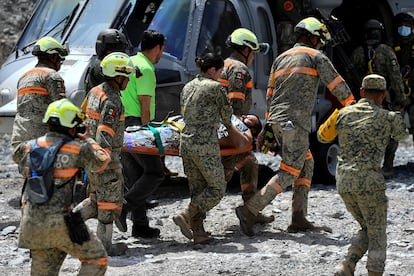
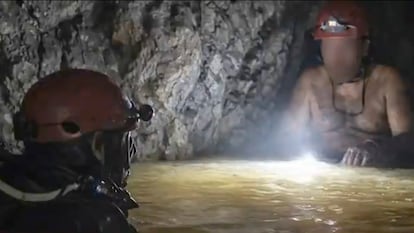
On the 13th day, a miracle occurred. One of the miners trapped after a gold mine in Sinaloa collapsed emerged from the darkness alive. Located wth the help of a team of divers, the rescue of Francisco Zapata Nájera gave hope to those waiting outside. He was still conscious when a head poked out from under the water and asked him if he was okay.
— Are you alright? Mexican Army, emergency response battalion. What’s your name?
That was the first thing the miner heard after 13 days underground.
— Francisco Zapata Nájera.
— Okay, Zapata. We’ve come to get you out.
One miner is still missing. His colleagues are cooperating with the authorities to figure out how to get through a network of complex flooded tunnels.
The bare-chested miner was submerged in water up to his waist. Lucid and coherent, he told the rescuers that the water level had almost reached the ceiling. “It went up to my neck,” Zapata said later. Treated for a severe case of dehydration, Zapata unknowingly helped with his own rescue as the lamp he kept on underwater guided the rescue team to him. The mine is 300 meters deep if measured in a straight line to what is known as the zero point, but a series of zigzagging tunnels extends for at least 3.2 kilometers (two miles). Some areas were flooded to the extent that the miners were shut off from each other and didn’t know of each other’s predicament. The same day that Zapata was rescued, another miner was found dead. A week earlier, another was rescued alive, severely disoriented.
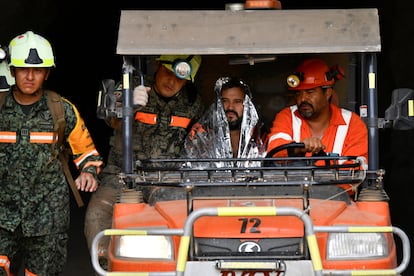
How do you survive so many days underground? “The miners are resilient, they know the area well, the hydration and aid points,” explains Roy Navarrete, state coordinator of Civil Protection. Their familiarity with the environment fueled hope from the beginning that they would be found alive. When José Alejandro Cástulo Colín, 44, was rescued after five days, on March 30, at just after midnight, that optimism grew.
Only the miners know the layout of the tunnels, the ventilation shafts that allow air to circulate, and the spaces that maintain adequate oxygen levels inside. Inside the mine, there are special areas for oxygenation and hydration, something that all the workers should know by heart. The temperature inside can drop to 23ºC compared to over 30ºC outside. That contrast facilitates humidity inside the mine and slowed dehydration. The most challenging problem for the rescue effort has been getting the trapped miners out.
The ordeal began on March 25, when a dam breach caused by a structural failure flooded the mine. That day there were 25 workers inside but only 21 managed to get out. When the dam broke, it poured waste deposits called jale into the tunnels, making it one of the worst disasters in the local history of the mine. “Jale is a manageable material for humans, it is not toxic,” says Navarrete, who added, however, that “it is a heavy material.”
The tsunami of waste sloshes around the tunnels. To move forward, rescuers have installed wooden structures that allow them to move better, but they have found the waste even in the lowest levels of the mine. It is here that the help of specialists and the miners themselves has been needed. Outside the mine, military specialists in rescue, diving, and civil protection have gathered together with around 20 miners. “They are colleagues from different parts of the country, who live here in Chele and who have not stopped searching,” says Navarette. Families have remained near the site, standing guard day and night, waiting for news. “They don’t move. They watch the activity that continues around the clock,” Navarrete says.
From the moment news of the accident broke, the federal government moved in. A command system was installed classified as “unified inter-institutional,” which includes the National Coordination of Civil Protection, the Ministry of National Defense, the Federal Electricity Commission and the workers of Santa Fe. More than 300 rescuers have participated in different tasks, from drilling, installing over 3,000 meters of electrical cable, reinforcing structures in critical areas, undertaking inspections with cameras, and tours with search dogs and detection probes. There are even spokespeople for the families of the men who were trapped, as well as cooks and others trying to keep everyone’s spirits up.
The conditions have been changing with time. Within the mountain where the mine is located there are aquifers and water gushes from them. This has mixed with the waste accumulated at the bottom of the mine. Specialists of the Federal Electricity Commission have installed water suction pumps. These required electricity supply in humid areas, so lines were installed inside the mine to operate the equipment, while geologists analyzed the stability and risk conditions. But every time they suck the water out, the mountain releases more.
Meanwhile, inside the mine, it has become impossible to advance through certain areas due to the level of flooding, and divers have been called. They were the ones who located Zapata Nájera. After his rescue, he was transferred to Mazatlán to receive specialized medical attention. Hours later, his colleague was found dead.
“We are still missing a miner,” says Navarrete, who refuses to give up hope. “Action is being taken and we have faith.” The operation has been tiring in every way, with a rollercoaster of emotions combining with physical exhaustion. Finding the first two miners alive gave rise to optimism, but the location of the third changed the mood. “When we found the first one, it fueled our determination to locate the others, then we reached the second 13 days later and a few hours later, the third,” says Navarrete.
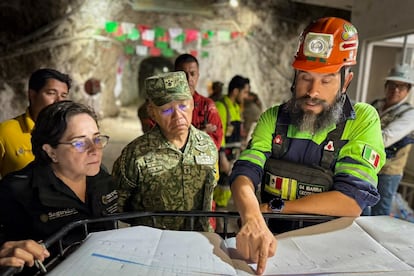
But there is one thing that keeps everyone going: the miners themselves have organized shifts, working around the clock to locate their colleague. “The miners learn first aid and are familiar with security work, so that they can survive eventualities, as they have always done. They and the family are aware of these risks. They are the specialists and they know the mine well and know how to work in it,” says Navarette. In Santa Fe, the fourth miner had not yet been found as darkness fell. But there will be no giving up until he is.
Sign up for our weekly newsletter to get more English-language news coverage from EL PAÍS USA Edition









































