
Hair vs. oil: The curious method to clean beaches affected by the spill in the Gulf of Mexico
Authorities insist on the effectiveness of conventional water cleanups while citizens are requesting hair donations to remove traces of crude oil in Veracruz
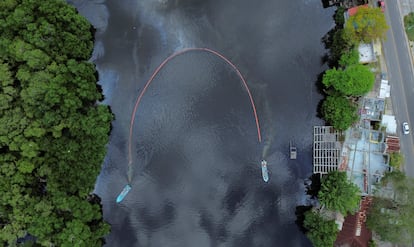

Amid the uncertainty surrounding the oil spill in the Gulf of Mexico, a citizen initiative to clean the contaminated waters has gained attention. Businesses such as barbershops and dog groomers in Veracruz have requested donations of clean, dry hair to remove traces of crude oil from the ocean. The plan involves using the hair to create nets that will act as barriers to block the flow of the fuel and absorb what is dispersed in the sea. According to the civil organization Ayudando Patitas (Helping Paws), one kilogram of hair can clean up to eight liters of oil.
This isn’t the first time such an idea has emerged. More than 15 years ago, when the Deepwater Horizon platform caught fire on April 20, 2010, while drilling an oil well off the coast of Louisiana, causing a “national catastrophe” in the United States, citizens also organized to combat the tragedy with hair. The organization Matter of Trust stated at the time that people from all over the world, from France and England to Australia, had expressed interest in participating. The enthusiasm has even reached Petco, an American pet supply company that also offers dog grooming services. “We have about 1,000 salons across the country, and I think we can send up to a ton of fur per day. We can make a real difference,” a company spokesperson told the Associated Press.
On that occasion, the initiative involved coordination between the local population and the government, which was responsible for collecting the nets already assembled with the hair and then transporting them to the affected areas where they would be used. Mexican authorities, asked this Tuesday at a press conference about the hair collection initiative that has emerged in Veracruz, insisted on the effectiveness of traditional clean-up methods. “What works is cleaning in the conventional way, that’s what works, and that’s what we’re focused on [...] How? With shovels, with our people… that’s the most important part,” responded Miguel Ángel Miranda, deputy director of safety, occupational health, and environmental protection at state-owned oil company Pemex. The official, who stated that he respects these kinds of efforts, emphasized that their method is what has yielded results for them for years.
Collection points have been announced on social media in various locations, where donations of food and supplies — such as shovels, masks, boots, gloves, and jute nets — will also be received to protect those carrying out the cleanups. According to the association, all collected supplies will be centralized in Coatzacoalcos, where the hairnets will be made, and then transported to Pajapan. The communities in this municipality in southern Veracruz have been very vocal since denouncing the arrival of oil on their shores in early March.
Residents of the towns near the Ostión Lagoon have accused authorities of negligence in managing an ecological disaster that has prevented them from fishing and left them without a livelihood. In her morning press conference this Wednesday, Claudia Sheinbaum asserted that they are working to contain the spill, investigate the sources of contamination, and support the fishermen through Bienpesca, a government program.
EL PAÍS reported on Monday that the ship Árbol Grande, contracted by Pemex to repair underwater pipelines, spent eight days on top of an oil pipeline. Satellite images reviewed by this newspaper show a large oil slick around the vessel, in an area the government has identified as one of the sources of the spill. The state-owned company, which has maintained from the beginning that the slick is not linked to them, responded: “The fact that a ship is stopped at sea does not mean that there is a broken and leaking pipeline below.” However, Pemex did not explain why the ship was there.
From the Reef Corridor Network, various organizations and communities in the affected areas warned this Tuesday that the oil spill extends 933 kilometers (580 miles) along the coast, from Tabasco — through Veracruz— to Tamaulipas. The group has called for a day of protests this Sunday to demand answers from the authorities regarding a problem that seems to grow more unclear with each passing day.
Sign up for our weekly newsletter to get more English-language news coverage from EL PAÍS USA Edition









































