
The Epstein files destabilize several European monarchies
The arrest of former Prince Andrew adds to the scandal surrounding Norway’s Mette‑Marit, who maintained contacts with the sexual predator and whose son, Marius Borg, has been accused of rape
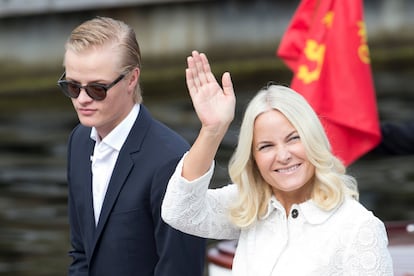

The varying degrees of contact maintained by several members of Europe’s royal families with the sexual predator Jeffrey Epstein have plunged the affected monarchies into crisis. The stance adopted by Queen Elizabeth II during her 70‑year reign — “Never complain, never explain” — has been blown apart by the Thursday arrest of her third son, former Prince Andrew, the brother of King Charles III. Not only will he have to explain himself, but he will have to do so to the police. In Norway, the situation is also extremely tense. Crown Princess Mette‑Marit, the wife of Haakon, the heir to the throne, appears thousands of times in Epstein’s files and has issued two public apologies.
“The only way to contain this situation is to remove the implicated members from the core of the institution,” argues Dutch historian Gerard Aalders in a telephone interview. As an example of this form of damage control, he points to Spain’s Felipe VI and his decision to distance himself from his father, Juan Carlos I, over a tax haven scandal. Amid the controversy, the emeritus king left Spain and moved to Abu Dhabi. “It’s a different situation from that of Andrew and Mette-Marit because with Juan Carlos, it involved the use of opaque funds. The only way for King Felipe VI to survive was to distance himself from his father,” says Aalders.
A similar move was made with former Prince Andrew, who has been stripped of his titles and removed from the residence he occupied for three decades. “But not much more can be done unless there is a change in the Constitution and the monarchy is abolished,” says Aalders, who acknowledges, however, that “this requires a broad consensus, which is very difficult to achieve in countries with a functioning monarchy.”
A poll conducted by Ipsos in the U.K. between October 31 and November 3, 2025, just as King Charles III began the process of stripping his brother Andrew of his titles, shows that 90% of Britons considered it “the right decision.” Some 77% had a negative opinion of the former prince. And 47% believed that abolishing the monarchy was not good for the country. Mette-Marit’s situation is more complex, “because she is the wife of the Norwegian heir, and as such enjoys immunity,” Aalders explains.
In Norway, the ongoing trial of Marius Borg Høiby, 29, the son Princess Mette-Marit had before marrying Prince Haakon, has also taken a toll on the institution’s popularity. The young man is accused of 38 crimes, including rape and abuse, and although he is not a member of the royal family, he was raised within that environment. Nevertheless, while recent polls by the Verian group show that 47.6% of Norwegians “prefer that Mette-Marit not be queen consort,” support for the institution remains strong. In February, 141 of the 169 members of Parliament voted to maintain the monarchy, while 26 voted against it.
In Belgium, Prince Laurent, King Philippe’s younger brother, also appears in the Epstein’s files. He has stated that the pedophile wanted to meet his parents “to introduce them to his billionaire friends.” “I replied that my parents were not for sale or for show,” he declared in a statement sent to the Belgian News Agency.
For Aalders, the monarchy’s “impossible task” is ensuring that its members behave in a way that allows them to serve as an example for the rest of the country — maintaining trust and dignity so that their actions speak for them. That, and remaining “above politics and political parties.” The expert points to the Netherlands as an example, where the prime minister meets with King Willem‑Alexander every Monday. “What they discuss is private and confidential, and cannot be commented on by the political leader; something that seems contrary to democracy to me.”
Sacrificing the reputation of royal family members whose behavior has been improper is a protection strategy that requires several stages. Given the political scrutiny applied to Europe’s monarchies, public apologies are the first step. Crown Princess Mette‑Marit has taken that step twice. In December 2019, after Epstein’s death, she acknowledged having had contact with him — between 2011 and 2013 — claiming she was unaware of his crimes. The financier had been convicted in 2008 of soliciting a minor for prostitution, and in the documents released, Mette‑Marit tells Epstein that she had looked him up online. She apologized again this February, issuing a formal note addressed to her in‑laws, King Harald and Queen Sonja.
The second stage of breaking royal silence extends — in the United Kingdom — to the reigning monarch and his successors. King Charles III has reduced his brother Andrew, a prince by birth, to the status of an ordinary citizen: Andrew Mountbatten‑Windsor. And while the fallen royal is left exposed and a possible legal path opens, the king has said that “the law must take its course.” For their part, William and Catherine, the Prince and Princess of Wales, said they are “deeply concerned” for the victims and have already hired Liza Ravenscroft, a communications and crisis‑management expert.
The demand for transparency within the monarchy can, in some cases, reignite other debates — such as whether royals should pay taxes. In the Netherlands, it is a recurring issue with no resolution in Parliament for now, given that the sovereign pays taxes on his private assets but does not pay income tax or taxes on the salary he receives from the state.
Sign up for our weekly newsletter to get more English-language news coverage from EL PAÍS USA Edition









































