
German airline Lufthansa acknowledges it was ‘clearly’ part of the Nazi system
A group of German historians claims that the company used more than 10,000 forced laborers
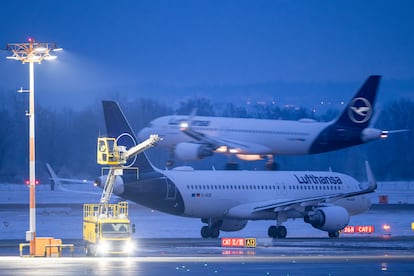

The German airline Lufthansa acknowledged this week its responsibility during National Socialism and has commissioned an exhaustive scientific study on the role it played during that period, especially regarding the exploitation of forced laborers. Until now, it had been reluctant to revisit this past, arguing that the company that operated between 1926 and 1945 had nothing to do with the Lufthansa that emerged after 1953.
“Lufthansa was clearly part of the system,” said the airline’s CEO, Carsten Spohr, on Tuesday afternoon at a press conference at the group’s headquarters at Frankfurt Airport, ahead of the centenary of its founding, which will be celebrated next April. This included the initially secret rearmament as a “clandestine air force,” integration into the Nazi war economy, and the unscrupulous exploitation of forced laborers in workshops and armaments factories.
To mark the anniversary, Lufthansa has commissioned a new scientific analysis that critically examines this period. The study by historians Hartmut Berghoff, Manfred Grieger, and Jörg Lesczenski will be published as a book and will be available in a few weeks. In addition, an exhibition at the new conference and visitor center also addresses, among other things, the company’s evolution during the National Socialist regime in Germany. It is not common for German companies to review their past. According to a study by the Business History Society, not even 8% of German companies have professionally analyzed their own role under Nazism.
“Lufthansa was a company of National Socialism,” historian Manfred Grieger said during the public appearance, describing the airline’s close ties to Adolf Hitler’s administration. “This symbiosis led to Lufthansa’s downfall at the end of the world war,” he explained. “The company went down completely with the regime to which it had chained itself.”
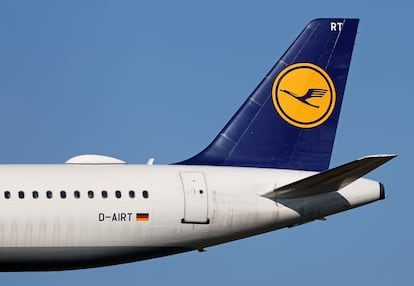
The current Deutsche Lufthansa AG is not the legal successor to Deutsche Luft Hansa AG, founded in 1926 and written as two words. The company disappeared along with the Nazi regime in 1945. Formally, the first Luft Hansa ceased to exist in 1946 when it was liquidated by the Allies, although it secured the rights to the name, the distinctive color scheme, and the iconic crane symbol.
However, since the group wants to celebrate Lufthansa’s centenary this year, Spohr believes there is no doubt that the darkest chapter of German history also had to be examined closely — something that, in his view, has not been done “sufficiently” in the historical accounts of either the first or the second Lufthansa.
According to Grieger, there is no doubt that Luft Hansa aligned itself closely and voluntarily with the new rulers and the Nazi takeover beginning in 1933. At first, it became a state‑subsidized airline, and from the start of the Second World War it shifted from being an aviation company to an armaments company, eventually becoming a structural unit of the German Air Force (Luftwaffe).
Board member Erhard Milch was promoted in 1933 to State Secretary of the Reich Air Ministry. This dual role turned Lufthansa — whose shareholders were mainly state and municipal bodies — into “the company of National Socialism,” as Grieger puts it. That same year, Luft Hansa became the joint‑stock company Deutsche Lufthansa Aktiengesellschaft.
According to the historian, this rapid alignment was driven less by political conviction than by economic motivations. When the Second World War began, the company built a plant for radar equipment in Tempelhof (Berlin) and took charge of repairs at the front. In 1944, the company earned two‑thirds of its total revenue from armaments contracts. To provide these services, it also relied on more than 10,000 forced laborers: deported Ukrainians, as well as German Jews. “No questions were asked when these people were taken to the gas chambers. They were Berlin Jews with whom they could communicate. It is hard to understand,” Grieger said.
For the historian, there is no doubt that the first Lufthansa, because of its deep involvement in the armaments industry — including the use of these tens of thousands of forced laborers — became both “a protagonist and a beneficiary of the Nazi war economy.”
Sign up for our weekly newsletter to get more English-language news coverage from EL PAÍS USA Edition









































