
An emboldened Trump travels to Davos with threat over Greenland looming large
Since the military operation in Venezuela, the US president has deployed his rhetoric to take over the semi-autonomous island of the Kingdom of Denmark
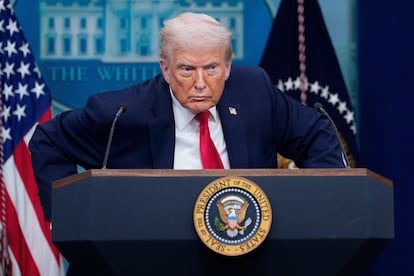

A more emboldened Donald Trump, with openly imperialistic intentions, will arrive Wednesday at the Davos Forum to meet with NATO leaders at a summit that is shaping up to be crucial for the future not only of Greenland, but of NATO as a whole. The Republican appears unwilling to compromise or back down on his ambitions to annex the Arctic island, a sovereign territory of the Kingdom of Denmark. Nor is he willing to abandon his aspirations to become the world’s arbiter.
“There’s no going back,” he warned before his departure. And, during a press conference to commemorate the first anniversary of his second term, before taking flight, he replied “you’ll find out” when asked how far he was willing to go to seize Greenland.
The U.S. president appears more uninhibited than ever regarding his global ambitions. And increasingly vocal. Or more arrogant, depending on who you ask. “Peace through strength,” he proclaims, adopting the slogan that defined Ronald Reagan’s foreign policy in the 1980s.
This weekend, the composition of the so-called Gaza Board of Peace — and beyond — was announced, and Vladimir Putin has been invited to join. The Russian leader alone will have veto power, and Europeans fear he intends to compete with the United Nations in future crises. To secure a permanent seat, aspiring countries will have to contribute $1 billion, which Putin will manage, according to U.S. media. The White House maintains that this contribution is voluntary.
“We just created the Board of Peace, which I think is going to be amazing,” Trump declared at his press conference Tuesday. “I wish the United Nations could do more. I wish we didn’t need a Board of Peace, but the United Nations, and, you know, with all the wars I settled, the United Nations never helped me on one war.” Regarding the possibility of this new entity competing with the UN, he acknowledged that it “could” replace it, although he also pointed out that the United Nations has “potential.” “You got to let the UN continue,” he added.
Trump has invited dozens of leaders to join the Board of Peace, including Putin, Argentine President Javier Milei, and Turkish President Recep Tayyip Erdogan. Others have declined the offer, such as French President Emmanuel Macron, and Trump has responded by threatening 200% tariffs on French wines.
Trump’s increasingly aggressive rhetoric and actions have intensified exponentially since the U.S. military operation in Venezuela on January 3, which proved even more successful than the White House anticipated: President Nicolás Maduro and his wife, Cilia Flores, were captured by U.S. soldiers and there were no casualties among the American ranks, in an intervention that the Republican described as “one of the most stunning, effective, and powerful displays of U.S. military might and confidence in history.”
That result, coupled with the bombing of nuclear sites in Iran seven months earlier, an operation in which there were also no American casualties, has convinced the Republican magnate that his country’s troops are invincible and that he — as he declared to The New York Times — has no limits other than those imposed by his “own morality.” For the first time in more than a century, the possibility of the United States conquering territory by force is being raised. And not just any territory, but one belonging to Denmark, one of its most committed allies, where it has open access to increase its military presence as much as it wishes, in addition to economic cooperation.
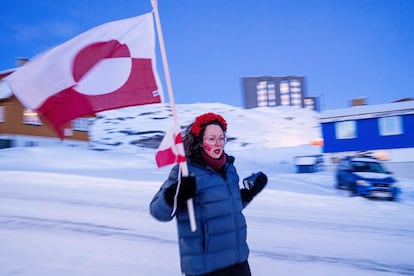
If Trump’s morality had previously advised him to pursue peace, with the self-serving hope of winning the Nobel Prize, that restraint is no longer there. On Saturday, he announced tariffs of up to 25% against the eight nations that sent small military contingents to Greenland to participate in defensive exercises. This, despite his own assertion that he needs to control the territory, by fair means or foul, to prevent Russia or China from ultimately doing so.
The message with which he responded to Norwegian Prime Minister Jonas Gahr Støre’s proposal for a phone call could not have been more blunt: having not received the award — something he blamed on the government in Oslo, even though it is the independent Nobel Committee that decides the winner — he no longer feels obligated to “think purely of peace” regarding Greenland. Trump said he could “now think about what is good and proper for the United States of America.” In other words: the gloves are off.
And how. Twenty-four hours later, he declared from Air Force One that there was “no going back” on his ambitions regarding Greenland, which he vowed to achieve one way or the other. And in a flurry of messages on his social media, sent in the early hours of the morning, he leaked screenshots of messages he had received from European leaders: NATO Secretary General Mark Rutte and Macron. Both urged him to de-escalate tensions and engage in dialogue.
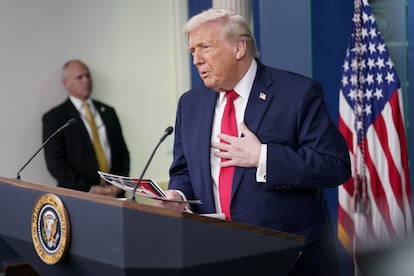
Trump is convinced that, however much the Europeans protest now, they will eventually be forced to comply. This could be due to the economic pressure he believes he can exert, or the prospect of military action — something that seemed unthinkable just a few weeks ago. But the intervention in Venezuela has demonstrated that the Republican is not afraid to approve the use of force.
“I don’t think they’re going to push back too much,” the U.S. president told reporters aboard Air Force One. “We have to have it... They can’t protect it.”
This isn’t a new sentiment. Trump flirted with the idea of buying the Arctic island during his first term. But back then, his National Security team didn’t go along with it, and Danish Prime Minister Mette Frederiksen didn’t even think the proposal was serious. This time, his advisors, selected for their blind loyalty to the president’s every word, are closing ranks around him. The State Department is proclaiming on social media that “this is OUR hemisphere.”
On Tuesday, Treasury Secretary Scott Bessent dismissed as a “false narrative” the suggestion that Europe might respond to U.S. threats with forceful measures such as selling U.S. Treasury bonds, which could create market chaos similar to that unleashed after Trump announced sweeping tariffs on April 1. That situation ultimately forced the Republican to backtrack within days.
“It’s been 48 hours. As I said, sit back, relax,” Bessent urged from Davos. “I am confident that the leaders will not escalate and that this will work out in a manner that ends up in a very good place for all.” United Nations Trade Representative Jamieson Greer echoed this sentiment, noting that the tariff threats could “lay the groundwork” for negotiations on Greenland.
In the meantime, Trump launched another attack. On his social media platform, Truth, he retweeted a comment that read: “At what point are we going to realize the enemy is within? China and Russia are the boogeymen, when the real threat is the UN, NATO, and this ”religion” (Islam).”
Sign up for our weekly newsletter to get more English-language news coverage from EL PAÍS USA Edition









































