
Mexico’s crusade against fentanyl reduces trafficking to the US and overdose deaths
Despite Washington’s criticism of the ‘gradual approach,’ Claudia Sheinbaum’s security strategy, focused on drug seizures, the destruction of laboratories, and direct attacks on cartels, has yielded results

In 2020, during the final stretch of Donald Trump’s first term as U.S. president, Washington was already sounding the alarm about the fentanyl epidemic among its population and the phenomenon’s connection to Mexican cartels. At that time, the U.S. indicated that criminal organizations were manufacturing the synthetic opioid from precursors shipped from China and demanded stronger action from Mexico to contain the problem. The Mexican government’s campaign against the drug began during Andrés Manuel López Obrador’s presidency, but the results were not immediately tangible as the number of overdose deaths in the United States multiplied, reaching almost 74,000 in 2022. It wasn’t until 2024-2025, between López Obrador’s departure and the first year of Claudia Sheinbaum’s presidency, that the government campaign intensified and managed to reverse the tragic trend. For the first time in years, the trafficking of fentanyl into the U.S., and overdose deaths related to the drug, have decreased.
The UN had already highlighted this downward trend in mid-2025. The strategy and its results have a more or less clear explanation: Trump’s return to the White House a year ago was accompanied by increased pressure on Mexico. The Republican magnate used the demand for greater security results from Mexico as leverage to soften the imposition of tariffs on exports from his southern neighbor. The agreement involved reinforcing the border between the two countries with military personnel, reducing irregular migrant crossings, and cracking down on drug trafficking, with an emphasis on fentanyl. The Sheinbaum administration launched Operation Northern Border, a strategy specifically aimed at combating criminal organizations linked to drug trafficking to the U.S., which has severely damaged the Sinaloa Cartel, the largest producer and importer of fentanyl to the north.
One year after its implementation, the figures demonstrate that the strategy has yielded clear results in all areas covered by the negotiations, despite the criticism expressed this week by Washington regarding the “gradual progress,” which it deemed “unacceptable.” From October 2024 — when Sheinbaum assumed the presidency — to the present, Mexican security agencies have seized 1.8 tons of fentanyl, destroyed nearly 1,900 drug production labs, and captured almost 41,000 people allegedly linked to organized crime, including key leaders of the Sinaloa Cartel and the Jalisco New Generation Cartel (CJNG). This is in addition to the unprecedented summary extraditions of major drug lords to the United States.

According to official data obtained by EL PAÍS, the Mexican army alone seized a third of all fentanyl confiscated in 2025 (559 kilos), a figure 65% higher than that seized in 2024 (340.7 kilos), the final year of López Obrador’s six-year term. During the same period, the army also saw increases in seizures of methamphetamine (176%), marijuana (12%), heroin (82%), and opium gum (132%). These figures are complemented by seizures carried out by other agencies within the Security Cabinet. For example, in December 2024, a few months after Sheinbaum took office as president and a month before Trump’s inauguration, the Mexican Navy seized 1.5 tons of fentanyl, the largest haul of that drug ever confiscated.

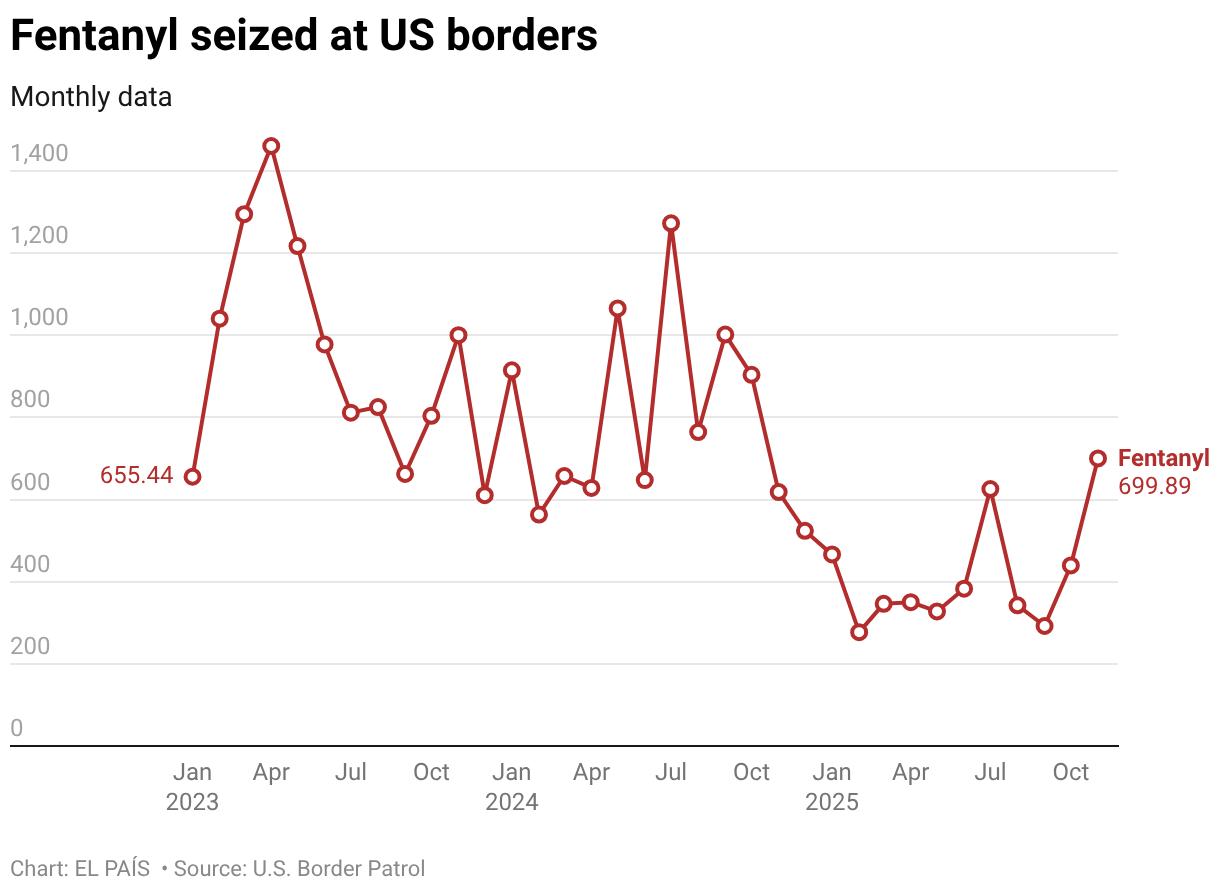
The effect of the crackdown on fentanyl production in Mexico has resulted in a sharp drop in its trafficking into the United States. According to figures from the Customs and Border Protection (CBP) agency, in 2025 — excluding December — 4.5 tons of fentanyl were seized at U.S. borders, 52% less than the previous year, when 9.5 tons were confiscated. This decline had been ongoing since 2023, the year in which 11.3 tons of the synthetic opioid were seized. Cocaine seizures also saw a 14% decrease: in 2025, CBP confiscated 29.4 tons, compared to 34.4 tons the previous year. There was, however, a 9% increase in methamphetamine seizures, rising from 72 tons in 2024 to 78.8 tons a year later. In the case of marijuana, 77 tons were confiscated in 2024, and 87 tons in 2025 (11% more).
Fentanyl overdose deaths in the United States dropped dramatically starting in 2024, during the final months of López Obrador’s presidency in Mexico and Joe Biden’s term in the U.S. That year, there were 47,735 deaths from this cause, according to preliminary data from the U.S. Centers for Disease Control and Prevention (CDC). This figure is 35% lower than in 2022, the worst year of the crisis since the beginning of the millennium, when there were 73,838 fentanyl-related deaths. This reduction in fatalities had not been seen since 2019.
Irregular migration is another area where there was a positive balance — in accordance with Trump’s demands. As of November 2025, the last month for which official records are available, Mexico detained 4,305 migrants, 95% fewer than in 2024, when immigration authorities apprehended 96,563 people in an irregular situation, according to data from the Ministry of the Interior.

It is true that the main reason fewer migrants are transiting through Mexico is due to the tightening of the policy against undocumented immigrants decreed by Trump, as this newspaper has extensively documented. However, CBP apprehension statistics at the border with Mexico confirm that fewer migrants are attempting to cross into the United States. In 2025, there were only 4,300 arrests by the Border Patrol, 88% fewer than in 2024, when 37,816 apprehensions were recorded, according to data from that agency. This reduction could be due to the deployment of 10,000 National Guard troops to the border ordered by Sheinbaum in February of last year with the aim of curbing the illegal entry of drugs and migrants.

As a consequence of Mexico’s fight against the cartels, the number of murders has also decreased. In 2025, there were 22,415 intentional homicides, a figure 27% lower than the previous year, when 30,063 homicides were recorded. This is the lowest figure in a decade. Many of the murders are linked to drug trafficking, and the decrease cannot be explained without the government’s shift in approach to combating the cartels.

Under López Obrador, security forces were limited to patrolling and violence deterrence. Arguing that direct confrontations should be avoided to protect the civilian population — the “hugs, not bullets” paradigm — the cartels assumed they had free rein to commit crimes. Sheinbaum has implemented a fundamental qualitative shift: using force with precision strikes, investing heavily in investigation and intelligence, and in coordination among all security agencies, with Omar García Harfuch, the president’s right-hand man in the fight against drug trafficking, at the helm. This has been accompanied by an intense campaign to communicate daily official operations involving drug seizures, dismantling of laboratories and weapons, and arrests of suspected criminals.
Sheinbaum has cited official figures from both countries to argue that Mexico has fulfilled its part of the agreement, despite Washington’s disdain. The Mexican president believes that, in contrast, the United States has not done enough to contribute to solving shared problems. Sheinbaum has maintained that the U.S. government should dismantle the criminal networks that enable drug distribution in the country and implement preventative strategies to address the addiction crisis among its population, especially young people. Trump explains the problem of drug trafficking and addiction in the U.S. with the same argument he applies to other complex phenomena: that they come from abroad. With the reduction in migration and Mexico’s ongoing crusade against fentanyl, there are few external factors left to blame.
Sign up for our weekly newsletter to get more English-language news coverage from EL PAÍS USA Edition









































