
Claudia Sheinbaum, the trending president: Why the Mexican leader has gone viral
The first woman to govern Mexico has become a hot topic on social media with teens sharing memes, songs and costumes inspired by her
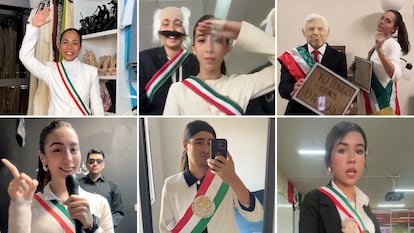

A teenage girl dances to reggaeton, wearing a presidential sash and a high ponytail. It’s Claudia Sheinbaum — or at least her TikTok version. In the video, the voice of Mexico’s president can be heard stating one of her campaign promises: “We’re going to build more high schools close to people’s homes.”
What began as a joke among friends quickly turned into a phenomenon, spreading across thousands of screens and sparking imitations, memes, songs, and costumes. Claudia Sheinbaum Pardo — the serious scientist, disciplined politician, and successor of Andrés Manuel López Obrador — is now a trending topic. She’s in vogue, not just in the traditional sense of a president with high approval — 78%, according to the latest Enkroll survey for EL PAÍS and W Radio — but in the most literal, contemporary sense: she went viral.
Like so many trends, it all started with a TikTok video that got out of control. The original video was made in Guadalajara when Silvana Pardo, a 17-year-old high school student, dressed up as Sheinbaum for a school activity. She wore a white suit, the presidential sash, and Sheinbaum’s signature ponytail. Accompanied by a couple of friends dressed as Miguel Hidalgo, she recorded herself dancing. “I posted it thinking only my dad and grandma would see it,” Silvana recalls. The video has now amassed over 33 million views and four million likes.
“Because of my last name, people have always told me the president is my aunt,” she jokes. “But no, we’re not related.” Now, when she walks down the street, people recognize her and ask for photos. “I laugh so hard, but I love it. I’ve always been the girl who participates in debates and talks about politics. So, I’m living the dream — having the best time of my life,” Silvana shares.
@chupiritas0 @silvanaa por la quinta transformación !!!!!@Claudia Sheinbaum Pardo #mexico🇲🇽 #fyp #vivamexico
♬ sonido original - chupiritas
The video went viral just in time for Halloween and Day of the Dead, and the algorithm did the rest. The dance was dubbed the “well-being trend,” a nod to the social programs promoted by Sheinbaum’s party Morena. “I posted the video without thinking much,” says Silvana. “I admire that the president took it so positively. Another politician might have been offended, but she saw it for what it was: a gesture of admiration.”
Sheinbaum not only found out about the video, she celebrated it. In her message marking the first year of her government, delivered at the Zócalo square in Mexico City, she referenced the video and, days later, displayed it during one of her morning press conferences. “About 20 kids welcomed me in Puebla, all singing: ‘We’re going to build more high schools close to people’s homes.’ And that’s the goal,” she said with a smile. In March, Sheinbaum announced an investment of 1.25 billion pesos ($67 million) to build 18 new high school centers nationwide. Silvana met her shortly afterward at one of the president’s events in Jalisco, completely unplanned, she says. “She recognized me and said, ‘Oh, you’re the one from the video.’ She’s super nice,” says Silvana.
In recent years, various politicians have tried to speak the language of social media. Former minister Arturo Zaldívar declared himself a Swiftie for his love of Taylor Swift, ex-foreign minister Marcelo Ebrard flaunted his love for K-pop and earned the nickname Tío Marcelo, while the Institutional Revolutionary Party (PRI) filled its networks with shitposting — ironic or absurd content to seem less stiff. But the results have been mixed. “If my friend does it, it’s funny. If the PRI does it, it’s cringe,” sums up Alexis Yáñez, a 25-year-old communications specialist. “Young people not only interpret the meme, but also consider who it’s coming from,” he adds.
Experts say the key to the Sheinbaum phenomenon is its organic origin. Andrea Samaniego, a political discourse analyst, explains: “On social media, feigning sympathy is quickly spotted and punished. In contrast, a spontaneous gesture, even a dance or a parody, can have more impact than a million-dollar campaign.” For her, this phenomenon represents “the opposite of marketing. And genuineness always wins.”
Samaniego notes that perceptions of Sheinbaum haven’t always been so positive. “During the campaign, her communication with young people wasn’t effective. They said she was gray, that she lacked charisma. From being perceived as a rigid and inexpressive scientist, she has become a meme-worthy figure.”
Jorge Pérez Gómez, a communications professor at FES Acatlán, National Autonomous University of Mexico (UNAM), analyzes the presidential aesthetic: “Her image is recognizable and admired by young people for its sobriety — her hairstyle, her clothing, her way of speaking. I think people are tired of the stereotype of the male, macho politician in a suit. She acts more like a teacher, which she was for many years,” he notes.
Her status as the first female president of Mexico also adds to her appeal. “She represents the possibility of female leadership in a country historically dominated by men,” Pérez points out. For many girls, that is a source of inspiration.
“Beyond political affiliation, it’s admirable that she reached the presidency as a woman,” says Itzela Cruz, a high school student.
“I don’t follow the morning press conferences much, but she inspires me,” shares 15-year-old Talia.
Other young people interviewed for this story are more indifferent. “I don’t support any party, but I don’t dislike her,” says Yáñez. Along with José María, 15, they believe that the government’s taxes to improve the country’s health have cost her some popularity, particularly the 8% tax on violent video games: “She’s just doing it to get more money, and it won’t stop violence. Outside of that, I don’t know if she’s fulfilled her promises,” he says.
Beyond entertainment, the phenomenon has electoral implications. Young Mexicans aged 18 to 29 make up nearly a third of the electorate. For Pérez Gómez, the fact that Sheinbaum has become a reference point even among teenagers is “a communication triumph.”
The president also maintains a high level of credibility by Latin American standards, notes Samaniego. “Unlike other leaders who try to replicate these dynamics, she combines authenticity and consistency in her governance,” she explains. “The hardest thing in political communication is credibility. Parties like the PRI or PAN [National Action Party] have lost ground, which is why their attempts to connect through memes don’t work. In contrast, Sheinbaum retains legitimacy and discipline.”
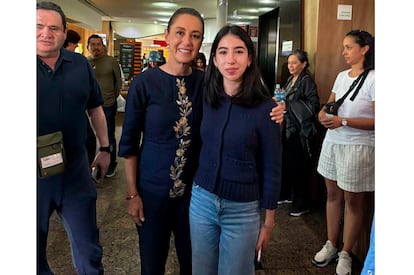
One year into her term, Sheinbaum has faced diplomatic tensions and economic challenges without becoming embroiled in corruption or enrichment scandals, says Samaniego. “That reputation gives her a solid foundation to become a figure people can identify with,” she argues. Still, Samaniego warn that popularity is no guarantee of immunity. “Young people are giving her a vote of confidence. But if she fails to meet expectations, it will be taken away quickly. This generation punishes inconsistency more than any other,” she notes.
For now, the wellbeing trend is still going strong. On TikTok, the audio of “more high schools near home” continues to be shared amidst dances and costumes. “It’s fleeting,” experts say.
Yet even as the trend wanes, Sheinbaum has already made her way into the feed of a generation that lives through screens.
Sign up for our weekly newsletter to get more English-language news coverage from EL PAÍS USA Edition









































