
Venezuelans settle in La Esperanza, the border community that has come to symbolize the turmoil of transition
Nicolás Maduro’s capture is regarded with uncertainty by migrants living in the informal settlement in Colombia
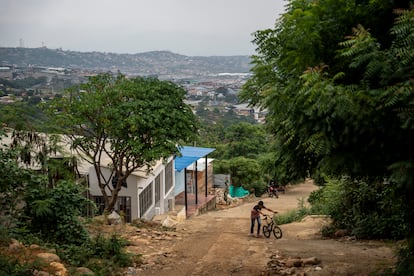

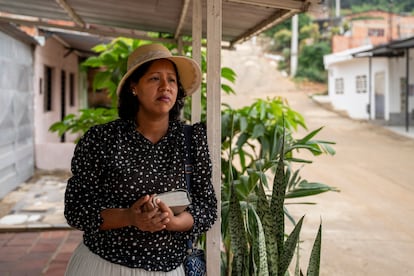
Jenny de Silva moved to La Esperanza seven years ago. That’s no metaphor. La Esperanza — which means “hope” in Spanish — is one of the neighborhoods in Villa del Rosario, part of the metropolitan area of Cúcuta, which is located a few miles from the Simón Bolivar border crossing that connects Colombia with De Silva’s home country of Venezuela. Like many other Venezuelans, she fled from the economic situation in the country. “The crisis began, I was pregnant, and we had to emigrate. You couldn’t get food or medicine,” she recounts bitterly in front of a house in which free Bible classes are offered, in the Andean foothills.
“It’s sad, because you don’t want to leave,” says the 41-year-old woman, who is originally from the city of Valencia, and who, as a Jehovah’s Witness, walks up and down the labyrinthine streets of La Esperanza, sharing the message of her faith. “I am a cancer survivor, and Cúcuta has given me the opportunity to beat the illness. In Venezuela, that would have been impossible,” she says.
Besides her husband and their two children, the rest of De Silva’s family still lives in Valencia, in the state of Carabobo. They say that since the United States captured Nicolás Maduro, residents only leave their homes on strictly necessary errands, after which they promptly return. What lies in store for Venezuela seems uncertain. “No one know what is going to happen,” says de Silva. For the moment, she rules out returning home. “If my illness comes back, they won’t treat me there,” she says.
In the last decade, thousands of Venezuelans like De Silva have settled in the neighborhoods that abound in the outskirts of Cúcuta, the largest Colombian border town, located on the country’s border with Venezuela. Many of the inhabitants of La Esperanza — “almost the majority,” says De Silva — are Venezuelans, or Colombians who have returned after spending a large part of their lives on the other side of the border. In the uppermost part of the neighborhood, where the bulk of its residents live, informal settlements have sprung up made of small homes built with wooden planks, zinc and for the most fortunate, bricks.
Many still carry with them the fears that led them to leave Venezuela, and they are cautious when it comes to expressing their political views. Lady, 25, declines to have photos taken or to share her last name. “I didn’t want to be there anymore and I left,” she says tersely from the doorway of her home, standing alongside her young daughter. “It doesn’t affect me, they’re in their world and I’m in mine,” she comments on the detention of Maduro, who has been charged with crimes related to narco-terrorism by a New York court.
“When it comes to politics, I haven’t gone with one or the other, because the situation in Venezuela hurts,” she says. Her family is Chavista, even supporters of Maduro, and they still live in Puerto La Cruz. “The only one outside the country is me,” she explains. They nag her to come home, she says, without offering further details. “I think I will return to Venezuela, but not yet,” she says. By the end of the conversation, she opens up. Lady was a member of the National Bolivarian Guard and she deserted. “I’m really afraid that they will lock me up,” she admits.
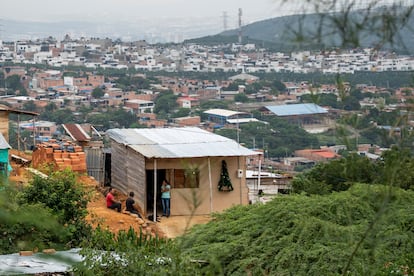
It is an unusually cloudy Wednesday in Cúcuta, and a light drizzle falls intermittently. Children on bicycles race along the dusty slope of the mountain, where there are breathtaking views of the border. You can even see the Táchira River in the distance, dividing the two countries. Cars cannot climb some of these steep, clay roads, which are accessible only to motorcycles that dodge their barking dogs.
At more than eight million people, the Venezuelan diaspora has spread throughout Latin America, but neighboring Colombia is by far the primary receiving country. Nearby border crossings have served to funnel this enormous flow of people. The porous, 1,378-mile border is also replete with informal crossings known as trochas.
Simón Bolivar, the primary access point to the town of San Antonio del Táchira, has often been overwhelmed by successive waves of migrants, who are driven by hyper-inflation, insecurity and a lack of food and medicine. On the Colombian side of the crossing is La Parada, another famous settlement that has become the first stop for many arriving in a country that has to-date received nearly three million Venezuelans. Of them, more than 200,000 live in Cúcuta, the sweltering capital of the Norte de Santander department, which borders the Venezuelan state of Táchira, where another 40,000 cross every day at Villa del Rosario.
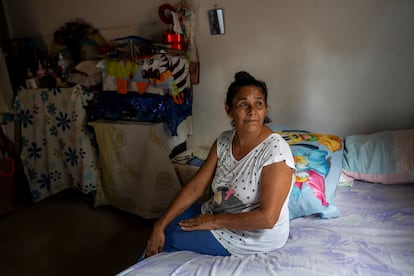
“What is happening in Venezuela pains me,” says Ivia Marlene Esleiman, a 68-year-old retired schoolteacher who now sells chucerías (snacks) in the uppermost section of La Esperanza. In Valencia, she had been “very alone and very sick,” she laments, and an accident in which she dislocated her femur hastened her departure just a year ago to join her son, she recounts from her wheelchair. When it comes to her physical challenges, “here, I feel a little calmer,” she says from behind a fence which serves as a counter for her sales of candy and her tailoring services. “I love my homeland, but I love Colombia just as much,” she declares to anyone who will listen.
One of the resident on this block was a technician for PDVSA, the Venezuelan state oil company, and prefers not to share his name as his current work requires coming and going from San Cristóbal. He has seen how the regime monitors cell phones and social media, and wants to avoid trouble. “The same people are still there,” he complains, citing the appointment of vice-president Delcy Rodríguez as Maduro’s replacement.
In these hills, there are as many stories as there are migrants. “If you want me to take you guys to my nona [grandmother], she’s also from there,” offers Sara, an 11‑year‑old girl, spontaneously. And she does. Her grandmother Rosaura Josefina Carrillo, 65, originally from Ciudad Bolívar, has already been in Colombia for almost seven years. She has about 10 children; four are here and another is in Chile. She left her land behind, but wants to return to build a shack. “These are things that only God knows,” she says about “that man they took out,” referring to the uncertain transition in Caracas. She speaks with the same faith that is also seen in other La Esperanza locals. “I think,” she says, “Venezuela will shine again. It will have light again.”
Sign up for our weekly newsletter to get more English-language news coverage from EL PAÍS USA Edition









































