
Venezuela’s border forgets about Maduro: ‘And now, are things going to get better?’
Life on either side of the bridges that connect Venezuela to Colombia unfolds in anticipation of change

Jonathan Maldonado wears tight pants and a green t-shirt. He reports on what happens each day on the border between Venezuela and Colombia. He works as a reporter for the newspaper La Nación, a Táchira-based paper on the Venezuelan side. The dollar has dropped, he says into the cell phone held by his father, who is also his cameraman. And a man has been arrested for gender-based violence.
-You come here every day, what’s your impression of the mood?
“It was believed that the border crossings would be closed after Maduro’s removal, but that didn’t happen,” Maldonado replies. “Now there’s a lot of uncertainty about what’s to come.”
-By the way, this just happened: Trump spoke on the phone with Delcy and said he thinks she’s a “wonderful” person.
-I already knew that, I had heard it before.
Journalists are not enthusiastic about others bringing them news.
It’s been almost two weeks since a U.S. elite force captured Nicolás Maduro while fighter jets bombed key locations to neutralize the Chavista army. Delcy Rodríguez has been named the acting president. The U.S. president says he is running Venezuela. María Corina Machado is trying to convince him to let her take over. Oil companies want to return to the country, but they want more guarantees. Political prisoners are being released. The fact is, every day has been a world unto itself; it feels like years have passed.
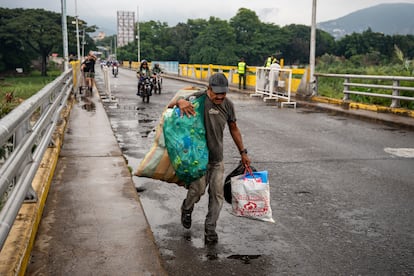
On the Simón Bolívar Bridge, the main land route connecting the two countries, uncertainty reigns, as Jonathan Maldonado aptly puts it. A different atmosphere pervades the air in Cúcuta. People come and go. On the bridge’s banks, 30 eggs are sold for $2, haircuts are offered for $4, and an orthodontist adjusts a teenager’s braces with pliers. A man, blind for 13 years due to an ulcer, sells ice cream for 20 cents while using a cane. “I’m not going to see any change. Hahaha,” he jokes.
The Colombian military presence has diminished. President Gustavo Petro had reinforced it in case the United States invaded Venezuela. It didn’t, but it did overthrow the self-proclaimed president, and the power vacuum has been filled once again by Chavismo. The Trump administration speaks of an initial stabilization process, followed by recovery, and later, a transition. These highly technical terms can be interpreted in a thousand ways. “No idea, no idea,” replies María Dolores, a vendor of just about anything imaginable. “Maduro is over, we’ve forgotten about him. What’s next? And now, are things going to get better?” she asks.
What she’s sure of is that she still prefers living on the Colombian side. “Over there,” she says, pointing to Venezuela, “one day a pair of pants costs 25, 40 the next, 35 the day after that. Here, everything is more stable.” Jesús Ramón, standing next to her, says that precooked corn flour, a staple of the Venezuelan diet, costs 3,500 pesos a package, almost a dollar. In Venezuela, it costs 1.09. It would be a small amount if little were consumed, but Jesús Ramón loses three kilos a week, a fact that is astonishing. He’s thin, and his bones are visible in his shoulders and face. “It’s my normal build,” he says with the haughtiness of someone who doesn’t gain weight. “Did you know that we’re prone to 172 diseases according to our genetics?” he asks.
“Everything’s gone up!” shouts a fruit vendor from a car, clearly with a keen eye for spotting journalists. The new year has brought even more inflation. Some blame Maduro’s arrest, others the minimum wage decreed by Petro. The truth is, nobody knows for sure; it’s all just intuition. The same goes for Harvard economists and TV analysts, except they sound so earnest that we believe them. But they don’t know either.
Mario shaves the head of a man who runs a corner store right there in the middle of the street. The shopkeeper was a soldier, and it was during his military days that he picked up the habit of shaving his head completely, as if he weren’t aware that his head of hair was a blessing from God. Mario would love to go back to Venezuela. He has a house there that he abandoned in Caracas. He says he left because he was fed up with the food bags distributed by the Chavista regime being pocketed by the neighborhood leaders in his area.
Life isn’t easy here in Colombia either. He has eight children, as far as he knows. Utilities are more expensive here than back home: electricity, water, gas. He gets overwhelmed just listing them. He owes two months’ rent, for December and January. He’s already sent his landlady a message telling her not to rush.
-I’d go back, brother, I’d go back. If things get better, I’m going there. There’s nothing like being at home.
Sign up for our weekly newsletter to get more English-language news coverage from EL PAÍS USA Edition









































