
Venezuela breaks energy agreements with Trinidad and Tobago due to alleged complicity with the US
Caracas accuses the Caribbean island nation of participating in the seizure of an oil tanker off the Venezuelan coast
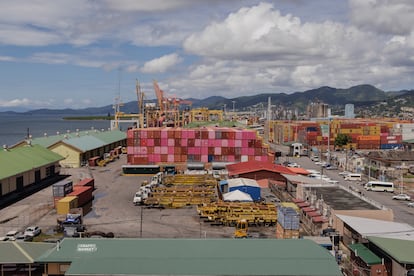

The government of Nicolás Maduro denounced on Monday that Trinidad and Tobago participated in the seizure of a tanker carrying 1.9 million barrels of oil that the United States intercepted last week off the coast of Venezuela. Caracas has deemed this operation an act of “piracy” and has therefore decided to immediately break off all negotiations and contracts with the small Caribbean nation for the supply of natural gas, which fall under the Framework Agreement on Energy Cooperation signed between both countries a decade ago.
“This official has turned the territory of Trinidad and Tobago into a U.S. aircraft carrier to attack Venezuela, in an unequivocal act of subservience,” the Venezuelan Vice Presidency said in a statement, alluding to the Prime Minister of Trinidad and Tobago, Kamla Persad-Bissessar. “Given her complicity in stealing oil, the Bolivarian Government of President Nicolás Maduro is terminating any contract or negotiation that involves the supply of gas to this neighboring country.”
Hostilities with the neighboring island nation have been escalating in recent times. Maduro has accused Persad-Bissessar of driving a “hostile agenda against Venezuela” since she came to power in May 2025. This move follows Maduro’s earlier denunciation in October of the energy deal with Trinidad and Tobago.
Then, Venezuelan Foreign Minister Yván Gil asserted that a “false flag operation” was underway targeting U.S. military installations and equipment in the neighboring country, with the intention of “blaming Venezuela and giving Washington a pretext to launch direct attacks on Venezuelan territory.”
The energy agreement between Caracas and Port of Spain was signed in 2015 and was automatically renewed this year. It includes, among other things, the development of infrastructure for the joint exploitation of gas fields such as Campo Dragón, located in Venezuelan waters. In early October, the United States granted Trinidad and Tobago a six-month license to negotiate a gas agreement with neighboring Venezuela without facing sanctions from Washington, according to Trinidadian authorities.
The Chavista regime has stated that the seizure of the oil tanker is a “blatant violation of the principles of free navigation and trade.” The tanker, named Skipper, was sailing under a false flag and was seized on December 10 by order of a U.S. judge due to its prior links to the smuggling of Iranian oil. The vessel had already been sanctioned by Washington, although on this occasion it was carrying Venezuelan crude, according to The New York Times.
Increased U.S. surveillance of so-called “ghost ships” that Venezuela uses to trade its oil despite sanctions has caused some cargo ships to deviate from their routes, Reuters revealed on Monday.
Also on Monday, the government of Trinidad and Tobago confirmed that it will allow U.S. military aircraft to transit through local airports in the coming weeks, as part of bilateral security cooperation between the two countries. According to Trinidadian authorities, approvals were granted for the movements, which the United States has described as “logistical in nature,” for resupply and routine personnel rotations, as part of the extended military deployment ordered by Donald Trump in the Caribbean, which has kept the region in a state of increasing tension since August.
Both countries maintain close defense cooperation that in recent months has included joint military training exercises, improvements in surveillance capabilities and the installation of an advanced radar system, which has supported counternarcotics operations.
Sign up for our weekly newsletter to get more English-language news coverage from EL PAÍS USA Edition









































