
The incredible evacuation of Maksim from the Ukrainian front
A land drone successfully rescued a soldier in an operation that Kyiv described as ‘legendary’ after he spent 33 days cut off with a comrade facing Russian positions


Olena, 39, spoke daily with her husband, an officer in the Ukrainian army deployed on one of the fronts in the eastern Donetsk region. So, when she lost contact with Maksim, 33, on September 24, she was on high alert. The next day, she started pulling strings and soon received a response from his superiors. In any case, she calmly explains that she even typed, “Google, how long can a husband remain missing?” Olena stayed informed the whole time, but she didn’t know that the five most harrowing weeks of her life lay ahead of her, despite the fact that the army withheld a significant part of what had happened. She’s grateful for that.
Maksim not only starred in one of the most incredible rescues of the war, but his evacuation, completed on October 27, demonstrates that it’s not just aerial and maritime drones that are shaping the course of the conflict. Land drones are also playing a crucial role, like the one used by his comrades to save the life of this soldier, who was seriously wounded the day he lost contact with his wife. The vehicle, equipped with a kind of metal sarcophagus to protect the body, managed to survive a mine explosion and a drone attack. Olena and Maksim (who prefer not to use their surnames), now together, receive EL PAÍS in a hospital room in Kyiv.
On September 24, Maksim and his unit were tasked with delivering supplies and batteries to comrades at the front. They were advancing on foot when he stepped on one of those small, camouflaged mines left by the Russians, designed not to kill, but to maim. His right leg was badly injured, requiring amputation. This is what Olena didn’t know. Helping a wounded soldier at the front requires resources, especially when, as in this case, it takes place in an area under enemy control, constantly monitored by drones.
A soldier is left behind to look after him, but after two or three days, another explosive device wounds Maksim again, this time in the arm. They are in a small, practically destroyed village where, according to his account, Russians occasionally arrive in pairs or small groups to take up positions. Both manage to find refuge and hide in what they call the village’s “library.” The Geneva Convention prohibits attacks on wounded service members, but reality on the ground demonstrates that this is not respected.
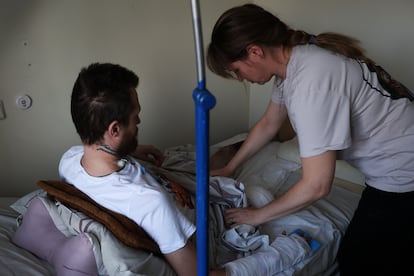
“My comrade found some canned food and water in the houses that were more or less intact. He would go out when the drones were less active. The first few weeks were tough: no water, no food, no painkillers while he helped me treat my wounds,” Maksim recounts. Only later were his comrades able to get supplies and medicine to them by drone, allowing them to survive. The wounded officer doesn’t want to give any details about the soldier who cared for him during that long month because he’s still on the front lines, but he’s aware of what he did: “Without him, I wouldn’t be alive today.” “I’m waiting for the day he gets out of there so I can hug and kiss him,” Olena adds gratefully.
The First Medical Battalion began to develop what became known as Operation Gver, an acronym with no specific meaning, intended to rescue Maksim. Attempts to deploy drones on the ground, remotely controlled vehicles similar to those used in aerial operations, were made repeatedly. But the Ukrainian army was unable to reach the target. On one occasion, a drone came very close to Maksim and his companion’s position, but it was ultimately bombed by the Russians. In total, four of these drones were lost in successive attempts. Finally, on the seventh attempt, a Ukrainian-made Maul model reached its target.
“The weather was favorable for operating a land drone. As night fell, it started to rain. We maintained radio communication and were told that the vehicle had begun to move and to stay in contact,” Maksim recalls. “We lay down waiting until it arrived. I don’t remember what time it was. We heard the engine and confirmed over the radio that it had arrived. My partner got out, opened it, and then came back for me. He helped me out. I got in. He closed the door and it started moving,” the soldier adds. From an operations center, every movement was monitored by a dozen soldiers on several screens.
“There’s still some left, there’s still some left”
“I felt two explosions. One near the drone and another when the vehicle hit the mine, but it kept going,” he says. “Along the way, I was afraid it would be destroyed, that it would stop and I’d be stuck there in the middle of it,” Maksim explains. “Then I started to feel tired. It was incredibly hot inside because of the engine. I just wanted to get there as quickly as possible while on the radio I kept hearing, ‘There’s still more to go, there’s still more to go.’”
For five hours and 58 minutes, the Maul vehicle traveled 40 miles, 23 of which it covered using only three of its four wheels after losing one when it hit the aforementioned mine, according to military sources. It is no surprise that Maksim ultimately lost his right leg, but “the armored capsule saved the injured man’s life, allowing him to remain inside unharmed,” they added in a statement. They are certain that the operation will go down in history as an incredible modern example of Casevac (Casualty Evacuation).
Ukrainian President Volodymyr Zelenskiy was quick to congratulate and decorate the soldiers involved in an operation that has been hailed as “legendary” by the army itself. This is due, firstly, to their having saved Maksim’s life and, secondly, to their having successfully evacuated him for the first time using a domestically produced vehicle under such adverse conditions. Previous versions of the Maul UGV (Unmanned Ground Vehicle) were tracked and electrically powered by a battery. The latest version, the one used in Maksim’s rescue, is wheeled and equipped with a gasoline engine.
Olena, more talkative than her partner, recalls those 33 days when she clung to the presence of her 14-year-old son like a lifeline: “There were positive moments, like when he communicated with me through his commanders on the radio, and I could hear his voice, even though those commanders didn’t tell me that he was wounded at the time. And while I was listening to his voice, I didn’t even suspect he was. He would tell me, ‘Honey, I love you, everything is fine, I’m working.’”
Maksim still can’t explain how he managed to come back alive. Surviving for almost five weeks with a tourniquet to prevent him from bleeding to death was an ordeal. It’s a medical measure that normally has to be removed after a few hours. That’s why Olena is overflowing with gratitude towards those who made the rescue possible.
Maksim looks back from his hospital bed. He remembers his time as a security guard at a supermarket in Kherson, until the Russians occupied part of that southern region during the major invasion launched in February 2022. He and Olena, who met in 2018 and married in 2021, eventually escaped after a “tough and dangerous” period under Russian occupation. They settled in Odesa, also on the Black Sea coast, and in 2024, Maksim was called up and deployed in the east.
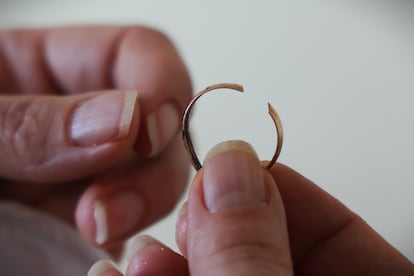
Among the various tattoos that dot his skin, one on the right side of his neck stands out: it reads “Save me and protect me” in Spanish. Both he and his wife maintain that this seemingly random phrase has nothing to do with what has happened in recent weeks. His next goal, once he leaves the medical center, will be to receive a prosthesis and learn to walk again in a country where, between 2022 and 2024, the number of amputees due to the war reached almost 100,000, according to official figures. On the bedside table, Olena keeps the engagement ring that the paramedics had to remove by cutting it from Maksim’s swollen finger, and which they hope he will soon be able to wear again once his arm has healed.
Sign up for our weekly newsletter to get more English-language news coverage from EL PAÍS USA Edition









































