
Four Salvadorans deported by Trump and held without charges located in Bukele’s prisons
The Inter-American Commission on Human Rights demands information from the Central American leader regarding their situation
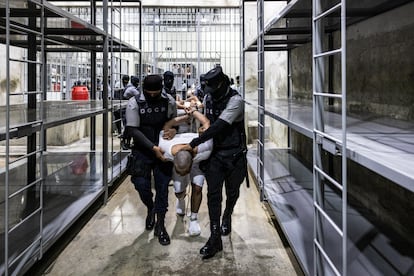
Four Salvadorans deported by the Donald Trump administration last March, who had been reported missing by their families, were finally located in different prisons within the Central American country’s penitentiary system, according to official documents obtained by EL PAÍS. They are José Osmín Santos Robles, Brandon Bladimir Sigarán Cruz, William Alexander Martínez Ruano, and Irving Geovani Quintanilla García, who were deported in March 2025 along with more than 238 Venezuelans, accused of being members of terrorist networks without the Republican administration providing evidence against them.
After their deportation, Nayib Bukele’s government refused for months to provide information about the men’s whereabouts to their families. However, following repeated requests for information from the Inter-American Court of Human Rights (IACHR), the executive branch of El Salvador finally acknowledged that they are in its custody. According to documents obtained by EL PAÍS, only Brandon Sigarán is being held at the Terrorism Confinement Center (CECOT), the mega-prison promoted by Bukele and now a grim symbol of the lack of guarantees for Salvadoran prisoners. The other three are being held at the Santa Ana Industrial Center for Sentence Enforcement and Rehabilitation, a less strict prison.
Last week, the IACHR issued precautionary measures in favor of the first three, while measures had already been requested for Quintanilla García on October 2. According to the international body, the lives of the four young men are at risk of “irreparable harm,” and it has asked the Salvadoran state to guarantee their safety.
The IACHR also requested that the Bukele government formally clarify the legal situation of the four detainees, specifying the crimes they are accused of and whether they have already been presented before a judge. The plaintiffs before the IACHR claim they have not been informed of the charges against the detainees or why they remain in prison, as they have not had access to the inmates since their deportation. The IACHR has also requested an end to the prisoners’ isolation and for them to once again be to regularly contact their families and lawyers.
In the preceding months, the families of the four had reported their disappearance, contacting various media outlets. Following these contacts, the Salvadoran government accused the IACHR of leaking information from its internal communications and requested measures to “guarantee the confidentiality of the information.”
EL PAÍS obtained the document, dated November 6 and signed by El Salvador’s Permanent Mission to the Organization of American States (OAS), in which the country’s authorities argued that public knowledge of these cases “facilitates their manipulation for purposes unrelated to the objective of the precautionary measures.”
For seven months, the Salvadoran government denied knowing the whereabouts of the four young men, until mid-October, when it confirmed their location. However, none of their families have yet been able to see the detainees.
Detained without knowing why
Although the Salvadoran government has admitted that it is holding the four deported young men, on several occasions it tried to avoid providing information about them. In another document dated August 29, 2025, the government told the IACHR that it had no information on Irving García, since “the young man’s arrest occurred under the jurisdiction of another state.” It added that this placed El Salvador “in a position of being unable to provide information.”
The same occurred in the case of Brandon Sigarán Cruz. A relative of the migrant shared with EL PAÍS dozens of screenshots and official documents showing the family’s requests for information to different government offices, including the Salvadoran Embassy in the United States, the Ministry of Foreign Affairs, and the General Directorate of Penitentiary Centers. In the screenshots, officials can be seen passing responsibility from one office to another without providing the family member with any real information.
Sigarán was captured on February 22, 2024, while on his way to work with his brother. After a year in detention, he was deported in March 2025 along with hundreds of Venezuelans. After identifying him in a video published by President Bukele, the family began a legal process to locate him and seek his release. “A lawyer helped us search all the prisons in El Salvador until she found out he was in CECOT. After that, she resigned because she said she feared reprisals for going against President Bukele’s government,” said a relative of Sigarán.
The precautionary measures issued by the IACHR in favor of the four Salvadorans note that the crimes they are accused of and whether they have been presented before a judge remain unknown, in violation of the law.
On March 15, President Bukele announced via his X account that El Salvador would receive hundreds of Venezuelans and deportees of other nationalities from the United States in exchange for payment that would allow the U.S. to extend its prison system. However, months later, it became clear that there was another motive behind the agreement: Bukele wanted a dozen gang leaders in the custody of U.S. authorities who might testify against him.
After multiple obstacles, the prison agreement between Trump and Bukele to incarcerate undocumented migrants appears to have reached its final stage. In July, the Salvadoran president handed over more than 200 Venezuelans who had spent months in CECOT in exchange for a quota of U.S. political prisoners. A recent report by Human Rights Watch and Cristosal confirmed that those Venezuelans were subjected to torture. Meanwhile, the fate of the Salvadorans held in the same prison remains unknown. Despite intense official propaganda, CECOT continues to be a black hole from which almost no one emerges.
Sign up for our weekly newsletter to get more English-language news coverage from EL PAÍS USA Edition









































