
Claudia Ortiz, leader of the opposition to Bukele: ‘El Salvador is moving toward an authoritarian regime’
In an interview with EL PAÍS, the politician describes the state of political resistance, denounces harassment, and shares her fears about living in a country without judicial guarantees
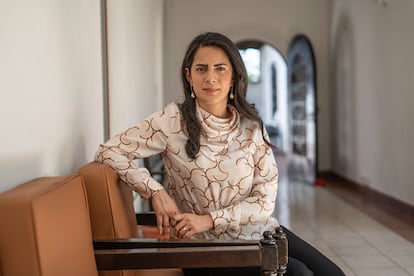
Claudia Ortiz, 38, has become the most visible political figure in the opposition to Nayib Bukele in El Salvador. Her political capital is far from matching the president’s propaganda machine and overwhelming popularity, but today she is the only leader in the country mentioned as a possible option for a possible post-Bukele era.
The outlook, in any case, seems distant. Bukele maintains control over all three branches of government, including the Legislative Assembly, where Ortiz is a representative. In 2023, lawmakers aligned with the president reduced the number of seats in the house from 84 to 60, raising the threshold for votes needed to occupy a seat. The maneuver ultimately wiped out the traditional parties: ARENA, the right-wing party, was reduced to two representatives, and the Farabundo Martí National Liberation Front (FMLN), which had held the presidency before Bukele, was practically wiped off the political map.
Ortiz, elected on the Vamos ticket, a sort of third way, emerged strengthened. Her voter base grew, and in the 2024 elections she became the most supported opposition candidate in the country. Even so, she decided not to face Bukele in the presidential race. In this interview with EL PAÍS, conducted via videoconference, Ortiz portrays the current state of the Salvadoran opposition: she complains that they don’t even have access to basic information such as meeting schedules; she admits that she suffers harassment and fears living in a country without judicial guarantees; and she even confesses that she would consider exile if she were to quit politics.
Question. What is it like to be an opposition lawmaker in El Salvador?
Answer. It’s a huge challenge. We’re not doing politics in a normal situation. There’s an institutional blockade, there are violations of my political rights: I don’t have access to all the information necessary to properly evaluate legislative initiatives, in some cases because they’re presented in a rush. We don’t have access to meeting agendas; we don’t know in advance what’s going to be discussed. And yet, we’ve learned to develop some skills to sniff them out and say, ‘Well, surely this is what’s on the agenda because there are signs of it.’ But it’s complex because, to the extent that I do a better job of telling the truth to those in power, of conducting oversight, of exposing these legalized corruption schemes, or of denouncing human rights violations, I run more risks.
Q. What risks are you referring to?
A. It’s a whole. I’ve been a constant victim for years of a machinery that generates hate speech toward my party. From the most vulgar troll to Diario El Salvador [the government’s mouthpiece newspaper]. Secondly, because we’re working in a context where there are no guarantees for any citizen. The fact that I’m a member of parliament doesn’t imply special protection for me either. We see how many citizens have opted for silence, exile, or self-exile.
Q. You now enjoy political immunity as a member of parliament. If you lose your seat in the next elections, would you consider going into exile?
A. It’s difficult to answer without being in the specific situation. What I can tell you is that the last thing I want to do is leave my country. But, obviously, after all the work I’ve done, all the accusations, my statements, it’s obvious that the more I do my job, the more risks I run. And, well... I would have to consider it. I’m aware that I would face a great risk.
Q. Don’t you think that being in opposition at this point is like playing into the hands of a government that shies away from the label of dictatorship?
A. I think playing into their hands would mean being complacent with the government’s positions, remaining silent, or talking about trivial matters. Our party has always had a clear position, and we’ve assumed the political cost or the cost of defamation that has been inflicted on us for having a clear position, for example, with the state of emergency and the idea that there is a better way to provide security. None of our positions have been aimed at legitimizing what’s happening; rather, they have been the opposite: denouncing the lack of democracy and the authoritarian drift in El Salvador.
Q. Why is it necessary to revoke the emergency regime?
A. The state of exception is not a security policy. Strictly speaking, it is the suspension of three constitutional guarantees for the entire Salvadoran population throughout the country. But before the state of emergency, crime could already be prosecuted. Criminals could be investigated. They could be brought to trial and sentenced.
Q. People are not so much afraid as downright terrified that by removing the state of emergency, gang members would be released.
A. One important thing needs to be made clear: El Salvador’s criminal justice system has already undergone so many reforms that, even if the state of emergency were to be discontinued, there would be no way for those detained to be released. What we’re experiencing isn’t leading to more justice, it’s leading to less justice.
Q. We have already seen in several cases that the state of exception is being used to persecute dissidents and political opponents.
A. The mandate at the level of human rights instruments says that if a state of exception is going to be applied, it must be limited exclusively to the need to restore public order. Therefore, applying the state of emergency and not guaranteeing the constitutional rights of Ruth López, Enrique Anaya, Pastor José Ángel, Alejandro Enrique, and others is excessive, because the application of the state of emergency is limited specifically to gang members.
Q. Do you consider El Salvador to be a dictatorship?
A. El Salvador is moving toward an authoritarian regime, because all the signs are there. There is a concentration of power, there is a restriction on freedom of speech, on freedom of the press. There is no real division of state powers. There is no real oversight between branches of government. And I think one of the most serious things is that there is no institution in El Salvador that safeguards citizens’ rights. The electoral process is extremely compromised... That constitutes the elements of an authoritarian political system.
Q. Is that a dictatorship?
A. An authoritarian regime is the same as a dictatorship. It’s a dictatorship, it’s just that it’s in the process of evolving. Maybe it’s not completely consolidated yet, but it’s an authoritarian regime, which, at its core, is the same as a dictatorship. The thing is, there are still spaces where people can fight to reverse that. Some people say democracy is dead, but acting defeated and giving up is playing into the hands of authoritarianism. It seems to me that saying ‘well, there’s nothing we can do now’ is playing into its hands. As a political leader, my role isn’t to be pessimistic, but to nurture hope.
Q. A few weeks ago, you filed a constitutional challenge against Bukele’s indefinite reelection before a Supreme Court controlled by him. Don’t you think this, far from working, could pose more risks for you?
A. I take risks every day. But that lawsuit was something that had to be done because it sets a precedent.
Q. Do you want to govern El Salvador?
A. That’s right.
Q. Do you want to be president?
A. It seems to me that every politician, every political project, every political project leader, if they get involved in this activity, does so to gain power. Because they want to put into practice the ideals and the vision of the country that they’ve built, that they have.
Q. In the last election, there was a strong expectation that you would be a presidential candidate. Was it proposed to you? And if so, why didn’t you accept?
A. Yes, they proposed it to me. And I didn’t accept because the strategic vision we had as a political project at that time was specifically the Legislative Assembly.
Q. Are you planning to run for president in 2027?
A. I haven’t decided yet. We’re going to make that decision as a party, strategically considering what’s best for the people and the country. We don’t yet know which option (mayor, member of the Legislative Assembly, or president). What we’ve decided is that we’re going to participate.
Sign up for our weekly newsletter to get more English-language news coverage from EL PAÍS USA Edition









































