
The lessons the Dayton Accords taught the world 30 years after the Bosnian War
The pact between Bosniaks, Serbs, and Croats, brokered by the Clinton administration, demonstrated how to stop a conflict, but not how to build a fragmented country
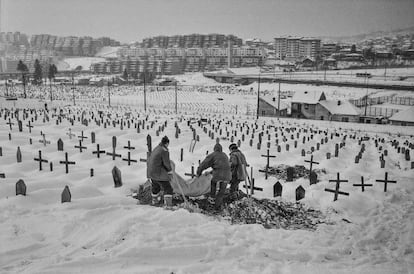

The Clinton administration’s envoy to the Balkans, the renowned Richard Holbrooke, was a hardliner. Exactly 30 years ago, the world watched helplessly as the bloodiest war in the former Yugoslavia raged: 100,000 dead in a conflict that pitted Bosniaks, Croats, and Bosnian Serbs against each other from 1992 to 1995. Holbrooke brought three leaders — delegates from the three warring communities — to Wright-Patterson Air Force Base in Dayton, Ohio. The location was not chosen at random: it was far from the media and political pressures, over 400 miles from Washington and some 5,000 miles from Sarajevo, the Bosnian capital.
Holbrooke used to say he needed a place from which “no one could escape.” And that’s where, on November 1, 1995, Alija Izetbegovic, president of Bosnia and Herzegovina, Slobodan Milosevic, president of Serbia — representing the interests of the Bosnian Serbs — and Franjo Tudjman, president of Croatia, entered the equation. “The negotiations were simultaneously intellectual and physical, abstract and personal, something like a combination of chess and mountain climbing,” Holbrooke recounted in his book, To End a War. The three leaders left the military base on November 21 with the agreement in hand, a pact that was solemnly signed on December 14 in Paris. And it left no one satisfied.
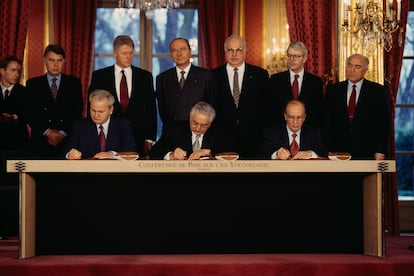
Tudjman died of cancer in 1999, Izetbegovic of cardiovascular disease in 2003, Milosevic of a heart attack in his cell in The Hague in 2006, and mediator Holbrooke in 2010 after an aortic dissection. The pact remains in force, though in poor health.
In Dayton, a Constitution was forged that was almost a work of engineering, shaping a state with two entities: the Federation of Bosnia and Herzegovina (FBiH), primarily Bosniak and Croat, comprising 51% of the territory and subdivided into 10 autonomous cantons; and Republika Srpska, with a Serb majority and comprising 49% of the territory. Later, the Brčko District was added to these entities, under joint administration and international supervision.
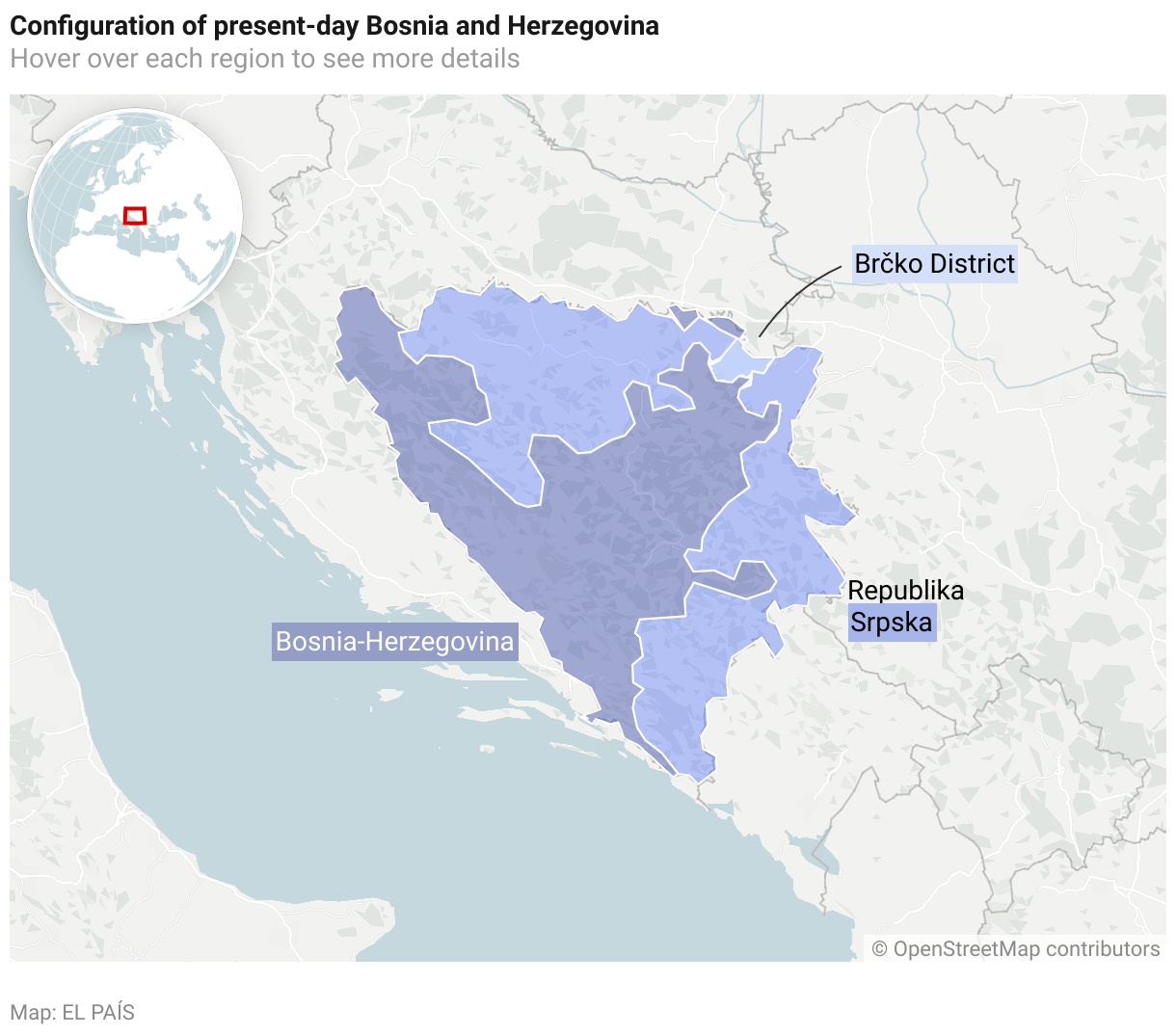
The country has a tripartite presidency and remains under the supervision of the Office of the High Representative (OHR). This office, held since 2021 by the German politician Christian Schmidt, has possessed the so-called “Bonn powers” since 1997. These powers allow the OHR to impose laws when local parties are unable or unwilling to act, remove elected officials, or even ban certain individuals from holding public office for life.
The Dayton Accords have been criticized for many reasons: for creating a slow, complex, and often inefficient political system, for relying too heavily on international oversight, and for entrenching divisions between ethnic groups. But there are also those who defend them. Such is the case of journalist Haris Imamovic, 36, who explains by phone from Sarajevo that this country of 3.5 million inhabitants has seen great progress since 1995: “In the late 1990s, you couldn’t travel safely in the country. And 10 years later, you could move around freely. There are interactions between Bosniaks and Croats. Even among Serbs.”
Regarding the excessive bureaucracy, agencies, and officials, Imamovic points out: “It’s true there are a lot. But the major problems of daily life — healthcare, education, and security — ultimately fall to the local authorities in the cantons.” The journalist, who worked for four years in the country’s presidential office, notes: “Dayton tends to be blamed for everything. But the truth is that the country’s biggest problems are the depopulation of rural areas and unemployment. And that’s not Dayton’s fault, because it’s happening in the rest of the Balkan countries as well.”
The Dayton Accords are often cited whenever a difficult-to-resolve conflict erupts, such as the invasion of Ukraine or the Gaza War. Mira Milosevich, senior researcher for the Balkans at the Elcano Royal Institute in Spain, cautions that wars are only similar at the tactical level and don’t always offer valuable lessons. But she explains that the accords demonstrated the “enormous capacity of the U.S. to compel representatives to negotiate.” She also points to another lesson from those agreements: the recognition of conquered territories. “The 30% of the Serbian population that conquered 49% of Bosnian territory was recognized.”
Milosevich concludes that Dayton’s greatest success was achieving this “frozen peace.” “Bosnia has not made progress in democratizing its institutions. It’s difficult to do so when Republika Srpska continues to look toward Serbia, and the Bosnian Croat Federation toward the European Union.” The researcher believes that the country and the Balkans will only be reborn “when there is a generational change.”
Florian Bieber, professor of Southeastern European studies at the University of Graz in Austria, believes the country’s biggest challenge now is reforming the Constitution to make it compatible with EU membership, which Bosnia and Herzegovina is pursuing. Bieber explains that the last “serious attempt” to reform the Constitution was in 2006 and failed by only two votes in parliament.
Bieber believes that one of the biggest obstacles, “though not the only one,” to reforming the Constitution is the presence of pro-Russian leader Milorad Dodik, who has been president of Republika Srpska for the past 15 years. Dodik had repeatedly threatened to unite Republika Srpska with Serbia. On August 1, he was sentenced to a six-year ban from holding political office for disobeying the rulings of the Constitutional Court of Bosnia and Herzegovina and the High Representative, Schmidt.
“Dodik is clearly determined to rule from behind the scenes,” Bieber warns. “He seems to be counting on running Republika Srpska through figureheads, which makes any change unlikely.” The second major challenge is the demand by the dominant Croat party for greater protection of Croat rights, something the Bosniak majority rejects as reinforcing ethnic divisions.
Bosnian Serb analyst Tanja Topic laments that in the wake of Dayton, a wealthy political class emerged that, for three decades, has consolidated the country’s ethnic and nationalist structure. These leaders keep the country trapped in a war of words, employing inflammatory rhetoric. Topic criticizes the parties for blocking reforms by prioritizing self-interest and for using the High Representative as an excuse for inaction. The analyst acknowledges that Dayton brought an end to the war, but warns that it also entrenched ethnic divisions and a corrupt, clientelist, and nepotistic political system.
Topic believes that the rule of law is “an unattainable dream” in Bosnia and Herzegovina. “It is necessary to restart the entire society and try to change the paradigm of values. And that is a process that could take another three decades,” she concludes.
Sign up for our weekly newsletter to get more English-language news coverage from EL PAÍS USA Edition









































