
Mexico and US outline new security, migration, and trade agreement in the 11th hour of tariff extension
The Sheinbaum administration is confident of ‘reaching a very successful conclusion’ in the negotiations with Washington
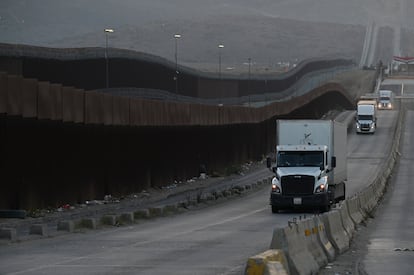

Mexico is once again seeking to defuse Donald Trump’s tariff bomb with a new collaboration agreement on security, migration, and trade. Next week, the truce granted by the U.S. president on implementing a tariff increase from 25% to 30% on Mexican exports outside the USMCA expires. In the run-up to the end of this pause, both countries are preparing a series of commitments to curb migration, drug trafficking — particularly fentanyl — and the arrival of Asian imports to North America. The Ministry of Economy expects this new bilateral agreement to be finalized during the first week of November, at the Asia-Pacific Economic Cooperation (APEC) forum, which will be held from October 31 to November 1 in South Korea. “We have several meetings at APEC and we need to see what position President Trump will take [on tariffs]. After that, I can provide detailed information on what will happen,” said Economy Secretary Marcelo Ebrard after participating in the Milken Institute’s Global Investors Symposium in Mexico City.
Hours earlier, at the same forum, Undersecretary of Foreign Trade of the Economy Luis Rosendo Gutiérrez expressed confidence in the negotiations with Washington. “We believe we will reach a very successful conclusion in the first week of November. Agreements will be reached with Jamieson Greer (head of the Office of the United States Trade Representative) that reflect important advances in security, border, and trade competitiveness,” Gutiérrez stated.
Sources close to these working groups have confirmed to EL PAÍS that bilateral discussions have included increased immigration surveillance along the Rio Grande and the imposition of more tariffs from Mexico on Asian products, primarily in key sectors such as automotive, telecommunications, and electronics. The options are still on the table, but they align with the main concerns dictated by Washington: blocking drug trafficking from Mexico, stemming illegal immigration on its southern border, and halting the arrival of some Asian imports. On the other hand, the Sheinbaum administration seeks to preserve and improve the so-called “preferential treatment” that the U.S. has granted thus far regarding tariffs imposed on other countries.
Ebrard commented along these same lines this week during his appearance in the Chamber of Deputies. In his opinion, tariff negotiations with Washington were 90% complete. The remaining 10% was the 50% sectoral tariff that still weighs on the Mexican steel industry. Mexico is seeking a discount on the tariff, as well as on the levy Washington is threatening on cargo trucks. Ebrard acknowledged that while fentanyl trafficking was initially the focus of discussions with his U.S. counterparts, the conversations have now shifted to how to ensure security in the region’s supply chains.
Adding to this complex crossroads of agendas is the upcoming review of the USMCA, scheduled for July of next year. Trump’s protectionist onslaught has cast doubt on the agreement’s longevity. The Republican has threatened to derail the agreement if it doesn’t benefit his country. In the last tariff truce granted to Mexico, on July 31, the U.S. government committed its Mexican counterpart to reaching a new trade agreement within 90 days. Regarding the progress of this USMCA dialogue, Ebrard was optimistic. “We already have these foundations of trust, of dialogue. We have common problems. There’s no way to compete with Asia if we don’t have coordination between the three countries (Canada, Mexico, and the U.S.),” the official stated.
From steel and aluminum to automobiles and tomatoes, Washington has dealt several trade blows to Mexican exports. Going against the grain and under pressure, Sheinbaum’s cabinet has held more than 80 meetings with Washington to try to negotiate these measures. To date, they have only achieved a few victories, such as tariff pauses and tariff reductions on foreign automobiles proportional to U.S. content.
Just days before the results of these negotiations between Mexico and the U.S. become clear, Trump’s protectionist wall has placed the Mexican economy in a latent state of uncertainty. Mexican exports to the U.S. remain stable, totaling more than $309 billion in the first seven months of the year; however, manufacturing and construction activities have slowed their momentum. Although the Sheinbaum administration still forecasts GDP growth of at least 1.8% in 2025, the consensus among analysts and multinational organizations points to an increase of less than 1%. More than 80% of Mexican exports are destined for the U.S. market, and any change in the direction of this river of resources has far-reaching repercussions for the Mexican economy.
Sign up for our weekly newsletter to get more English-language news coverage from EL PAÍS USA Edition









































