Los Vázquez, an Argentine club created by local residents to ‘get kids off the streets’
The social, cultural, and sports club seeks to offer alternative solutions to address crime and drug addiction in Tucumán
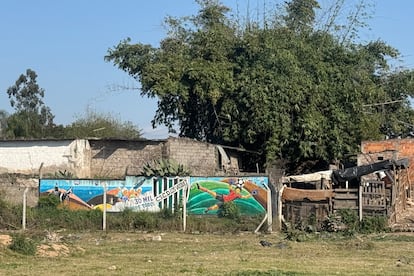
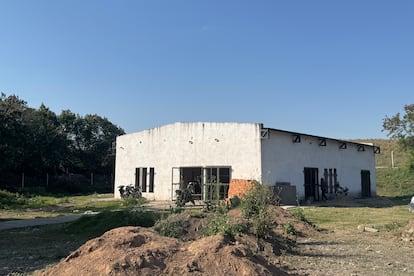
Chickens cluck in the background as Daniel Miguel Gómez, “Goyito," and Juan Antonio Monteros, “Poro," arrive in the morning for work on the construction site. Born and raised in the Los Vázquez area, they work and learn alongside a team from the Tucumán Community Infrastructure Agency to continue the construction of the neighborhood’s social, cultural, and sports club.
“First, we started digging for the water. Now I’m painting and he’s welding. We’ve done several things,” says Goyito, 18, of the work they started over a month ago. “I’m happy this is continuing. I want it to continue until it’s all finished because the kids love the club; they can’t wait to get the soccer field.”
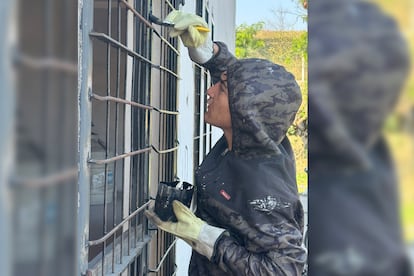
“It’s going to be a big change for the neighborhood,” says Poro, 27, about his expectations for the club. “It’s going to get kids off the streets. When they come here, they have fun, they relax, they don’t hang around on the streets or do things they shouldn’t, like using drugs, because most of them are broke because of that.”
The neighborhood and the club
To the east of the capital of Tucumán, a northern Argentine province, lies the Los Vázquez neighborhood. It stands on a garbage dump that was in operation until 2005 and provided jobs for the first families who moved there. Today, it is part of the National Registry of Popular Neighborhoods (RENABAP) and is home to more than 200 families.
As in many informal or marginalized neighborhoods, drugs and addiction are life-threatening problems in Los Vázquez. A decade ago, psychologists Emilio Mustafá and Gabriela Morales, along with residents and community leaders, created With Hope We Strengthen, a neighborhood therapeutic group for addiction treatment. In addition to a snack bar, the kids asked for a soccer field, as there wasn’t one.
Then, the possibility of creating a club arose. The design and plans were put together by the team from the Participatory Habitat Improvement Program, made up of professors and researchers from the Faculty of Architecture, as well as other technicians and officials from various public agencies. National funding was obtained, and construction began in 2023. However, at the end of that year, work was halted, and for the entirety of 2024, with the allocated budget, it remained on hold. “That they come and inspire you, and then leave and never come back — that’s very sad,” says Víctor Guerra, “Yor,” the club’s president, a resident, and a key local figure.
With construction halted, one of the biggest risks looming was that a drug dealer might move into the mental health center to sell drugs. So the club’s board of directors, made up of residents and some professionals, began negotiations and secured funding through the San Pablo University-T program run by the Tucumán municipal legislature. “The central objective was to generate a subjective effect from a perspective of hope, which is a sign of good health,” Mustafá explains. “The money is only enough to complete the multipurpose room, but it means the club’s construction can resume.”
Poro, Goyito and the residents
“I started in the group when I was little, nine or 10 years old,” Goyito says. He used to go to the soup kitchen. He remembers that where the club is now was all fields, and it was the residents who, with a machete and scissors, cleared the weeds to make the first soccer field. “Now there are a lot of kids who are broke, addicted, because of all this drug nonsense,” he says. “And it’s bad to be out there like that, to be cold, to be hungry on the streets, it’s really bad,” he adds, from his own experience.
On his 18th birthday, almost a year ago, Goyito left the General Manuel Belgrano Children’s Home. The neighborhood psychologists had found a place for him there because he’d been struggling with serious substance abuse for a long time. “Things were tough. They took me from here, from the corner, and I was pretty much homeless on the streets. Now I’m doing pretty well. I come to work, and I’m proud to have this job.”
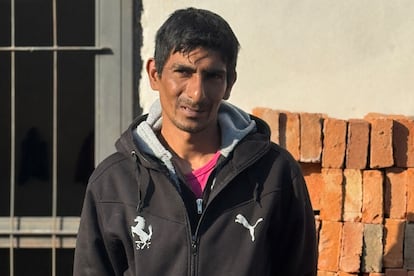
Poro was also born and raised in Los Vázquez. His son and daughter live there and coach soccer at the club, in addition to going to the soup kitchen. “I’ve never used drugs, but my brothers are into it. I talk to them, and they don’t understand. And I see most of the kids here in the neighborhood, and they’re young kids, you know? If this works, for me, it’s going to change a lot, if they want it and if they give it a chance,” he says.
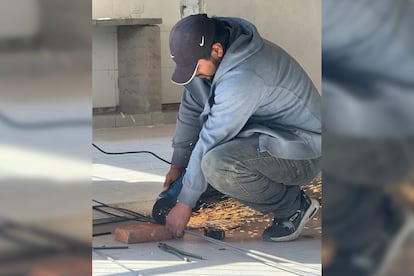
Hope for the future, for improvement, for health, lies in the construction of the club. A space that, due to the conditions of its formation, the residents feel is their own; they have built it with their own hands.
“Recently, a truck came with these bricks, the ones we’re sitting on now, and the cement, but it didn’t want to come in here, so it left them at the entrance. It was almost 5:00 p.m. How do we unload the truck among us?” Yor says. “It’s the greatest joy I’ve ever had, an incredible thing. All the kids who come to train, helping to unload the truck, passing around the bricks. It gives me great joy to know that they’re taking charge of things that might not be their responsibility, but they feel strongly about the club. That makes me very happy.”
There is still no completion date for the project and, in fact, at this stage, the only part of the club that is expected to be finished is the multipurpose room. However, decisions are made by the board of directors, which is made up of residents of Los Vázquez, who have begun to pay a membership fee of 300 pesos, approximately $0.25. In search of more members for the club, they point to its self-management, its decision-making power, and its health facilities.
Sign up for our weekly newsletter to get more English-language news coverage from EL PAÍS USA Edition