
Mexico awarded 190 public contracts to a network linked to Los Chapitos even after US sanctions
Since the Treasury targeted Sumilab in May 2023, its owners have received over three million pesos in government allocations
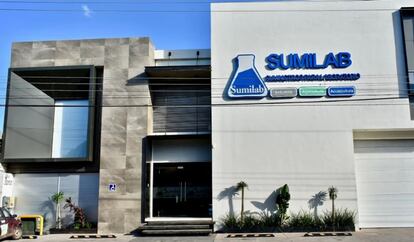

On May 9, 2023, the U.S. Department of the Treasury targeted the company Sumilab for supplying chemical precursors to the Sinaloa Cartel. It was sanctioned in the same round as Joaquín “El Güero” Guzmán López, the son of convicted drug trafficker Joaquin “El Chapo” Guzmán Loera. The Office of Foreign Assets Control (OFAC) reported that both had been sanctioned for having engaged in activities or transactions that “materially contributed to [...] the international proliferation of illicit drugs.”
Since then, the owners of Sumilab — which the U.S. identifies as the center of a fentanyl trafficking network — have received more than three million pesos ($163,620) in direct awards for their other companies. In total, over just more than two years, this network has secured over 190 public contracts from the federal government, hospitals, and state universities in northern Mexico.
“A family affair.” That’s how the Department of the Treasury described this week the network that the Favela López family set up in Sinaloa to assist Los Chapitos — the faction of the Sinaloa Cartel run by El Chapo’s sons — and their intermediaries in the production of fentanyl and methamphetamine. Seven family members — Jorge Luis, Francisco, Víctor Andrés and Gabriela Favela, Guillermo Gallardo, Jairo Verdugo, and César Elías López — and seven companies — Favela Pro, Agrolaren, Storelab, Qui Lab, Viand, Favelab, and Marcerlab — were targeted on Monday for forming “a network of chemical, laboratory equipment, and agriculture-related companies” serving the Sinaloa Cartel.
While OFAC has been tracking this network for years, following the sanction of the main company, these businesses in Mexico continued to receive public funds through June of this year.
The saga dates back further, to 2001, when Jorge Luis Favela, together with his brothers — the twins Francisco and Víctor Andrés — and brothers-in-law Guillermo Gallardo and Jairo Verdugo, founded Sumilab. The company’s purpose was to distribute reagents, chemicals, and any materials needed in a laboratory. Over the years, the brothers brought in their wives, children, nephews, and cousins to expand the family empire. This gave rise to Favela Pro, Agrolaren, Storelab, and Qui Lab (all led by Jorge Luis Favela), Favelab (headed by Francisco), and Viand (headed by Víctor Andrés).
All of these companies were operational when Sumilab was sanctioned by the United States in 2023. Up to that point, the company had received nearly 15 million pesos ($818,100) in contracts from the Sinaloa state government alone between 2018 and 2022. The OFAC sanction was a severe blow. Public awards for the parent company vanished, as can be verified in Mexico’s National Transparency Platform.
In the days and weeks that followed, the brothers leading Sumilab began stepping down as administrators and presidents of the other companies in the network. They transferred their shares to their children, sisters, or wives, and in some cases to front persons, such as César Elías López, who heads Marcerlab, according to the U.S. Treasury Department.
“Victor Andres, Francisco, and Jorge Luis each removed themselves and/or other family members from numerous corporate filings — to include Agrolaren, Viand, Favelab, and Fagalab — and installed front persons in their place,” the U.S. agency reported, when announcing the latest round of sanctions.
However, by the summer of 2024, the brothers had returned to many of their positions, according to public documents reviewed by EL PAÍS.
With the parent company blocked, public contracts continued — albeit on a smaller scale — to the rest of the network. Of all the companies, only Agrolaren received no awards in these years. According to the National Transparency Platform, the largest sum went to Favelab, which secured 1.32 million pesos (around $70,000) from July 2023 through June 2025, half of it from the State University of Sonora for the supply of chemical, medical, and laboratory products, and the rest from institutions such as the Autonomous University of Baja California Sur, the Sonora Institute of Technology, and the Sinaloa DIF. Meanwhile, Storelab received nearly one million pesos ($54,540) from the Center for Research in Food and Development (CIAD), which belongs to the federal government.
The company with the largest number of contracts was Qui Lab, which obtained almost 120 direct awards from the Sonora Institute of Technology, some for as little as 540 pesos (a total of nearly $4,000), for purchases such as two glass test tubes. In total, all acquisitions from this institution over the last two years amounted to 555,000 pesos (just over $30,000) for the company. The only client of Favela Pro and Viand was the ECOSUR college, which bought filter paper, detergent, potassium chloride, and baking soda from these companies, even though they were thousands of miles away.
Marcerlab received contracts from the Civil Hospital of Culiacán in Sinaloa. The company started receiving contracts just as the war in Sinaloa broke out. In July 2024, Joaquín Guzmán López and Ismael “El Mayo” Zambada were taken into U.S. custody after El Chapo’s son allegedly betrayed the veteran leader of the Sinaloa Cartel. This triggered a brutal conflict between the two factions of the Sinaloa Cartel — Los Chapitos and Los Mayos. The ongoing violence in the state, which has already left over 1,800 dead — some even at the gates of the Civil Hospital of Culiacán — has coincided with the flow of public funds to this company, now accused of also working for Los Chapitos.
Sign up for our weekly newsletter to get more English-language news coverage from EL PAÍS USA Edition









































