
For struggling Venezuelans, specter of US invasion is a remote concern: ‘We’ve been hearing the same story for a while’
The state of maximum alert declared by President Maduro is clashing with the priorities of the population, which lives day-to-day in permanent economic stress
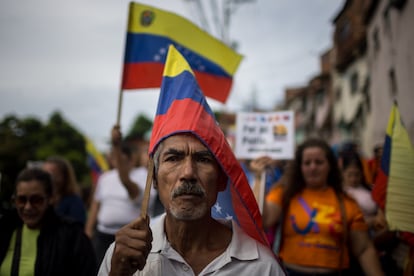
As U.S. President Donald Trump was announcing a military attack on a boat he claimed had left the Venezuelan coast loaded with drugs, Nicolás Maduro, acting unaware of the situation, appeared on television on Tuesday. The Venezuelan president looked relaxed and in a good mood, recalling his beginnings as a political activist in El Valle, an impoverished neighborhood west of Caracas, and trying to convey that he maintains political control over his government.
The state of alert remains at its highest level within the power structures of the Bolivarian Revolution in this latest clash with the White House. On the streets of Venezuela, however, daily life largely unfolds outside these tensions. Few citizens, in fact, foresee the imminence of an armed conflict or a regime change in Venezuela.
Maduro had earlier asserted that if attacked, the Chavistas will declare an “armed struggle,” an extreme situation that has been present in all of the ruling party’s conflict scenarios in recent years, and which underpins the civic-military nature of this movement.
The government is now working hard to document in great detail, through constant broadcasts on state television, the anti-drug operations carried out by the Army and the National Guard in the states of Zulia, Táchira, and Amazonas, bordering Colombia. Police and military checkpoints have been deployed on the streets, conducting patrols and intelligence work. Uniformed personnel have been sent to overcrowded, suburban neighborhoods of the city, searching for potential recruits.
The civilian recruitment drives organized by the Chavista authorities in Caracas’s Plaza Bolívar have a clear political content, with a wealth of nationalist slogans. The images of Simón Bolívar and Francisco de Miranda, heroes of the independence movement; of José Gregorio Hernández, a scientist about to be sainted by the Vatican; of Alí Primera, a leftist protest singer; and of María Lionza, a goddess of an Afro-indigenous cult popular among low-income Venezuelans, have been recreated by the government using artificial intelligence on television and social media, calling on the population to enlist in the fight against the imperial enemy.
“Solve your terrible problems and stay away from Venezuelan shores,” Vice President Delcy Rodríguez recently stated, reiterating that Washington’s accusations of narcoterrorism against the Maduro government “are one of the greatest slanders in history.”
The government’s call to enlist hasn’t elicited a massive response, but it has attracted several hundred people of all ages.
“I don’t know if people are fully aware of the consequences of a U.S. military invasion, the kind of disaster that would be. Well, everything would come to a standstill, some of us wouldn’t be here anymore,” says Alfonso Ramos, a lawyer. “In the end, I’m sure nothing will happen. We’ve been through this before. It will end as it always does. The pressure will grow, and they won’t let it get to them.”
Many Venezuelans in the diaspora maintain a growing faith that the growing tension will crack the ground under Chavismo and ultimately bring about a transition to democracy. Within the country, this expectation is much more nuanced. “I’m not interested in the issue, honestly. If they want to invade, let them invade, or not, as long as those who have to pay do so,” says Jesús, a motorcycle taxi driver stationed on Solano Avenue, in the residential area of Sabana Grande. “I’ve already put it out of my mind. All I know is that if I don’t work, I won’t eat. We’ve been hearing the same story for a while now, that change is coming, that the gringos are coming.”
These days, Henrique Capriles, one of the country’s opposition leaders, has received a fierce barrage of criticism on social media after distancing himself from any military action designed to pressure Venezuela and even questioning the existence of the Cartel of the Suns in an interview. The fiercest barbs have come from his former colleagues in Primero Justicia.
“Well, the Maduro government brought this on itself. It didn’t show the election tallies, it didn’t prove its victory, and many doubts remain,” says Juan Pablo Jiménez, an electronics technician, who is very skeptical that tension could escalate to the point of triggering political change in the country.
“If they dare set foot in Venezuela, if they attack us, we are ready to fight,” said Defense Minister and Commander-in-Chief of the Bolivarian Armed Forces, Vladimir Padrino López, one of Maduro’s staunchest allies in his power structure. Padrino maintains that the United States is seeking a continental conflict with its accusations.
The desire for political change is currently a widespread sentiment in Venezuela. But regarding a military invasion, consensus is less clear. The Maduro government’s narrative about defending “Bolívar’s homeland” resonates with a segment of the population, which, if anything, shares the antipathy toward the idea of foreign aggression.
“The Americans are going to do something with all those weapons. I don’t think they’re just going to come for a walk,” says Giovani González, who makes his living as an electrician. “I do think people have some concerns, some curiosity to know. The thing is, you can’t say anything out loud here these days because you could get arrested. There’s a lot of fear.”
Sign up for our weekly newsletter to get more English-language news coverage from EL PAÍS USA Edition









































