
Fleeing in Gaza for the 11th time: ‘Come back quickly. They’ve warned the whole area. They’re going to bomb it’
A Doctors Without Borders physiotherapist recounts how an Israeli attack destroyed her home in Gaza City, forcing her to leave for good
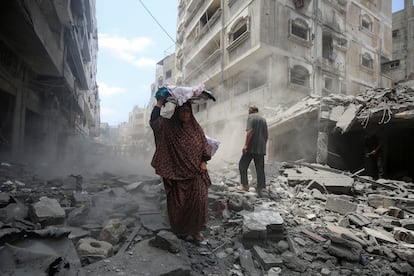
The intensification of Israeli military operations in Gaza City will have catastrophic humanitarian consequences. With 86% of Gaza already under evacuation orders or in militarized zones, the remaining areas are severely overcrowded and uninhabitable, with almost no access to food, water, or medical care. The capacity of medical facilities in the south is overwhelmed. Doctors Without Borders (MSF) staff have been forced to flee repeatedly, some more than 11 times since the start of this war. MSF once again calls for an immediate and sustained ceasefire to save the lives of civilians and allow the entry of much-needed aid into Gaza.
Sabreen Almaseri is a physiotherapist who has been working for MSF for five years. On August 19, Israeli forces destroyed her home in Gaza City, forcing her and her family to move for the 11th time. This is her first-person account.
“My home”
Two weeks ago, when the situation near my home in the Saftawi neighborhood seemed calmer, we decided to return home. The building had fresh damage to it, but I felt joy again simply being inside my house, the house that is part of my soul, the place I love so much. My home represented a 13-year journey of struggle and perseverance.
Until August 19.
I was walking home from work when I saw people running, women screaming and crying. My phone rang: it was my husband. He said, “Come back quickly. They’ve warned the whole area. They’re going to bomb it.” He said we only had a few minutes. I joined him and our daughters on a nearby street; they were crying, scared. I hugged them tightly, and we moved to another street. Moments later, we heard the impact. The explosion not only shook the ground, but it shattered our hearts. Our home, with all our memories, was gone.
I’ve been working for MSF since 2018. From the beginning, my goal has always been to do everything possible to help patients and treat the wounded so they can recover from physical trauma.
The explosion not only shook the ground, but it shattered our hearts. Our home, with all our memories, was goneSabreen Almaseri, Doctors Without Borders physiotherapist
I was never just a physical therapist. I supported my patients emotionally, listening to them and comforting them as they shared their pain. Behind each patient was a heartbreaking story, another life marked by suffering. The people here are exhausted, broken, yet they still try to move forward and find reasons to smile.
When our lives changed forever
I’ll never forget the first time we were forced to leave our home in northern Gaza, just a week after the war began. A ring of fire surrounded us; my husband, my daughters, and I clung to each other, thinking we were taking our last breath. It was terrifying; shrapnel was flying over our heads. Our building was damaged, the doors and windows shattered by the impacts. There was blood on the ground, dust, stones, and the air was filled with ash. My middle daughter was vomiting in fear; my youngest begged us to hold her tighter. We formed a circle, hugging each other, before finding ourselves on the street, crying, displaced again.
After being displaced from Saftawi, we moved to another location in Gaza City. Shortly after, we narrowly survived another bombardment that claimed more than 500 lives. We were later forced to flee south. I was unable to return to northern Gaza until the ceasefire in mid-January 2025. For a year and a half, we lived between displacement and fear, waiting and longing for my parents, my siblings, and the home I had left behind, without knowing what had become of it.
A moment of peace
When I finally saw my house again, during the ceasefire, I could breathe again. It was still standing, partially damaged, but habitable. We repaired what we could. We patched up the holes in the walls, covered the broken windows with plastic sheeting, and built makeshift doors. We cleared the rubble and went back inside. But our joy was short-lived, as the truce ended and the bombing returned with greater intensity.
This is the 11th time we’ve been forced to flee since the beginning of this war. But this time is the hardest, because I know I’ll never return homeSabreen Almaseri, Doctors Without Borders physiotherapist
We fled again, this time within Gaza City, where we lived in a tent, enduring the stifling summer heat, the hardships of carrying water, and the harshness of daily life as a displaced person. Two weeks ago, when we finally returned to our home, we had hoped that perhaps we would finally be safe. But that hope has vanished again, crushed along with our home and our belongings.
Once again, we’re displaced. This is the 11th time we’ve been forced to flee since the beginning of this war. But this time is the hardest, because I know I’ll never return home.
Sign up for our weekly newsletter to get more English-language news coverage from EL PAÍS USA Edition









































