
Eduardo Bolsonaro, the man urging Trump to punish Brazil
The congressman and son of the former Brazilian president moved to the United States to maneuver against Lula, pave the way for tariffs against his home country, and encourage sanctions against the judge investigating his father
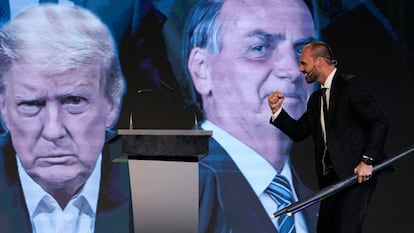
These days, dozens of countries are negotiating against the clock to avoid tariffs being imposed by U.S. President Donald Trump. Only one of them has a congressman in Washington actually pushing for a higher tariff hike: Brazil.
One of former President Jair Bolsonaro’s sons, Congressman Eduardo Bolsonaro has been in the United States since March 2025, attempting to persuade the Republican administration to maneuver in favor of his father. The senior Bolsonaro is facing legal action for attempting a coup d’état in January of 2023. Eduardo, a 41-year-old lawyer, is the main architect (so he says) of Trump’s decision to increase tariffs on Brazilian products to 50% starting August 1, which is more than any other country. He’s also behind the sanctions against Brazilian judges, which were announced in recent days by the White House in response to the so-called “witch hunt” against Bolsonaro.
Each new blow that Trump inflicts on Brazil’s economy and institutions is celebrated with jubilation by Eduardo. Meanwhile, his right-wing allies wonder how the riskiest maneuver of his career will end.
In mid-March, Eduardo posted a video on social media announcing that he was temporarily resigning from his seat in the National Congress to move to the United States. The motive was clear from the start: to take down the Supreme Court judge leading the case against his father.
“Here, I will be able to seek just punishments for [Judge] Alexandre de Moraes and his Gestapo [...] my goal in life will be to make you pay for all the cruelty you have inflicted on innocent people,” he announced.
After months without concrete results, a mixture of nervousness and discouragement spread among Bolsonaro supporters. Meanwhile, one of their greatest idols was posting photos of himself smiling alongside his family at Disney World.
The result was slow in coming, but when it did, it fell like a bombshell. Earlier this month, Trump announced the tariff increase, while embracing the entire narrative of Bolsonaro’s persecution. After the former president was forced to wear an ankle monitor, Washington retaliated by revoking the U.S. visas of Judge Alexandre de Moraes and other Brazilian Supreme Court justices, who are considered to be aligned with this alleged judicial persecution.
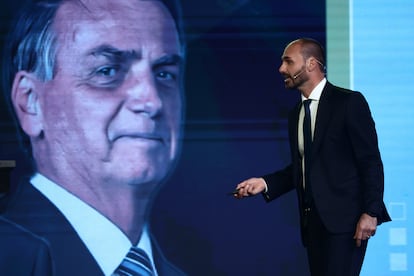
Eduardo Bolsonaro celebrated and recorded a video in which he threatened a Federal Police commissioner. In recent days, he’s even fantasized about the U.S. deploying aircraft carriers to Brazil and expelling the South American country from the SWIFT international payment system. However, his allies – especially moderates, who are trying to calm the anxiety of Brazilian business leaders who will be affected by the tariffs – fear that he’s choosing his words poorly and that his reckless gamble could backfire.
Eduardo and his father are both being investigated for possible crimes of coercion and obstruction of justice. The son is accused of moving to the U.S. to conspire against Brazil, while the father is accused of financing this strategy. As Bolsonaro himself has openly stated, he sent his son two million reais (almost $360,000) so that Eduardo and his family “wouldn’t suffer hardship” in their new life in the northern hemisphere.
Eduardo isn’t alone in this new life. He’s accompanied by Paulo Figueiredo, the lesser-known face of the lobbying duo. The latter says he met Trump at his Florida golf course in 2012: he claims that the tycoon took an interest in him when he told him that he was the grandson of the last president of the Brazilian military dictatorship (1964-1985), General João Batista Figueiredo. Shortly before Trump became president for the first time, he joined him in a partnership to build the Trump Hotel Rio de Janeiro. The project failed, and Interpol even issued a red notice for Figueiredo, as he was accused of having bribed bank executives in exchange for a loan to build the hotel. Even so, the relationship with Trump remained strong. Through the U.S. president’s intermediation, Paulo and Eduardo have managed to meet with several cabinet secretaries at the White House in recent months.
The self-exiled congressman’s relationship with the American far-right dates back years, when Trump and Bolsonaro were in power during their first terms. One of the then-Brazilian president’s first controversies was the attempt to appoint his son as his ambassador to Washington. Beyond some student exchanges and a job “frying hamburgers in the cold of Maine” – as Eduardo himself recounted – he had no diplomatic experience. The blatant case of nepotism never materialized (to the relief of the Brazilian diplomatic sector), but the relationship with the Trump clan remained strong. Eduardo, in fact, is Bolsonaro’s main bridge to the international far-right.
He’s also not lacking in popularity at home. In 2018, he became the most voted-for legislator in Brazilian history, receiving nearly 1.8 million votes. He’s the most charismatic and outspoken of his brothers, who are all involved in politics (Senator Flávio and Councilmen Carlos and Renan). Until recently, he was considered one of the possible replacements for Jair Bolsonaro in next year’s presidential elections. But now, all his political capital is at risk: he’s been stained by the perception that he’s punishing Brazil from abroad. And, in recent days, his leave of absence from the National Congress expired. If he doesn’t want to lose his position, he must return to Brazil within the next three months at the latest… but as he has already said, for the moment, he doesn’t intend to do so (for fear of arrest).
If Eduardo Bolsonaro ultimately resigns as a congressman, his future wouldn’t be promising, either. Given that he’s under investigation, Brazilian law stipulates that he cannot run for elected office until 2035.
Sign up for our weekly newsletter to get more English-language news coverage from EL PAÍS USA Edition









































