
Riyad Mansour, Palestinian UN ambassador: ‘We are on the same path as South Africa — in the early stages, not too many people were coming to help them’
The diplomat visited Colombia for the first summit of the Hague Group, geared toward taking action to pressure Israel into ending the war in Gaza
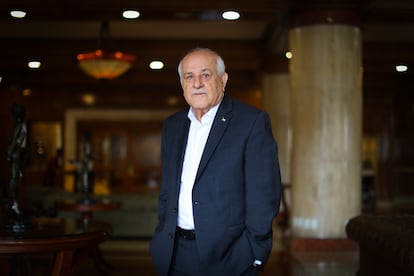

The Palestinian ambassador to the United Nations, Riyad Mansour (Ramallah, 78 years old) has unwillingly become one of the faces of the frontlines of the war. During his speech before the Security Council at the end of May, the diplomat broke down in tears while speaking about the deaths of children in Gaza. The image was shared around the world and has come to represent the emotional pain incurred on hundreds of thousands by Israel’s military operation in the Gaza Strip.
“You don’t plan for these moments. What was flashing in my head were my grandchildren. I could not bear the pain. As we get older, we become more emotional,” Mansour says, his voice having since regained its flow and solidity. The ambassador was in Bogotá for the first summit of the Hague Group, an eight-country bloc led by Colombia and South Africa, which is looking to pressure Israel into ending the war. The meeting was brought to a close on Wednesday by Colombian President Gustavo Petro, with the announcement of six economic and diplomatic measures that will be taken toward that goal.
Question. Were your expectations for the summit met?
Answer. Yes. It is extremely important that this group [the Hague Group eight and some 20 additional delegations] met in Colombia, one of the leading countries of this initiative. Since the International Court of Justice announced its historic opinion that this occupation is illegal, a movement has started to emerge to have practical measures in order to force Israel to stop this genocidal war in Gaza and pressure it to comply with international law.
Q. That movement has been particularly driven by countries from the so-called Global South. How can those from the north be convinced to join?
A. At the beginning, the number of countries who are willing to risk negative reaction will be small. But everyone must take measures that hurt Israel, though they expose them to pressure from the countries that are protecting it. Right now, those doing this are the small, brave ones. The Global South is huge, though the North is very sophisticated in dividing us. We are on the same path as South Africa -in the early stages, not too many people were coming to help them. With time, they were able to assemble bigger and bigger groups until the moment when it was not possible for anyone not to jump on the bandwagon of demolishing apartheid.
Q. That process took years. How can Palestinians be asked to be patient in such a violent context?
A. There is no silver bullet that one can have in their pocket, put it in the gun, fire it, and paradise is waiting for you. I wish there was something like that. We are resisting occupation by all possible means available to us. We know that diplomacy is important. Some people criticize us for engaging in diplomacy, but it changed our status at the UN to be an observer state and be able to join the International Criminal Court, which led to the issuing of warrants of arrest for [Israeli Prime Minister Benjamin] Netanyahu.
The last 21 months have been the most painful and difficult of my life. I hope that the Palestinian people do not see this nightmare ever again
Q. The United States is Israel’s biggest ally and has blocked UN resolutions calling for an end to the war. How can that obstacle be approached?
A. On some occasions, we have gone to the Security Council and received 14 votes, all except that of the United States, which has a veto. But in spite of that fact, we don’t give up. We keep going to the Security Council. During the last 21 months, we have succeeded in adopting four resolutions. One of them, 2735, is extremely important and calls for a ceasefire through three stages. Israel is not honoring it. So, although we know the power of the United States and the protectionism that it provides for Israel, the world sometimes succeeds in adopting resolutions.
Q. Donald Trump has been ambiguous on the issue. His plans have gone from the United States taking control of Gaza to building a tourist resort on the Strip. What role is he playing in this?
A. Countries don’t come to you as paradise to select or hell on Earth to reject. Your country is your country. If it is suffering, build it. If it is in pain, minimize the pain. If you can make it a glorious country, make it one. But this is up to us, the people of that country. This is our country. You see, Trump is a politician. When he saw the Arab summit that was convened in Cairo, where we worked with the Egyptians on developing a plan for reconstruction of Gaza, he retreated.
Q. You rose to fame when you broke down in tears speaking to the Security Council about the children of Gaza. It appealed to the feelings of many.
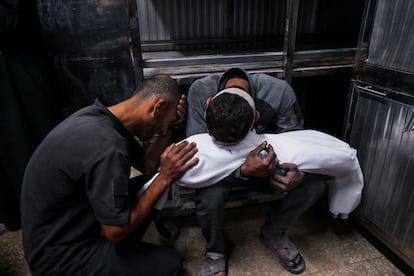
A. You don’t plan for these moments. When I was talking, what was flashing in my head were my grandchildren. I could not bear the pain that children are being killed in front of our eyes. The other day, six of them were trying to get some water to drink and a bomb came and demolished them completely. As we get older, we become more emotional. Many of my colleagues refer to that moment, which means it touched them. I’m glad that I was successful in conveying the pain of our people in that dramatic moment.
The best method of evaluation is elections
Q. How has it been for you, watching from a distance what is happening?
A. The last 21 months [since the war began] have been the most painful and difficult in my life. I hope that once we stop this genocidal war that the Palestinian people do not see this nightmare ever again, especially our children. These 21 months have felt to me longer than 21 years. As the secretary general of the UN said, Gaza is hell on Earth. Gaza is the graveyard of children. Gaza is the most dangerous place on Earth. We want an environment where children can play on the beaches of Gaza, fly kites, go to school, and dream the big dreams.
Q. After all that has happened, have you turned away from the two-state solution?
A. There is no Plan B. The two-state solution is the only realistic solution possible. I am not going to commit the mistake of saying let’s go for the one-state [solution], meaning I approve the annexation of the occupied territory to Israel. They need to end this illegal occupation, this land has to be free. Then after that, we will enter into a new stage. Who knows what we will do once we have the free state of Palestine, next to all these states in the Middle East. Could we build something like the European Union? I don’t know. I will not be around.
Q. The Palestinian Authority, which you represent, no longer enjoys the popularity it did when it was founded. What do you think should change moving forward, and will any significant change come after the war ends?
A. After the war ends, and I hope it ends very soon, the Palestinian people have the right to assess and evaluate the whole nightmare that we went through for the last 21 months. I think that the best method of evaluation is elections. When we go through elections, those who win, it means that in the eyes of the people, they did something right. Those who fail, it means that the people did not agree with their conduct and policies and behavior.
Q. You have been Palestine’s ambassador to the UN for two decades. What has been your biggest lesson during those 20 years?
A. That the most important thing is the Palestinian people. As our late leader and chairman [Yasser] Arafat said, as long as we are rooted in our homeland and protecting every inch of that homeland, Palestine will be free. We are not there yet, but we are marching in that direction, although we are paying a tremendous price. But we are a resilient people. The Palestinians are the ones who give us the ammunition to be diplomats to represent them in the best possible way. They are our compass.
Sign up for our weekly newsletter to get more English-language news coverage from EL PAÍS USA Edition









































