In search of Josy, the dog of a Spanish soldier killed in Ukraine
Miguel Carmona’s wife wants to recover the family pet, which traveled to the war zone in Donetsk with the army veteran
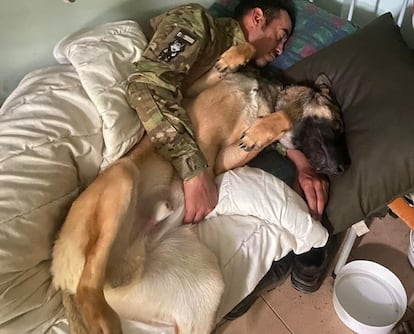

Miguel Carmona arrived in Ukraine last March and was killed in action on June 10 on the Donetsk front in the east of the country. Carmona was 42 years old and had briefly served as a soldier in the Spanish army during his youth. He volunteered for the Armed Forces of Ukraine to fight the Russian invaders. His is not an unusual case; there are hundreds of foreigners who have followed the same path, and who have also lost their lives. What makes Carmona’s story different is that he went to war accompanied by his dog, a Belgian Shepherd named Josy.
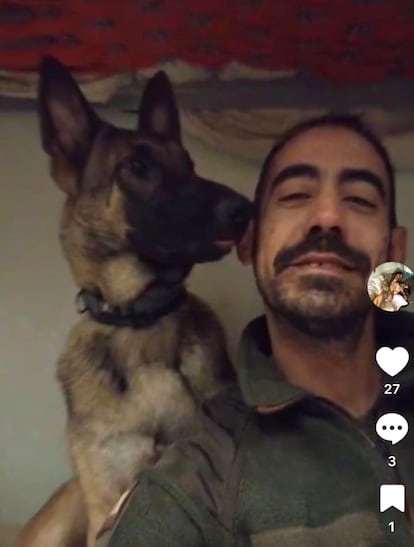
The photos Carmona shared showed Josy among soldiers at the barracks, or playing on the bunks used by troops. His 10-year-old son and his dog were what he loved most, according to his comrades in arms: the boy’s name was inscribed on his helmet. His estranged wife, Eva Álvarez, is demanding the repatriation of Carmona’s body and the return of Josy to her. Recovering the dog has become an obsession for her and also for her son, who wants it back because it reminds him of his father.
The most complicated factor is recovering Carmona’s remains. He was killed by an anti-tank grenade thrown at him by a Russian soldier from about 10 meters away. The account of that day, June 8, is provided by one of the soldiers who fought with him until the very end.
Neither this soldier nor any other interviewee for this article has chosen to reveal their identity. The battle in which Carmona died lasted only a few minutes, but was so intense that it left the handful of men who survived traumatized. The Russian infantry reached the position they were defending, and amid bursts of rifle fire, several drones from each side flew overhead, dropping bombs. Finally, before he himself was killed, a Russian soldier threw an anti-tank grenade at the defenders. Carmona died in agony two days later.
The survivors were evacuated over two weeks later, on June 26. Four bodies remained in that trench: two Russians, a Ukrainian, and Carmona. “It’s impossible to evacuate a corpse or a wounded man who can’t move; every step you take to retreat to the second line is like Russian roulette. For every 100 meters we advanced, 15 or 20 grenades from drones fell on us,” says one of the survivors.
On June 11, the family received the official report from the 4th Brigade of the Ukrainian National Guard announcing that Carmona was missing in action (his death cannot be officially confirmed until the remains are recovered). Álvarez, who began the bureaucratic process to return her husband to the northern spanish region of Asturias, along with Josy, explains that she is receiving assistance from the Spanish Embassy in Ukraine.
Josy has been in the house that serves as the rest center for Carmona’s platoon in a municipality of Donetsk for over a month. This house was the last place the dog and his owner lived together. In addition to the Spanish Embassy, Álvarez contacted Leslie Wilson, a 75-year-old American volunteer who provides social assistance to Carmona’s regiment. Wilson’s social media profile shows a person with extensive experience in crisis management following natural disasters.
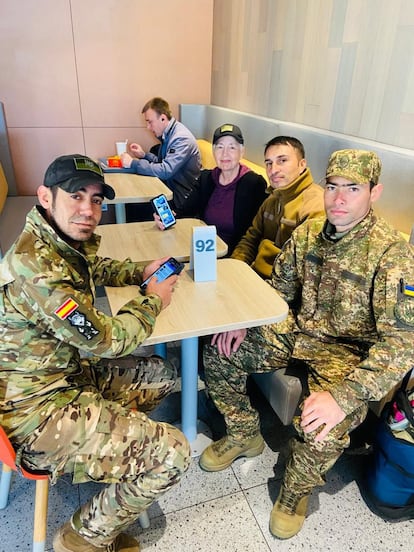
Wilson initially established herself as Carmona’s representative in Ukraine. The two formed a strong friendship, according to members of the Spanish-speaking unit. Wilson, for her part, is highly regarded by the foreign troops for the psychological support she offers and assistance with tasks such as bureaucracy.
“Miguel was like a son to me,” Wilson wrote to Álvarez on June 24, “very willing to help with the long-term [volunteer] project I’ve been working on in Ukraine for three years. I thought I’d finally found a manager who could take over when I handed over.” “Miguel is the greatest loss of my life,” Wilson added in an interview with this newspaper.
The American volunteer surprised Álvarez in her messages by assuring her that Carmona would be buried “with full honors in Ukraine,” specifically in Bucha, north of Kyiv, “in the cemetery where President Volodymyr Zelenskiy takes foreign dignitaries.” Wilson confirms that Carmona’s wish was to remain in Ukraine: “I pray they don’t take him. Miguel had no interest in his family or in returning to Spain.”
“Miguel always wanted to help and was obsessed with wars where there are good guys and bad guys,” says Álvarez. She and Carmona lived separately. They remained friends, but in recent months, according to his wife, the Asturian suffered a downturn that led him to leave for Ukraine. According to Álvarez, this was due to a stormy relationship with his last partner.
Military dog
Wilson’s position has cast doubt on the dog’s recovery because, according to the military personnel consulted, the American volunteer wants Josy to be transferred to the National Guard’s canine units. “Leslie wants to be faithful to Miguel’s wishes, because he wanted Josy to be an army dog. We trained him in our free time to learn how to attack and drag a body,” explains one of the Spaniard’s comrades. “He told us not to play with him, that he had to be an army dog, but he’s too nice and affectionate, I don’t think he’d be good for that.” Josy is only one year old.
“Josy’s situation is complicated,” Wilson wrote to Álvarez. “He is now a properly trained military dog, not suited for a family environment […] He has received excellent care and training, which is what he was trained for; this is not what you want to expose your son or other children to,” she added.
The American volunteer emphasizes that she will do everything possible to ensure the dog doesn’t return to Spain. “I’m worried about a military dog returning to civilian life; it’s not the same animal they knew.” Wilson assures that other soldiers in Carmona’s unit feel the same way.
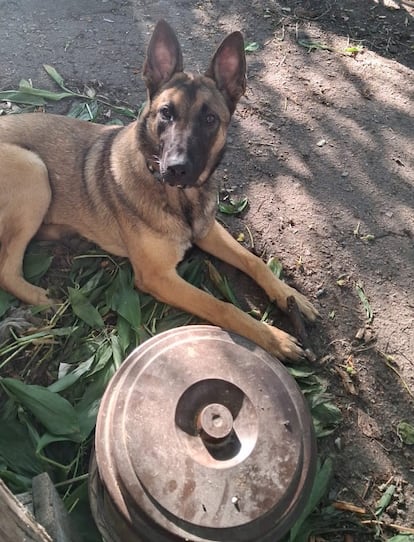
“Dear Josy, I promise I won’t stop until you’re here, with us, making my son happy,” Álvarez posted on social media. Carmona’s wife has clung to the hope that the Spanish consulate will recover their pet. The family, who is willing to cover the repatriation costs, is also planning to travel to Ukraine or Poland to pick him up.
Sources from Carmona’s regiment confirm that the Spanish consular service had planned to take the dog to Kyiv on July 11. A spokesperson for the 4th Brigade admitted on July 9 that he was unaware of the matter and stated that responsibility for the dog and its possible return lies with the platoon commander where it is being kept. This officer confirmed on July 10 that Josy was still with his unit, but neither he nor Spanish diplomatic sources would confirm whether Embassy staff ultimately collected the dog a day later.
Sign up for our weekly newsletter to get more English-language news coverage from EL PAÍS USA Edition