
Lucía Topolansky, widow of Uruguay’s José Mujica: ‘Pepe was the nice one in the family. I was the sergeant’
The widow of José Mujica remembers him during a conversation with EL PAÍS in the country house where they shared a life together. Topolansky, who previously served as a senator and as the vice president of Uruguay, and her husband dedicated themselves to politics for 40 years
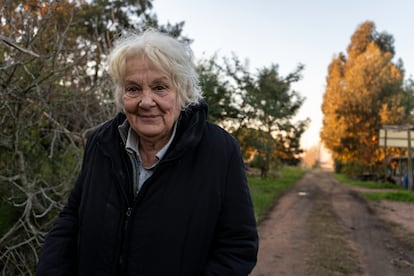
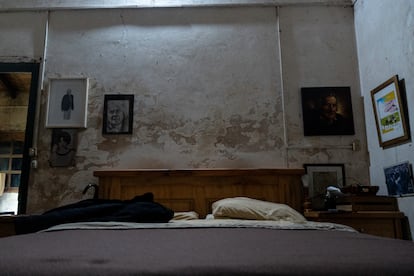
Lucía Topolansky, 80, has a small, nameless cat. “It showed up two days ago. It came in through the door… and since it’s so cold, I let it. But if it wants to stay, it’ll have to prove it knows how to catch mice,” she warns. Judging by her tone, she means it. The cat, however, isn’t so sure. For the 90-minute-long interview, it will settle – without remorse – in the room that José “Pepe” Mujica occupied until his death, on May 13, 2025.
Topolansky will try to keep the wood stove lit. But the chatter distracts her, so the flames tend to die out. She has difficulty walking, although she’s still very active. She says that she’s returned to political activism after a year of retirement, which was forced upon her by her husband’s illness. She smiles when she tells us that Mujica — who served as Uruguay’s president from 2010 until 2015 — left her a long list of pending tasks, such as “enlarging the chicken coop.”
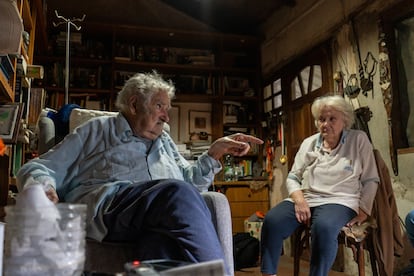
She becomes emotional when she remembers losing a comrade. They “discussed politics” for hours on end. They held some of those two-person get-togethers in the same place where she receives EL PAÍS, surrounded by books, photos and mementos. On warm days, she and her husband would chat over mate under the sequoia tree in the garden. That’s where she scattered his ashes just over a month ago.
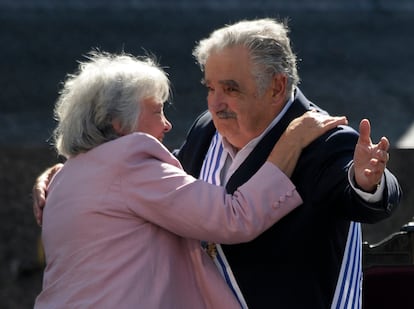
Topolansky was a congresswoman, a senator and vice president of Uruguay. In 2010, as the legislator who had received the most votes, she placed the presidential sash on Mujica before a packed Parliament. “And I said goodbye to him there, in that same place,” she recalls now, holding back tears.
Question. What have these last few weeks been like?
Answer. I’ve been an activist all my life. And I’m about to turn 81. I said to myself: “I can’t sit back and do nothing, because I’ll collapse.” I was involved in an activist role when Pepe’s illness began. And now, I’ve returned to that role, [holding talks] with my colleagues. In Pepe we had a friend who was an anthropologist, a brilliant man who used to say: “When I was 20, I made plans with a 40-year horizon. Now that I’m 90, I make plans with a 24-hour horizon.”
Q. Are there particularly difficult hours?
A. Every hour is difficult. I try not to have any gaps [in the day], because obviously, it’s a very big change. I [like to] organize my day. I’m an early riser: I tend to my chickens and I have a lot of other tasks. I work a lot on the computer, because I was in Parliament for 22 years. Since I have a lot of new colleagues, I support them from here. They send me questions.
Q. And do you feel that these younger colleagues listen to you?
A. I’m more from the 20th century than the 21st, so I listen to them, too. They have the keys to this century. I give my opinion, but I’m behind the scenes. When I talk to very young people, the first thing I say is: “Look, I’m from the Jurassic period.”
A. Even so, Mujica was a kind of oracle in his later years.
Q. He always maintained that there was a “crisis of grandparents.” That’s why young people listened to him: he would start by talking to them about life, how to live it, about love. And then, he would get into more mundane subject matter.
Q. And what were your conversations like?
A. I’ve had miles of conversation over more than 40 years. We were from an era when young people would go to a bar and [try to] fix the world. And we never lost that habit. Pepe always said: “In the beginning was the Word.” For him, words were extremely important. He had the gift of communication, something not everyone has.
Q. Did he listen to your opinions?
A. He paid attention to me and, sometimes, we exchanged ideas. I would explain why I saw something this way or that way, or [I would mention] what seemed to be missing. We always talked about politics. Now, I’m left without an interlocutor…
I was second-in-line to the throne. When he traveled, the vice president replaced him, but when both of them traveled, I replaced him. One day, I remember him saying to me, “Settle all my conflicts for me.” I always told him: “You have the best soldier in Parliament; you have a head start.” Although, since things aren’t black and white, I often could have a different perspective [from my husband].
Q. Do you remember the day you met Mujica?
A. [We belonged to] a clandestine organization [in the 1970s]. I worked in a document-making service. I met him there one day, when he came to pick up a document. We were in different places, but at a certain point, we had to be on the same side. And we began our relationship.
Q. What about him caught your attention?
A. I can’t answer that question, because some things don’t have a reason. There are just feelings. We were in the same [situation], at a time when you could be alive today and be dead tomorrow. Life is intense. We lived to the maximum.
Q. You were separated from each other when you were both imprisoned. What was the first thing you did when you were released?
A. I went to meet Pepe. The police dropped me off at my mother’s house. I greeted my whole family. I stayed there for a while. Then, a colleague took me to Pepe’s house. We met there. We didn’t consider any backtracking: we understood that we had to continue being together and [being] militant. We didn’t intellectualize anything; [our reunion] was almost without words.
Q. It’s often said that you were ideologically more hardline than Mujica. Is that true?
A. Oh, that’s because he was the nice guy in the family, [while] I was the sergeant.
Q. Can you explain that further?
A. He was always friendlier than me. When he was in prison, he received a visit from the Red Cross, which had managed to enter Uruguay after [exerting a lot of] pressure. When [the humanitarian workers] arrived at the prison where I was, I asked them if they had seen Pepe. “He’s like a bartender,” the Red Cross man told me. That was his personality. I always walked among a crowd of people, because in my house, there were seven of us siblings, my parents, my grandmother, uncles, cousins… there were always 12 or 13 people at any one time. In Pepe’s family, there were only three people. And so, he spent a lot of time out and about in the neighborhood. You’re shaped by your activities. I used to work in a bank.
Q. What was that experience like?
A. I didn’t work at a legitimate bank; [rather, I worked] in the underground, in the financial sector. When I went into hiding, it was because I was speaking out against it. They didn’t forgive me: you kill your mother and they punish you, but if you denounce a bank, they crucify you.
Q. Did your parents join you in your activism?
A. My father had a hard time understanding [what I was doing], but he didn’t impose [his views on me]. And mothers tend to follow their children because of their filial ties. Maybe they imagined a different destiny for me, but I always held my own.
Q. Do you remember the moment when you placed the presidential sash on your husband?
A. It was impressive. When faced with such extreme things, you have to shield yourself a bit. I swore Pepe [into office] in Parliament and I said goodbye to him there, in that same place…
Q. Were you shocked by the number of people at the funeral?
A. We always knew there would be a lot of people. We talked to him about it during his last days, [explaining] that the wake would be large. But it overwhelmed me, nonetheless. The entire political spectrum came, from all social classes: the most humble people, as well as the businessmen. There were adults, children and old people. One [mourner] said, “Wow, look at this…”
Q. You said that Mujica left behind a list of tasks for the farm. Have you decided about the farm’s future?
A. Since we don’t have children, we made a will. The house will [be left to our] political organization (the Movement of Popular Participation, MPP). But a piece of land is going to be maintained as a productive farm, where we’ve already started fulfilling the requests that Pepe left. We needed to enlarge the chicken coop, for example. That was the first thing we did. We’ve already fulfilled what he wanted! [Laughs]. From the time Pepe got sick, we had a little over a year to plan.
Q. Was life very hectic during his illness?
A. It wasn’t hectic, but when [the exit door is] closer, things are different.
Q. Are you putting your papers in order?
A. I’m passing on all the handwritten material to my colleagues. Historians are going to organize it all, to put Pepe’s thoughts together. Then, there are others working with everything that’s been recorded, which is quite impressive. With all that material, we’re going to hold a preview for the public on Heritage Day.
Q. Here, at the farm?
Q. No, at the party headquarters. I don’t want a museum or a cemetery here, because I have to live here. We’re going to bring [Pepe’s Volkswagen Beetle] and his bicycle. Later, we’ll create a permanent space. We have a lot of things: the funeral home gave us 57 guest books.
Q. What’s the story behind the sequoia where you scattered Mujica’s ashes?
A. Someone who had worked with Pepe during his presidency brought him the tree as a gift. And we decided to plant it where there was space, next to the house. When the weather was nice, we would sit under it in the afternoon, drinking mate. We always had the idea that when we left [this life] we would be cremated, so we could return to the Earth. And it would be under that tree. And we kept this promise, because he loved the land.
Q. Did you do it alone?
A. Yes, it was personal. There are things that belong to you, to your family, to your relationship.
Q. What did he leave the world?
A. While rummaging through his papers, I found that he said the best advice for young people was to “keep fighting” [and] to “have a cause.” It was like an obsession for him. And, later on in life, he was convinced about the idea of Latin American integration. Fighting for that was his last act of militancy.
Sign up for our weekly newsletter to get more English-language news coverage from EL PAÍS USA Edition









































