
Tired of war, Ukrainians distrust both Putin and Trump
Polls and interviews show that the majority of the country’s population is in favor of continuing to fight because they believe that Russia won’t honor a ceasefire
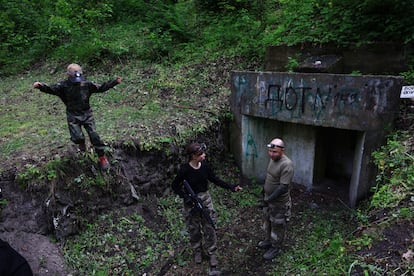

In an abandoned World War II bunker in the Kyiv province, the Vasilev family spent a Sunday this May playing with rifles that fire small rubber balls. They chased each other with these toy weapons through the corridors of this enormous structure. “It’s a bonding activity, to build a team,” explained their father, Dmitro. His daughter, Sofia, 17, is an encyclopedia of her country’s history. She provided the journalist with numerous details, for example, that the bunker was built in 1935 and that the Soviets reinforced the armored doors with oak wood.
Dmitro has three children and earns a meager income as a carpenter, his trade: “People don’t have money to do construction work.” Having three children exempts him from joining the army. Very few men are currently willing to volunteer; mobilization is being implemented under severe measures because, as the Ukrainian General Staff has reiterated, the main shortage its armed forces face right now is not weapons, but troops.
Men of military service age spend their days confined to their homes to avoid conscription patrols, or pay bribes of no less than €5,000 ($5,685) to avoid going to war. This situation is widespread, as confirmed by numerous testimonies collected over the last year. One of the latest examples obtained by EL PAÍS is that of hairdresser Viktor, who lives in Kyiv: this year he turned 25, the mandatory age for conscription, and left the barbershop where he worked. To get there, he had to use several public transport routes, where conscription patrols abound. He opted to look for another job closer to home. He justified his reluctance to enlist because he had become a father the previous year.
War weariness, the lack of prospects for victory on the battlefield, and not knowing how many years they’ll have to serve in the army are what drives so many men to avoid enlisting, with many even departing the country illegally — men aged between 18 and 60 are prohibited from leaving Ukraine during martial law. “I no longer have friends in Kyiv; half have gone to Europe, and the other half are in the army. I only have my family left,” Dmitro explains. “The educated middle class is leaving Ukraine; those who can’t afford to leave and the patriots are staying here.”
“I only have one friend left in Ukraine; the rest have gone to Europe,” adds Sofía. Her best friend lives in Seville, where she studies art history. She is convinced that few of her acquaintances will ever return to their country. More than six million Ukrainians, mostly women and children, have fled Ukraine during the invasion, according to the United Nations.
“It’s very difficult to win the war, but it’s even more difficult for people to return to Ukraine,” Lialia, a Ukrainian migrant in France, told this newspaper on May 15. Lialia cried because her daughter, a resident of Leipzig, Germany, has already decided not to return, and Lialia believes she won’t either: “We’re from Kharkiv, just 40 kilometers (25 miles) from Russia. They’ll never leave us alone there; we can’t live like this.”
Dmitro would like to see the negotiations between Kyiv and Moscow reach a successful conclusion to seal a temporary ceasefire. That would provide some relief from the “extreme fatigue” they are experiencing. A May survey by the Rating polling center indicates that 74% of Ukrainian citizens support a temporary truce. But Dmitro adds that the war’s continuation is inevitable because, in his opinion (and that of all those interviewed for this report), Russian President Vladimir Putin will not stop until he destroys Ukraine. “This will only end with the end of Ukraine or the end of Russia. And we are confident of our victory; there is no other option.”
“A madman in the United States”
According to a March survey by the Kyiv International Institute of Sociology, 82% of Ukrainians favor continuing the war, even if Washington’s military aid ends. U.S. President Donald Trump is reluctant to maintain the level of arms assistance provided by his predecessor, Democrat Joe Biden. According to Ukrainian government data released in January, Kyiv has stocks of U.S. weapons that will last until the end of June. “Until now we had a crazy neighbor, and now the U.S. is in the hands of another madman,” Dmitro concludes.
Mikola Siruk is 70 years old, retired, and spent 20 years as an engineer at the historic military optics factory at the Kyiv Arsenal. He later became a media translator. He lives in the same apartment with his daughter and granddaughter. Part of his family has moved to Spain, and he doubts they will ever return. He admits that he was a convinced communist during the Soviet era: “At certain times, like in the 1980s, there was more freedom in the Soviet Union than in Putin’s Russia.”
Siruk believes that, despite what the polls say, the majority of the population is so exhausted that they would now accept ending the war by ceding control of the occupied territories to Moscow, though never recognizing Russian sovereignty. He doubts there will be a ceasefire because Putin doesn’t want one and “because Trump is not Ronald Reagan”: “With Putin, you have to be tough, like Reagan was with the USSR. But Trump thinks like Putin; both laugh at the rule of law, at international law; both want to take over countries that aren’t theirs.”
Ludmila Molochdna lives in Sumy, a town near the Russian border, which is regularly bombed. She is the mother and grandmother of a large family. To calm her anxiety, she works for hours every day in her garden. She remembers her husband, a former colonel in the Red Army, crying in 2024, for the first time in years, upon learning that one of his grandsons was being drafted. “Another generation of the family will have to fight, like a curse.” Another close friend of hers, who prefers not to reveal his name, wants to avoid enlistment: either by buying papers that show he is studying, thus exempting him from going to the front, or by paying a bribe at the recruitment office.
Despite this paradox, Molochdna says there is no alternative to continuing to fight: “We can’t do anything else because Putin will continue to attack.” The Russian leader now has even more reason to continue his invasion, she says, because Ukraine has lost the support of Washington: “Trump is afraid of Putin. Trump is not our ally.”
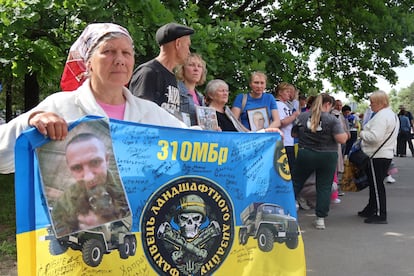
Last Friday, in a medical center near the Belarusian border, Valentina Ruchka awaited the return of the first batch of prisoners of war released following the Russian-Ukrainian agreement of May 16 in Istanbul. She carried photographs of her son with her so that those being returned could hopefully provide news of him. Maksim, 42, disappeared at the front in December 2024. She hasn’t heard from him since. Around her were dozens of other mothers, wives, and sisters holding photographs of soldiers, unsure of whether they are dead or alive.
“Of course we want peace now, we don’t want any more deaths,” Ruchka said, “but we don’t want to lose the territories to Russia; that would be our victory, to get them back. What would so many people have died for otherwise?”
Sign up for our weekly newsletter to get more English-language news coverage from EL PAÍS USA Edition









































