
David Lammy, UK Foreign Secretary: ‘The British have moved on from Brexit and they want a pragmatic government’
The champion of progressive realism says the first bilateral UK-EU summit in the post-Brexit era has begun to improve relations that had been ‘run into the ground’
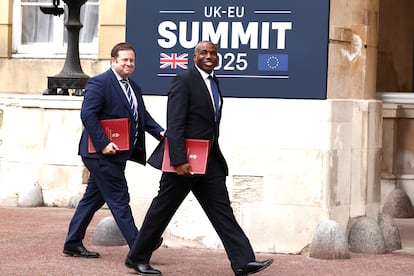

David Lammy, 52, arrived at the Foreign Office of the British Labour government almost a year ago, defending his idea of “progressive realism.” According to him, we must confront the world as it is, not as we would like it to be. But at the same time, it is important to pursue progressive goals, not just think about retaining power. That’s why he argues that the agreement from the first bilateral summit between the United Kingdom and the EU in the post-Brexit era, held this Monday, was never intended as a way to return to a club that the British decided to leave, but has instead managed to mend many fractured links between London and Brussels after years of Conservative and Eurosceptic governments.
Lammy talked with reporters from four leading European newspapers (Frankfurter Allgemeine Zeitung, Le Monde, Corriere della Sera and EL PAÍS) immediately after the summit.
Question. Some EU critics point out that this agreement isn’t a big deal. It’s too generic and leaves issues half-negotiated, they say. And British Eurosceptics accuse you of selling out to Brussels.
Answer. I think that it’s hugely significant that we have been able to sign a security and defense partnership with our European friends, a partnership that means that we’re working not just on the conventional issues of defense spending and warfare, but also working together on hybrid threats and issues like irregular migration. This is groundbreaking for the European Union and the UK, and we shouldn’t underestimate that. Despite a war in Europe, we didn’t have that relationship with the European Union. It also opens a pathway to the United Kingdom playing its full part in the big issue for Europe over this next decade, which is, how do we re-industrialize and ensure that we have the adequate procurement to keep us safe.
Q. Do you have any specific examples of what this agreement will entail? British troops on European missions, for example?
A. I was talking to Kaja Kallas [the EU’s High Representative for Foreign Affairs and Security Policy] about the challenges in the Balkans. Having traveled to Serbia, to Kosovo, to Bosnia, there are concerns about the undermining of the Dayton Accords, and we want to work closely with our European partners there. I think that it’s hugely important that we are able to complement NATO and to meet our obligations with the alliance in an era where Europe has committed to step up its burden-sharing responsibility. I think it is good that this agreement opens a pathway for us to be able to access the €150 billion (($163 billion) Defense Fund [SAFE, promoted by the European Commission].
Q. Two key aspects of the new agreement: the United Kingdom will see relaxed sanitary and phytosanitary (SPS) controls on products it exports to the EU, in exchange for aligning itself with EU regulations. And work is already underway on a Youth Experience Scheme that would allow young people to travel and work on both sides of the English Channel. The right-wing Eurosceptics are already talking about a “betrayal” by Labour.
A. My sense is that the British people have moved on, and what they want is a pragmatic government that is able to look to the future and to negotiate a deal that lowers their bills — and this government does that with deals on energy and electricity and carbon emissions — that is able to make their supermarket purchases cheaper — and that’s what we’ve achieved with the SPS deal — and of course, that makes them safer, and that’s the defense pact.
And that’s what they’ll be judging. Those in our political system who want to rehash the fights of the past can do so. But in the end, we must be pragmatic on behalf of the British people, and this is a deal that delivers prosperity, security, and economic growth.
Q. In the end, it’s proof that geography matters. The UK is an island, but it’s not isolated.
A. We left the European Union, but I don’t think anyone suggested that we left Europe. The last government had run our relations with countries such as France, Germany, and Ireland into the ground. They were at an all-time low, and trade between the European Union and the UK was falling. This is agreement that begins to arrest that decline.
We were very clear in the last general election that we would not be going back into the single market or the customs union. But we said we did want to make better the botched deal that Boris Johnson struck.
Q. But with these aspirations, why haven’t you gone further in the commitments? There aren’t many details regarding the youth mobility plan. It seems as though you‘re still afraid of the specter of immigration.
A. We made a deal with the British people, and we’re going to stick to it. And one of the deals we made alongside not joining the single market or the customs union was that we were not returning to free movement [of EU citizens]. We will work out the details of this Youth Experience Scheme, and I think it is a wonderful thing for young people in Europe to have the opportunity to spend time to work or study here in the UK and vice versa, just as we have similar arrangements with about 13 other countries in the world. But it will be capped and it will be time-limited, because that’s what the British people expect.
Q. Now that the defense agreement is out of the way, are we any closer to a Gibraltar deal?
A. We’ve always been clear that we want a deal that protects the sovereignty of Gibraltar, but together with the EU Commission, with my Spanish counterpart José Manuel Albares, and with Gibraltar Chief Minister Picardo that we are doing everything we can to work towards getting a deal. And just so you know, I’m putting a lot of effort into it.
Sign up for our weekly newsletter to get more English-language news coverage from EL PAÍS USA Edition









































