
French police are being accused of systemic discrimination in landmark legal case
Local grassroots organizations and international rights groups allege that French police target Black people and people of Arab descent in choosing who to stop and check
France’s highest administrative authority held a landmark hearing Friday over accusations of systemic discrimination in identity checks by French police. Victims are not seeking money, but a ruling to force deep reforms within law enforcement to end racial profiling.
Local grassroots organizations and international rights groups allege that French police target Black people and people of Arab descent in choosing who to stop and check. They filed France’s first class-action lawsuit against police in 2021, and the case reached the Council of State on Friday.
The government has denied systemic discrimination by police, and has said that police officers are increasingly targeted by violence.
A decision is expected in the coming weeks.
“This was a big step in a battle that I hope we will win one day,’’ said Achille Ndari, who attended Friday’s hearing and who is among those whose personal accounts informed the lawsuit.
He said he was targeted by a rough police ID check for the first time during his first year of law school, and that it made him cry in his bed. Ndari, who is Black, said it shook his confidence in himself, his identity and France’s system of law and order.
Now a street performer in Paris, he described his awe after attending Friday’s hearing, and the feeling that the experiences of people like him were finally heard.
“It’s not everyone who has the chance to go to such a place’' as hallowed as the Council of State, he said. “Now there will always be a trace of our suffering, our invisible, silent suffering.’’
Police officers who corroborate accounts of discriminatory checks are among people cited in a 220-page file submitted by the groups’ lawyers to the Council of State.
Critics have said such ID checks, which are sometimes rough and often carried out multiple times on the same person, can mark young people for life and worsen the relationship between police officers and residents of many low-income neighborhoods.
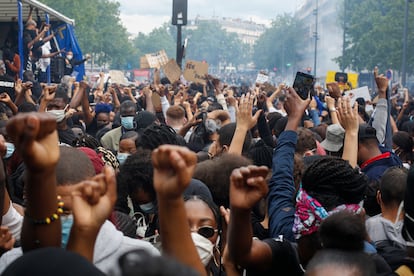
The hearing comes amid lingering anger over the killing of a 17-year-old of North African origin by police during a traffic stop in June. Nahel Merzouk’s death in the Paris suburb of Nanterre unleashed protests that morphed into nationwide riots. Tens of thousands of people marched last weekend around France to denounce police brutality and racism.
The case heard Friday focuses on ID checks, and was initiated by Amnesty International, Human Rights Watch, Open Society Justice Initiative and three grassroots organizations that work with young people. The NGOs took the case to the Council of State after the government failed to meet a deadline to respond to the class-action suit.
French courts have found the state guilty of racial profiling in identity checks in the past, but the case heard by the Council of State is different in that it is seeking reforms instead of damages.
The groups that filed the lawsuit want to require police to record data about identity checks and to abolish preventive ID checks; limits on checks targeting children; new training for police; and an independent mechanism to lodge complaints against police.
“We hope this hearing will bring recognition by the law of the injustice that young people of color in French cities face every day. To be stopped by police in the middle of the street for no reason; to be spread-eagled, to have your ID checked, to be frisked in front of everyone,″ Issa Coulibaly, head of community youth group Pazapas, said in a statement by the Open Society Justice Initiative.
Coulibaly, a Black man in his 40s, has described being subjected to numerous undue ID checks starting when he was 14.
Sign up for our weekly newsletter to get more English-language news coverage from EL PAÍS USA Edition









































