
Matthew Lieberman, psychologist: ‘Loneliness kills in ways that aren’t obvious’
The American professor has spent 30 years studying the social brain. He speaks with EL PAÍS about the loneliness epidemic, specifically how artificial intelligence and political polarization might influence it
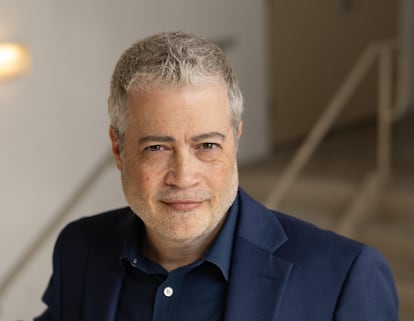

When Matthew Lieberman began studying social pain in the 1990s, very few of his colleagues bought into the idea that isolation, solitude and a lack of social skills – in short, loneliness — could cause a level of pain comparable to physical ailments. However, after the COVID-19 pandemic — which was followed by an epidemic of loneliness – Lieberman’s theories have made him one of the world’s most influential researchers in his field, with more than 58,000 academic citations. His book Social: Why Our Brains Are Wired to Connect (2013), continues to be translated at a time when his arguments are more relevant than ever, and has just been published in Spanish.
Today, few doubt that loneliness is one of the great ills of our time, exacerbated by polarization, social media and artificial intelligence (AI). Meanwhile, chatbots are beginning to replace the conversations we once had with other humans (with uncertain results).
Lieberman, 56, spoke with EL PAÍS via videoconference.
Question. Your book was published in 2013. Since then, has the world been changing for better or for worse?
Answer. [Things have] continued to get worse, without a doubt. There are two enormous changes. The first is that the world is much lonelier; we’re more isolated than before. There was already a 50-year trend toward isolation, but the pandemic put it on steroids. In the United States, we spent 18 months practically seeing only one family: our own. We bubbled together.
The other [big change], at least in the United States and in most of the Western world, is the partisan animosity, which is at a level that I’ve never seen in my lifetime. And I think that those two things have really shaped modern life in a way that makes a lot of people feel like the world has gotten worse.
For decades, I’ve been an optimist about the trajectory of the world. [But over] the last 10 years, it just feels like, where are the good parts? In terms of the trajectory of society, things are getting worse and worse, not better and better.
Q. The pandemic forced billions of people into isolation. What did that experiment reveal about what happens to the brain when it suddenly loses social connection?
A. We don’t need social connection to survive the way we need food or water… but we do need it to be able to thrive. What the pandemic did was make us acutely aware of this need. The immediate effect of isolation on the brain is similar to physical pain. But the long-term effect of chronic loneliness is that it constantly activates the immune system, generating inflammation. And this inflammation has been linked to cancer, cardiovascular disease and increased mortality. Loneliness kills, in a very literal sense. [And it does so] in ways that are far from obvious.
Q. We have more tools than ever to stay connected: mobile phones, social media, chatbots, video conferences like this one, and yet, loneliness is at record levels. What’s going wrong?
A. I wouldn’t say these technologies [in and of themselves] are making things worse. I’m a big fan of apps like Zoom, because they allow us to connect. I remember when Apple came out with FaceTime: suddenly, my son could see his grandparents, who were thousands of miles away.
The real problem is that we make choices that distance us from our social support systems: we move for work to cities where we don’t know anyone. And creating a new network of close friends in an unfamiliar place is extremely difficult. Zoom can help you feel connected and stay connected to people you already care about… but there’s something remote enough about Zoom that, if I put you together on the screen with someone [who you match perfectly] with as a friend, you’d have a friendly conversation, and then you probably wouldn’t talk again. It’s just not something that we go to naturally.
Q. There are studies that link the intensive use of chatbots with greater loneliness and less real socialization. What do you think about AI as a substitute for human connection?
A. AI is the most extraordinary invention I’ve ever seen. I use it many times a day, but not for social support, not to connect. However, I know that my son’s generation — those under 30 — use it as a source of social support. And we’re starting to study this in my lab.
AI replacing contact with real people isn’t good. People are complex and unpredictable in ways that AI isn’t. And that uncertainty — while sometimes frightening — is valuable. What worries me is that some AI companies are optimizing their products to be friendlier and more emotionally close, because that’s what sells. And the question we need to ask is: Are [these companies] also thinking about how to ensure that this helps people, rather than making them more dependent?
Q. You propose that many of our values and beliefs have been instilled in us by society through “the social brain.” Isn’t that unsettling? Where does free will fit in?
A. So, when you first learn about [this], it’s unsettling. It sounds like a kind of fascism or authoritarianism… like society is making you into one of its minions. But there’s another framing: by getting this training after we’re born, as opposed to just [relying on what] we inherit through our DNA, it allows us to learn how to sort of harmonize with the communities that we’re raised in. It allows us to have shared ways of seeing and understanding the world; [we can better] connect and collaborate.
If you asked 20-year-old me about this, I would say that it sounds horrifying. But as an adult who’s gone through more of the cycle of life and has seen how important it is to be able to fit in with new groups, the fact that we’re hardwired to do that as we’re going through our teenage years has a lot of advantages, in addition to the scary part.
Q. Earlier on, you mentioned political polarization, which has increased enormously since you published the book.
A. There are analyses showing that, when a conservative leaves California, a very liberal state, they’re twice as likely to move to a conservative state than a liberal state. And, when you look at the opposite, someone liberal leaving Texas, which is a conservative state, they’re much more likely to go to a liberal state than a conservative state. So, we’re sorting ourselves into states. And then, within states, we’re sorting ourselves between cities and rural areas. It just makes it hard to understand why we’re part of one larger community that we call a country. When you don’t interact with people who think differently in your daily life, they cease to feel like part of your community.
When I was a child, I lived in a cul-de-sac with 10 houses. We all knew each other. Some were liberals, some were conservatives, but it didn’t matter: they were part of our small community. That no longer exists to the same extent. And what I find truly dangerous is that we’ve turned political difference into this huge moral issue. In 1960, more than 50% of Americans opposed their children marrying someone from another race. Today, that number is maybe 5%. But now, they say, “Oh my God, please don’t marry someone [from another] political party.” I think that’s really dangerous for society.
Q. Is there any hope? Or are things going to get worse?
A. The only hope I can point to is the awareness that the real conflict tends to be between the 10% on [one] extreme and the 10% on [the other] extreme. And most of the people are in the middle… [well, maybe] not the middle – very few people are in the middle – but they’re close to the middle. And they align more with one side or the other, but they don’t have this furious need to take each other down. But the people who do have that need take up all the oxygen, they’re the ones running the far-right news and the far-left news. They’re the ones who’re going onto social media and arguing all the time. And so, they look like they represent all of us… [but] they don’t. They represent a small fragment of us.
The hope is that this large majority in the middle will realize they have more in common with each other than with the extremists. I don’t see that happening yet, but it could.
Q. In your book, you propose something interesting: reforming education and teaching history through narratives about people, rather than just using dates and battles. Is there evidence that this works?
A. I don’t know of any country that’s systematically implementing this. But what we do know is that humans are wired to listen to stories. We learn about people – their faces, their personalities, their motivations – much more easily and lastingly than when we learn abstract facts about the world. If I teach you about a war by telling you what was going on in the minds of those who made the decisions, it’s engaging and sticks with you. When we learn history as a series of maps and dates, we’re using the wrong format for how the brain works.
Q. In the book, you also argue that companies undervalue social connection as a driver of productivity. Has the massive shift to remote work during the pandemic, and the return to the office afterward, proven you right?
A. My university building is much more of a ghost town than it was 10 years ago. Professors come in when they teach or have a meeting, but hardly anyone is there from 9:00 AM to 12:00 PM anymore. And, [because of] that, we lose those moments of serendipity: the chance encounter in the hallway where someone says, “Hey, I saw a lecture yesterday that I think you’d be interested in,” [or] spending an hour in [your] office developing a new idea. That doesn’t happen the same way remotely.
In America, workers have really resisted going back to the workplace. And I get it. You can sit at home, do your work and be in your pajamas all day. There are lots of nice benefits: you can go see your neighbor and things like that. But there are benefits to why people come together in companies and not just over Zoom. There are things that happen when people meet physically that don’t happen [online]… and we haven’t yet found a way to compensate for that.
Q. Based on all your research showing how the brain needs social connection, what practical advice would you give to someone who feels lonely or has difficulty connecting with other people?
A. I started a company (Resonance) that’s trying to solve this problem. We have an app that can help people in large communities find the people that they should be talking to. We’re [doing] this with universities right now: before [thousands of students in a freshman] class show up, we connect each of the people in that class with, say, three other people. So, when they arrive on campus, [they already know] a couple of people, to help them navigate this experience. We do the same thing with companies.
But beyond that, I think there are two [pieces] of advice for someone who’s lonely. One is that you have to put yourself out there: go join a club or organization that does something you’re interested in. Start playing pickleball, join a group that talks about whatever it is that you’re interested in. This doesn’t automatically make you lots of friends… but it’s probably where you’re going to find some friends.
[Secondly], once you’re there, you have to sort of figure out how to turn acquaintances into friendships. Part of that is trying to be curious about the other person, not just doing all the talking. And you also have to share a little about yourself. We think that if we get into deep stuff, the other person is going to be turned off… but multiple studies have shown we’re wrong about all of that. People like being in these deeper conversations, because that’s what actually makes you feel more human.
You [also have] to dare to say “yes” when someone suggests something… even if that means a shared bad experience. The worst concert you ever went to with someone can become a bonding point. In a sense, making friends is about taking risks.
Sign up for our weekly newsletter to get more English-language news coverage from EL PAÍS USA Edition









































