
Dead tired: The things that ruin women’s sleep
Women sleep worse than men due to hormonal changes, mental strain, and a lack of shared responsibility. These factors affect mental health and increase the risk of developing chronic illnesses
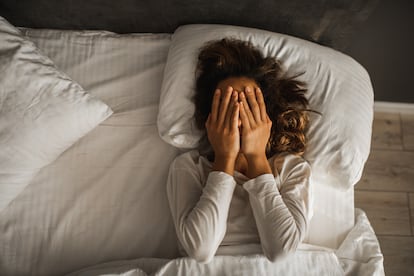

Sleep statistics also have a gender dimension: women sleep worse and report more fatigue than men. This is according to studies such as the Global Sleep Survey 2025, which, after analyzing interviews with more than 30,000 people in 13 countries, found that 38% of women have difficulty falling asleep more than three times a week, compared to 29% of men. Another study published in 2023 in the European Journal of Public Health also showed this trend: women tend to report worse sleep quality than men, even when the total hours are not very different, suggesting differences in how sleep is experienced and perceived between the sexes.
According to María José Aróstegui, a psychologist and member of the insomnia working group of the Spanish Sleep Society (SES), these problems often have a physical origin: “Our endocrine system is closely linked to the sleep centers in the brain. Therefore, changes in estrogen and progesterone levels are crucial.” Neurologist Ana Fernández Arcos, from the Spanish Society of Neurology (SEN), explains that these alterations begin in puberty, when girls’ circadian rhythm shifts earlier than boys’. “The menstrual cycle causes variations in sleep architecture that, in some cases, can be clinically significant, with awakenings or less restorative sleep,” she says. During pregnancy and breastfeeding, she adds, sleep is affected “not only by hormonal changes, but also by the pregnancy itself and prolactin, which regulates rest between feedings.” Regarding perimenopause, the expert points out that “up to 60% of women experience clinically significant sleep problems, such as spontaneous night awakenings or hot flashes.”
Furthermore, according to the neurologist, women are “more susceptible to the need to sleep after many hours of being awake, cortisol levels fluctuate upon waking, and experience a higher frequency of anxiety or depression,” all factors that contribute to more fragmented and lower-quality sleep. In Fernández Arcos’ words: “Women’s sleep is marked by the complex interaction of hormones, biological rhythms, and mental health: many women sleep more hours, but get less rest.”
On alert
Beyond physical factors, context is key to sleep problems, according to sociologist and PhD in Public Health Amaia Bacigalupe de la Hera. People from disadvantaged backgrounds or with less skilled jobs tend to experience more sleep problems, probably because they face more stress and difficulties associated with daily life. Gender adds another layer to these inequalities through the social roles that continue to fall on women: care work, household management, family planning and social networks, and the mental load associated with maintaining invisible relationships and responsibilities. “These tasks, which are invisible, unpaid, and without clear boundaries, disrupt sleep and significantly affect women’s health,” Bacigalupe reflects.
Situational stress is key, according to María José Aróstegui: “Worrying about work, family health, and finances keep the brain in a state of hypervigilance.” The psychologist explains that mental load isn’t just about doing things, but about planning and constantly remembering them: “Studies show that women, by assuming the role of ‘guardians’ in the home, maintain this alertness even while sleeping, which fragments their rest. Furthermore, women score higher on rumination scales [which measure a person’s tendency to dwell excessively on negative thoughts].” The 2025 Global Sleep Survey confirms that family responsibilities and work-life balance significantly affect women more.
It’s not surprising that, as Ana Fernández Arcos explains, gender differences exist in the ability to sleep. That is, to have an adequate amount of uninterrupted sleep, on a regular schedule, resulting in a feeling of restful sleep under optimal conditions. This, Fernández says, is often disrupted by individual and interpersonal factors, such as the period of raising children. And, although it may seem anecdotal, science confirms it: women sleep worse when they sleep with a partner. A study published in the European Respiratory Journal analyzed how sleeping with a partner who snores affects the objective quality of women’s sleep. Participants had their sleep recorded for two consecutive nights: one sleeping with their partner and the other sleeping alone. The study found that, when sleeping alone, women experienced fewer awakenings and more stable light sleep, suggesting that sharing a bed with someone who moves or snores can fragment women’s rest.
When sleeping badly is normal
According to sociologist Amaia Bacigalupe De La Hera, women’s chronic fatigue is not an individual failing, but rather the result of a system that makes work precarious and has not promoted genuine co-responsibility for domestic and caregiving tasks. “The result is inevitably chronic fatigue,” she points out, adding that the system’s response has been to depoliticize and medicalize the problem: “It is increasingly common for women to request anti-anxiety medication or sleeping pills to cope with this burden that has been assigned to them.” Bacigalupe emphasizes that motherhood intensifies this pressure, also affecting mental health and self-care habits.
Gender not only determines sleep quality but also how women are recognized and treated within the healthcare system. “Sleep is a public health issue,” states Ana Fernández Arcos, pointing out that sleep problems, especially when sleep is short, contribute to the onset and progression of numerous diseases such as diabetes, obesity, cardiovascular disease, cognitive decline, cancer, and mental disorders. Studies from Duke University show that, although men and women may report similar sleep quality, poor sleep quality in women is associated with higher levels of emotional stress and elevated inflammatory proteins, which in turn increase the risk of cardiovascular and metabolic diseases.
To improve women’s sleep and reduce the impact of poor sleep on their health, neurologist Ana Fernández Arcos proposes several measures. In the healthcare field, she believes it is crucial to “better train professionals to avoid diagnostic delays and biases that lead to overmedication,” as well as to advance specific research on women’s sleep, taking into account hormonal stages (fertility, perimenopause, postmenopause) and studying the differential effects of medications. She also points out the need to improve diagnostic tools, which until now have been designed with an androgenetic bias and may overlook characteristics specific to women’s sleep. But none of the above would make sense to the expert without social and political change. “Sleep also improves with better living conditions, and this includes gender-sensitive labor and work-life balance policies, and measures that reduce loneliness and socioeconomic inequalities,” she concludes.
Sign up for our weekly newsletter to get more English-language news coverage from EL PAÍS USA Edition









































