Neurologists warn against controversial migraine surgery: ‘Scientific evidence is lacking’
US plastic surgeons support the operation, but the Spanish Society of Neurology warns that its therapeutic role is not sufficiently supported
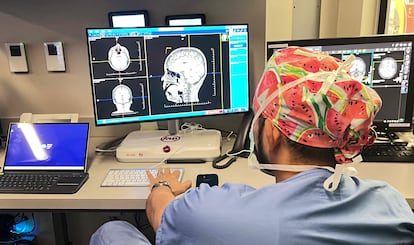

A controversial medical procedure has put Spanish neurologists on alert: a minimally invasive surgery, performed by plastic surgeons, that promises to treat migraines. In Spain, it is a niche practice, offered only by a few private clinics, but neurologists have raised the alarm after detecting a proliferation of these procedures. They warn that there is insufficient scientific evidence — or even a biological explanation to justify it — and urge patients not to undergo these interventions.
This controversial procedure, more common in the United States, is a minimally invasive surgical technique that involves decompressing extracranial nerves: surgeons identify areas of pain — trigger points — and release the nerves they believe are compressed there. American plastic surgeons defend the effectiveness of this approach, but Spanish neurologists warn that the studies supporting this technique are of low quality, with few patients, highly heterogeneous diagnoses (not all suffer from migraines), and also varied surgical procedures.
Its proponents — particularly those in the field of plastic surgery — claim that, in selected patients, this strategy can be effective in reducing symptoms and assert that they have conducted studies to demonstrate this. However, in Spain, those who support this technique are few and isolated. Anesthesiologists, the other medical specialty closely related to migraines and who typically lead pain management units, also do not recommend it. Migraines affect 12% of the Spanish population, although neurologists estimate that more than 40% remain undiagnosed and do not receive appropriate treatment.
This controversial migraine surgery originated serendipitously, in a chance discovery by surgeon Bahman Guyuron at the beginning of this century, when some of the patients on whom he had performed a forehead lift told him that, since the plastic surgery procedure, they had stopped suffering from migraines. From this, Guyuron theorized that migraines occur when peripheral branches of the trigeminal nerve become irritated and release neurotoxins, and he adapted the forehead lift to nerve decompression surgery.
No biological justification
“It’s outrageous that this technique is permitted without evidence,” states Robert Belvís, coordinator of the Headache Study Group of the Spanish Society of Neurology (SEN). The doctor maintains that migraine surgery “lacks biological plausibility,” meaning there is no pathophysiological explanation to justify the intervention: “Migraine is a brain disease; decompressing nerves makes no sense. No nerve damage has been observed. They haven’t demonstrated that these compressions exist.”
The neurologist also points out that international guidelines for migraine treatment — which reflect the scientific consensus for addressing this condition — do not even mention these surgical techniques.
The American Society of Plastic Surgeons, however, does include it in its clinical practice. It states that candidates are individuals diagnosed with migraines or occipital neuralgia who have unsuccessfully tried other therapeutic approaches, are in good physical health, and have realistic expectations. The price of these procedures ranges from $5,000 to $15,000, according to this scientific society. And the effectiveness, as stated on its website, is high: “Studies have shown that between 70% and 95% of patients undergoing surgery experience improvement or complete elimination of migraine headaches,” the society asserts.
To offer its opinion, the Spanish Society of Plastic, Reconstructive and Aesthetic Surgery refers to Ahmad Saad, an American plastic surgeon and member of the board of directors of the International Society of Aesthetic Plastic Surgery. The doctor, who also practices at a clinic in Barcelona, is an expert in migraine surgery and defends its validity: “It’s not a treatment for everyone; you have to choose the right patient. The evidence is of good quality, and the experience with thousands of patients is there.”
When asked about the neurologists’ stance, Saad points out: “The evidence is there, but I don’t know if they simply don’t want to see it or accept it. When the pioneers of this technique began performing it in the United States, they were at odds with neurologists, but today it’s the standard of care. In Spain, it’s not like that: you have the entire neurology community against you.” Regarding the limited adoption of this technique in Spain, the American doctor asserts that “it’s not that there aren’t surgeons to perform it, the problem is that there aren’t enough patients”: “Migraine patients are referred by neurologists. If these doctors don’t believe in migraine surgery, you’re not going to have any patients.”
Belvís argues that this technique has not gone through the animal experimentation phase and questions the research methods followed before transferring it to conventional clinical practice.
Questionable scientific evidence
Regarding the available scientific evidence, Saad shares some 30 studies — mostly by Guyuron and his team — that point to the viability of these techniques, including some clinical trials. But Belvís makes a point: “It’s not a question of quantity, but of quality,” he says, noting that the available studies are conducted with a small number of patients and various surgical approaches. He also points out that neurologists are rarely among the researchers who author the studies, and that they are usually published primarily in plastic surgery journals. “All drugs, before reaching the market, present three trials with more than 1,200 patients. The three trials for this surgery recruited fewer than 200 people.”
A review of 600 treated patients published in Frontiers in Neurology downplayed the effectiveness of the surgery, concluding that it eliminates migraine headaches in 38% of the patients with this diagnosis included in their analysis. However, the review emphasized: “More elaborate randomized trials are needed with transparent reporting of patient selection, medication use, and surgical procedures and implementing detailed and longer follow-up times.”
Agustín Mendiola de la Osa, vice president of the Acute and Chronic Pain section of the Spanish Society of Anesthesiology, Resuscitation and Pain Therapy (SEDAR), echoes Belvís’s sentiments: “We don’t have good results with migraine surgery. What we’ve seen in some treated patients is that, at first, they seem to be doing well, but then they aren’t. It seems more like a case of wanting to but not being able to; they want to get better, but reality sets in. We don’t recommend surgery for migraines because there’s no medical explanation to justify it.”
“Legally questionable”
In its statement, the Spanish Society of Neurology asserts that the aim of its warning is not only to address patients and doctors, but also the directors of Spanish clinics, both public and private, “who allow surgeries lacking scientific evidence to be performed as standard healthcare services.” “We believe that, moreover, it is even legally questionable,” they state, although they have not yet filed any official complaint with health authorities.
When contacted by this newspaper, the Spanish Ministry of Health stated that it has not received any formal complaints on the matter, but a spokesperson noted: “Healthcare centers (public or private) are responsible for ensuring that the procedures they offer are safe, ethical, and based on scientific evidence, and must have regional health authorization. If they offer techniques without scientific backing, they may incur administrative or professional liability.” The spokesperson also pointed out that “any new health technique, procedure, or technology may be subject to evaluation by the Spanish Network of Health Technology Assessment Agencies (RedETS),” an entity coordinated by the Ministry of Health. Its reports serve as a basis, for example, for including or excluding a technique within the National Health System. However, no organization has specifically requested that RedETS evaluate migraine surgery.
Sign up for our weekly newsletter to get more English-language news coverage from EL PAÍS USA Edition