
Estel Blay Carreras, the scientist who will lead an Arctic expedition simulating a mission to Mars
The goal is to recreate the conditions of a future colony on the red planet in the place on Earth that most closely resembles it
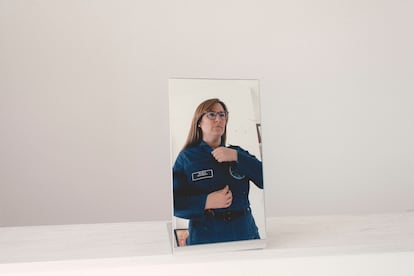

Estel Blay Carreras, 39, has dreamed of becoming an astronaut since childhood. More than half of girls who aspire to a career in science give up in adolescence, but that wasn’t the case for her. She turned a fantasy into a professional future. She studied aerospace science, earned a doctorate, and held several jobs. Today, Blay Carreras — who lives in a residential neighborhood of Spain’s Sitges with her family and two hamsters — greets us with a smile and wearing socks. She leads a seemingly conventional life, but in just over a year, she will be the next commander of a mission that will simulate an expedition to Mars on a remote Arctic island.
“I wake up happy, I go to work happy, and I come home happy,” says Blay Carreras. And it shows. During the day, she manages one of the European programs at the Institute of Space Studies of Catalonia, which funds projects using space technology for climate resilience. Afterward, she begins her volunteer work at Hypatia Mars, a Catalan non-profit organization run by women that promotes space research, supported by universities around the world.
The chosen site for the next mission is a base in Devon, in the Canadian Arctic. It’s the area on Earth most similar to Mars. The nearest hospital is a four-hour flight away, and this is the first time an all-female team will be deployed. “Here we’re moving to another level of complexity, and for that, I have a plan A, a plan B, and a plan Z, so as not to put anyone at risk. My role is to make sure things happen, and happen well,” says Blay Carreras.
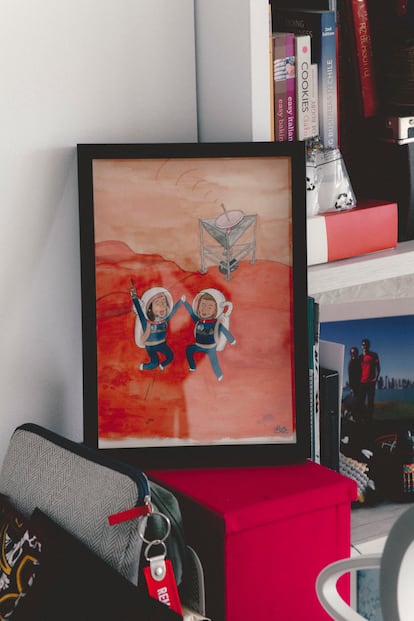
It will be the second simulation she takes part in. Last year, with Hypatia, she was in charge of health and safety during a 15‑day mission in the Utah desert, alongside six other women, also with the goal of reproducing Martian conditions. In addition to looking after the team’s well‑being, she took responsibility for three experiments. Together with the artist‑in‑residence Anna Bach Valls, she participated in the project Women Leave Their Mark, which involved creating a cross made of canvas large enough to be visible from space.
The astronaut underscores the difficulty of that last project: moving around in astronaut suits, gloves and helmets; communicating only through radio; and transporting heavy loads — the survival backpacks — across the desert, among rocks, wind, dust and sun. “We had to simulate the conditions of a future colony on Mars. If we reach another planet, our capacity to build will be very limited,” she explains.
The space they inhabited was extremely cramped. Each room had only a bed, and the improvised gym was so tiny that they had to exercise in two separate shifts because they couldn’t all fit. In a small greenhouse, they grew fast‑growing fresh vegetables such as arugula and herbs. They ate half a cherry tomato a day. Everything else was dehydrated food: hamburgers, broccoli, butter. Each person was allotted just 13 liters of water per day — a far cry from the comfortable 130 liters estimated for everyday life in her home country.
She has been isolated, in very small spaces, in hostile climates, eating little and eating poorly. One might wonder how she endures —and even seeks out— so much discomfort. “It’s an explosion of adrenaline and happiness,” she reflects. “When you’re isolated, and they take the phone out of your hand, there’s nothing else but the mission. You can almost think faster, because all your attention is focused on a single thing. My ability to concentrate was on another level…,” she says. Out of this world.
In such conditions, it’s almost impossible not to think about the possibility of death in an emergency. “I don’t think I’m afraid of dying in the Arctic. If I call the hospital, I’d obviously be breaking the simulation. In fact, if someone ends up with a leg in two pieces, the simulation, with all due respect, will have to wait for another time,” she replies.
In a few months, the team will begin preparing with an exercise routine, medical checkups, and a special diet. She no longer has the ambition to go to Mars — a goal also postponed by Elon Musk. With the calm of someone who understands how things work, and the optimism of those who still have much to do, she says: “There are too many things on Earth that I love for me to go on a suicide mission to the red planet.”
Sign up for our weekly newsletter to get more English-language news coverage from EL PAÍS USA Edition









































