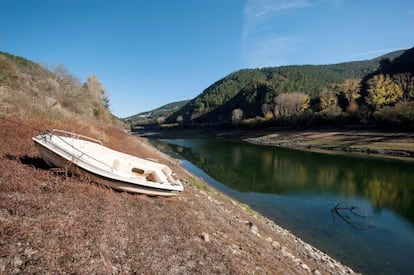
As drought drags on, northwestern Spain’s reservoirs hit record lows
A region unaccustomed to prolonged dry spells is now dealing with watering restrictions
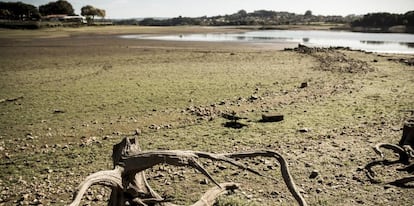
Northwestern Spain is being particularly hard hit by the drought currently affecting the country after three consecutive years of abnormally low rainfall.
The reservoirs in the Duero and Miño river basins have not been at such low levels since 1990, when the Agriculture Ministry began keeping reliable records.
The Duero basin reservoirs are at 29.8% capacity, while the Miño’s are at 38.6%. Overall, Spain’s water reserves are at 37.2% capacity, according to figures released on Tuesday by the ministry.
The Spanish government has declared a state of prolonged drought in the basins of the Duero, Júcar and Segura rivers. The water level at the Júcar reservoirs is 25%, and 13.4% at the Segura dams.
Until this year, the country had not experienced such a dry October since 1995
The last year that water levels were even lower at this time of the year was 1995. In the mid-1990s, Spain was going through another major drought.
The country had not experienced such a dry October since 1995, according to the AEMET national weather agency.
This time, the drought is being particularly hard on a part of Spain that is less accustomed to dry spells than elsewhere, and that has fewer reservoirs than southern regions.
The low capacity is affecting agriculture – some communities already have watering restrictions in place – as well as power generation at hydroelectricity plants.
More coal and gas
So far this year, power generation through water – which does not produce CO2 emissions and is thus considered a renewable energy source – is down 49.2% from the same period in 2016, according to data from the Spanish Electricity Network (REE).
The shortfall has been filled with coal (use of which has risen 27.9% from 2016) and natural gas (up 30.7%). In 2017, only 32.8% of electricity is being produced from renewable sources, down from 40.8% in 2016.
English version by Susana Urra.