
Bacteria that kills olive trees spreads from Italy to Spain’s Balearic Islands
The regional government has destroyed 2,000 specimens affected by the disease

The regional government of the Balearic Islands says Xylella fastidiosa, a bacterium that kills fruit-bearing plants such as olive trees, is now threatening its agricultural sector. In a bid to control its spread, authorities have destroyed some 2,000 fruit trees so far. At the same time, a ban has been imposed on the export of fruit or cuttings from susceptible species such as olives, cherries, grapes and almonds, as well as ornamental fruits.
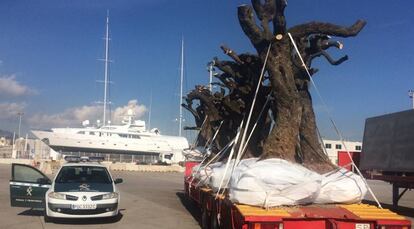
The Balearic Islands, which include Menorca, Mallorca, Ibiza and Formentera, have been declared a containment area while authorities try to stop the spread of the blight, which first attacks leaves, then the stem, and finally kills the roots. There are more than 20,000 hectares of almond trees, 10,000 hectares of olive trees and 2,000 hectares of grapevines. These plots are much smaller than they are in mainland Spain, where agriculture is a primary sector, but some of the trees are a key part of the islands’ landscape, including some centuries-old olive trees.
One year ago, the bacteria devastated olive plantations in the Italian province of Lecce. In the end, more than a million specimens were destroyed, either by the disease itself or by the authorities in the attempt to prevent the bacteria from spreading.
The authorities are trying to contain the plague by only killing infected trees
Alarm bells first rang in the Balearics in October, when the official laboratory of plant health detected the first case of Xylella fastidiosa in a cherry tree in Porto Cristo, Mallorca. The office immediately applied the protocol of prevention established by the European Union, which obliges authorities to destroy any at-risk species that are located within 100 meters of the infected plant and to take samples of trees located within 10 kilometers. They pulled out more than 1,900 trees.
Despite the containment measures, on January 12 three new cases were detected in Ibiza, along with others in Inca and Algaida, Mallorca. Eventually authorities found hundreds of infected trees. For now the Balearic government has decided to apply a containment protocol in which only infected trees will be destroyed.
Andreu Joan, head of agricultural services for the Balearic regional government’s environment department, says activating the EU’s protocol throughout the islands “would practically provoke the destruction of the primary sector.”
The plague has devastated olive plantations in Italy
The Balearic regional government is now waiting for Brussels to authorize the contamination protocol by which only infected trees are destroyed. Meanwhile, police are controlling the movement of trees and plants throughout the islands to contain the further spread of the bacteria.
But the measures taken so far have not satisfied the Association of Young Farmers (ASAJA), which has called on the authorities to combat the mosquito that spreads the bacteria.
“I can’t imagine a situation similar to what happened in Italy because it would be extremely serious,” said ASAJA President Joan Simonet, who thinks that a program of “massive elimination” of trees “would be even worse than the bacterial infection.”
Apart from the value of fruit trees to the agricultural sector, says Simonet, “one shouldn’t forget about the consequences for the landscape,” adding that the majority of infections have occurred in old trees, which are less resistant to the bacteria than younger specimens.
English version by Alyssa McMurtry









































