
Obama and Raúl Castro begin historic meeting in Havana
US president, who will also be meeting with business leaders and dissidents, calls encounter “just a first step”
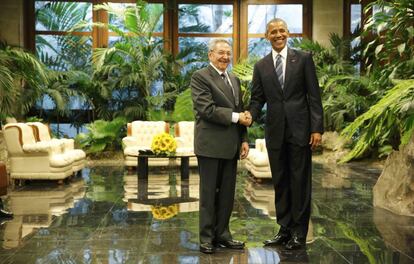
After his arrival in Cuba on Sunday, the first engagements of Barack Obama’s historic visit to the Caribbean island got underway today. The US president’s first act was to lay a floral tribute to the hero of Cuban independence, José Martí, before being received by Cuba’s president, Raúl Castro, at the Palacio de la Revolución in the capital, Havana. Obama will not, however, be meeting with the president’s brother, Fidel Castro.
In a photo of his arrival tweeted by Cuban state newspaper Granma, Obama was pictured alongside dignitaries with the image of revolutionary Che Guevera visible on the building behind him.
“It is a great honor to pay tribute to Jose Marti, who gave his life for independence of his homeland,” Obama wrote in the guest book for the Cuban hero
“It is a great honor to pay tribute to Jose Marti, who gave his life for independence of his homeland,” Obama wrote in the guest book in the museum dedicated to the Cuban hero. “His passion for liberty, freedom and self-determination lives on in the Cuban people today.”
Once he had been received by Castro, the two leaders posed for photographers in the Palacio de la Revolución, where their countries’ respective national anthems were played.
It was then down to business for Castro and Obama, who began a behind-closed-doors meeting. Crowds lined the streets to wave to the US president as his motorcade took him to the historic encounter with the Cuban president.
The first lady, meanwhile, met with young Cuban women at the Fábrica de Arte Cubano (Cuban Art Factory), as part of her Let Girls Learn drive. The initiative from Michelle Obama is aimed at fomenting the education of girls the world over.
The historic visit by Obama to Cuba marks the first time that a sitting US president has set foot on the island for 88 years. The 48-hour visit is the climax of a year’s worth of work to normalize relations after more than half a century of cold war. Over the course of this year, the US and Cuba have reopened their embassies, and Washington has eased the conditions for business and travel to the island.
Reporting by Marc Bassets, Silvia Ayuso and Pablo de Llano.









































