
Missing Spanish airmen may have been kidnapped, says ministry
Pedro Morenés admits it’s not the most likely scenario, but the theory hasn’t been ruled out The three men have not been heard from since Thursday, when their helicopter crashed
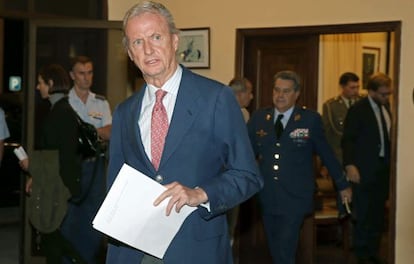
Spain’s defense authorities are not ruling out any options — not even the kidnap theory — in the case of the three members of the military who went missing after their helicopter crashed into the sea on Thursday around 45 kilometers off the coast of Western Sahara, in northern Africa.
A military judge is keeping the inquiry under seal, but Defense Minister Pedro Morenés said that Spain and Morocco are cooperating in the search for the missing men, all members of the Air Force’s 802 Squadron, which is based in Gran Canaria and is responsible for providing rapid support to the archipelago’s rescue services.
All ports in the area are under surveillance and search teams are combing the area where the Super Puma went down
All ports in the area are under surveillance and search teams are combing the area where the Maritime Search and Rescue AS332 Super Puma helicopter went down after losing contact with air traffic control at around 4pm Spanish time.
Asked about the possibility that the two pilots and a mechanic were kidnapped by unknown parties, Morenés said that “that is not the only feasible [option], nor the most likely one.”
But the minister admitted that Spain’s intelligence services are conducting “intelligence operations” along the African coast in partnership with Morocco, in case this theory turns out to be correct.
The hours following the helicopter crash are filled with question marks. On Thursday night, the Spanish Defense Ministry announced that all three crew members had been rescued and were traveling on a Moroccan fishing boat to the port of Dakhla, in Western Sahara.
But faced with the evidence that the men never arrived, the ministry issued another statement on Friday admitting that the Air Force members were being treated as “missing persons.”









































