
The Florida Keys tourist paradise is besieged by immigration agents: ‘We’ve never seen anything like this’
The highway connecting the islands to the rest of the United States has become an ‘easy trap’ where authorities set up checkpoints and roadblocks to detain migrants passing through the area
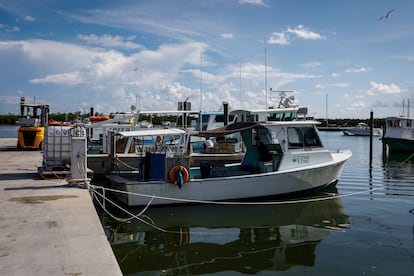

The only highway connecting the Florida Keys, a global tourist destination, to the rest of the United States has become a trap. Authorities have launched a large-scale immigration crackdown on the A1A Overseas Highway, which carries some three million travelers annually and connects the chain of islands stretching nearly 200 kilometers over the Florida Barrier Reef from Key Largo, south of Miami, to Key West, with checkpoints and roadblocks. According to activists, agents are checking license plates and detaining people with outstanding immigration cases. In Key West, the southernmost city in the country, a wave of arrests in recent months has sparked alarm in the community and terrified migrant families.
The idyllic Key West, just 4.2 square miles in size, receives more than a million tourists a year, drawn by its bohemian and relaxed atmosphere that inspired writers like Ernest Hemingway and Tennessee Williams, and which singer Jimmy Buffett described as an eccentric melting pot of fishermen, hippies and smugglers. Since its founding in the 19th century, Key West has forged an irreverent character that was underscored in 1982 when it symbolically declared its independence from the United States in protest against Border Patrol controls.
But with only one road in and out, the once-famous tourist destination has become, in practice, a migrant trap. In recent weeks, authorities have been conducting checkpoints, raids, and arrests almost daily during traffic stops, as part of the Trump administration’s anti-immigrant crusade. The operation has created a climate of tension and fear among Key West’s 27,000 residents, a fifth of whom are migrants.
Local activists with the Key West Immigrant Support Network (KWISN) have documented more than 300 arrests, mostly during traffic stops, and say they are assisting affected families and tracking immigration authorities’ movements in real time. Most of the 300 people detained since June have been men who were the primary breadwinners for their families, says Heather Slivko-Bathurst, founder of KWISN. The network is helping affected families with food, supplies, and legal support.
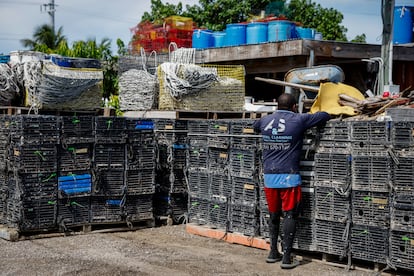
In the Stock Island neighborhood, where many Key West service workers live, residents are avoiding leaving their homes for fear of being stopped, says Slivko-Bathurst. A few months ago, authorities began stopping people as they crossed the small bridge to the island on bicycles. “Many people used to commute by bike from Stock Island to Key West for work. Now even that’s scary,” she adds.
The deportation of a local high school student
Discontent with the immigration crackdown escalated at the beginning of the month when Elvis Garcia, a senior at Key West High School, was arrested on his way to school and deported to Honduras days later, according to local media. Garcia had just turned 18 and had lived in Key West since he was a child. He had graduated from the local Fire Academy in May and was a talented member of the school’s wrestling team.
“He wanted to be a firefighter or join the army,” says Chazz Jiménez, García’s wrestling coach. “The whole team loves him. There’s no one who doesn’t.” The coach, a Key West native, says the “magnitude” of the wave of raids is unprecedented in the city. “We’ve never seen anything like this. We’ve heard of people being deported in the past, even parents, but never a student. What we’re seeing now is the separation of entire families, with children living in fear,” he adds.
The mother of a high school student, who asked to remain anonymous for fear of reprisals, told EL PAÍS that García’s arrest has caused a great deal of commotion in the community. “It’s humiliating. The children are devastated. This is out of control. Right now, it’s racial profiling. We’re not talking about criminals. This is devastating,” said the woman, who has lived in Key West for more than a decade.
On the day García was arrested, KWISN recorded more than 10 arrests, according to Dan Mathers, a member of the network and owner of a café in Key West. Mathers and other volunteers observe the operations and record masked agents as they arrest people. When local police conduct a traffic stop, the volunteers monitor how long it takes to “determine if it’s being intentionally prolonged to give the Border Patrol time to arrive,” Mathers explains. “We have indications that the stops last longer when the person speaks with a Spanish accent.”
Mathers was arrested in August while filming an operation, spent hours at the Customs and Border Protection (CBP) office on Marathon Key, and was released without charges that same day. He says the facility was cold and austere, with “nine or ten people behind a glass panel on the concrete floor. They had minimal padding, like a lawn chair, and an aluminum foil blanket.”
Volunteers post warning signs and helpful information for migrants in apartment complexes and mobile home parks, and alert people via social media about the presence of agents on the streets. “Immigration is patrolling Stock Island. Be careful,” says one message from the group on Facebook that has been shared dozens of times. “Avoid moving, stay where you are, don’t drive,” says another.
Mathers points out that the only highway leading to Key West “is an easy trap. We see Border Patrol vehicles stationed on A1A, reading license plates and waiting for someone to stop.”
In early December, a U.S. citizen was stopped on Highway A1A near Key Largo while driving to work. A Miami Herald reporter recorded a video of the violent altercation, showing officers forcibly removing the woman from her car as she yelled that she was a U.S. citizen. The car was apparently registered to the woman’s partner, who was reportedly undocumented, according to the Herald. The woman, a therapist who was wearing a hospital uniform, claimed she followed all the officers’ instructions, and before she could reach for her license, they threatened to break the window and pulled her from the car. Authorities released her after verifying her immigration status.
Key West signed an agreement in July known as 287(g) to cooperate with immigration authorities. Commissioners had voted against the agreement in late June, but reversed their decision after a threatening letter from Florida Attorney General James Uthmeier, indicating that they might be violating Florida’s law prohibiting sanctuary cities.
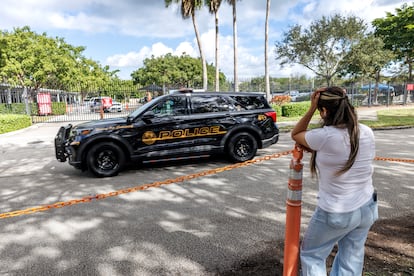
“It was a pretty intimidating letter” that even threatened the commissioners with losing their jobs, Key West District 1 Commissioner Monica Haskell told EL PAÍS. The commissioner says she has received complaints that police are detaining people of color during traffic stops. “These are simple stops that, in theory, should be resolved quickly, but they are holding people of color for 30 minutes or more, until immigration authorities arrive, until Border Patrol or Customs and Border Protection shows up,” she says.
The Key West Police Department said in an email that it has not made any immigration-related arrests and referred questions to Immigration and Customs Enforcement (ICE). The Department of Homeland Security did not respond to a request for comment for this article.
The Monroe County Sheriff’s Office (MCSO), which covers the Florida Keys, has reported about 10 arrests on federal immigration charges since August. The Florida Highway Patrol (FHP) has reported 42, according to official figures. Authorities have also been boarding vessels, including fishing boats, and arresting people at sea.
According to Slivko-Bathurst, distrust of local authorities has skyrocketed. “There’s a huge part of the community that no longer trusts the police because they see them as implementing policies we reject.” For migrant families, “the most disturbing thing is the feeling of institutional betrayal,” she adds. “They tell you to apply, they give you a work permit, social security, a driver’s license, and now all that information is being used against you.”
Sign up for our weekly newsletter to get more English-language news coverage from EL PAÍS USA Edition









































