
Spain will accept its corresponding refugee share, says foreign minister
But García-Margallo fails to cite figure on how many asylum seekers Madrid might take

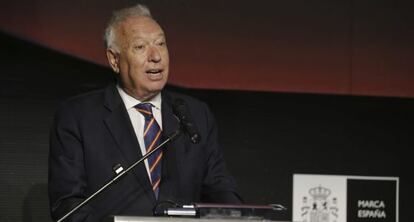
Following Brussels’ call for an EU-wide relocation of 120,000 refugees, to relieve pressure on some member states, Foreign Minister José Manuel García-Margallo said on Thursday that Spain is “perfectly ready to accept its corresponding quota in the effort.”
But the minister did not specify exactly how many asylum seekers Madrid would accept, instead falling back on earlier statements by Prime Minister Mariano Rajoy to the effect that Spain might take in more than the 2,739 refugees it had initially agreed to.
Nor did he say whether he agreed with Germany and France’s proposal to introduce binding migrant quotas, rather than the voluntary system currently in place.
This is the great problem of the 21st century, a European and a global problem”
Spanish Foreign Minister José Manuel García-Margallo
“We want to help, it’s a moral obligation, but let’s see what the formula is, let’s see the full picture,” said García-Margallo.
The Spanish diplomatic chief said that designing a common asylum and immigration policy will be “the central topic” of an informal meeting of EU foreign ministers scheduled for Friday in Luxembourg.
This policy should address the root of the migration problem (wars and poverty) in cooperation with countries of origin and transit, said García-Margallo. Only toward the end of the process should quotas be handed out, since “filling Spain with refugees will solve nothing.”
The minister underscored Spain’s “enormous effort” in recent years to “integrate immigrants with dignity,” in reference to the waves of undocumented sub-Saharans who regularly cross into Ceuta and Melilla, two Spanish exclaves along the northern coast of Africa.
But García-Margallo rejected the claim made by Hungarian Prime Minister Victor Orban that the refugee crisis is exclusively a German problem. “This is the great problem of the 21st century, a European and a global problem,” he said, adding that Spain will “probably” take up the issue at the United Nations Security Council, where it holds a rotating seat.
English version by Susana Urra.









































