
In Mexico, a pro-fracking committee is advising Sheinbaum on approving unconventional natural gas extraction
According to the list of its 47 members obtained by EL PAÍS, 17 are in favor of hydraulic fracturing and only seven are critical academics
In mid-April, after a couple of months of flirtations and false starts, President Claudia Sheinbaum announced that she would not be the one to ultimately decide whether to resume hydraulic fracturing, or fracking, in Mexico. The verdict would fall to a committee of “the country’s best scientists and academics” — dubbed the Avengers of Fracking by some media outlets — who were tasked with “assessing under what conditions it would be feasible to exploit unconventional gas” and “whether there are new technologies and where it would be viable to exploit it.” At that time, only a few of these experts’ names were made public.
EL PAÍS obtained an official list from the Secretariat of Science, Humanities, Technology and Innovation showing its 47 members at the end of April and, based on an analysis of names, positions and careers, 17 profiles are favorable to approving hydraulic fracturing, compared with just seven critical academics. According to what the president said on Monday, “this week or early next week” she will meet with “the group of scientists, which is already well advanced on a first recommendation.”
Of those members, who EL PAÍS has learned were made to sign a confidentiality agreement, 17 have expressed support for or hold positions and responsibilities that would lead them to back fracking. Examples include Luis Fernando Camacho Ortegón, a member of two of the committee’s four groups, who at that press conference said that “fracking, with current technology, has already reached a very stable level of safety”; Ulises Hernández, who sits on all four groups and is deputy director of Exploration and Production at Petróleos Mexicanos; Alma América Porres, former chair of the National Hydrocarbons Commission; Jorge Arévalo, director general of Hydrocarbons Exploration and Production at the Energy Secretariat and a member of the Advisory Council for the Promotion of the Hydrocarbons Industry; Carlos Serralde Monreal, whose specialty is the sustainable management of water from unconventional resource extraction; and José Adalberto Morquecho Robles, a specialist in well drilling and geomechanics.
The committee is divided into four groups. The first is Impact, which “considers social, economic, health, environmental, soil, air, workplace safety and hygiene, ecological risk and ecotoxicology, and ecological and territorial planning implications.” The second is Engineering, which analyzes “exploration and production techniques, geophysics, geology, geomechanics-hydromechanics, fluids.” The third focuses on Water and examines “use, reserves, supply, hydromechanics and treatment.” The fourth and final group is Planning and Foresight, covering “economic and social planning, financial analysis, economic policy, regulation, and scenarios for reducing gas demand that the Energy Secretariat will develop as a complementary part of this effort to reduce dependence on imported gas.”
There are only seven people on the list who have publicly voiced criticism of fracking, such as Rodolfo Omar Arellano-Aguilar of the National School of Earth Sciences; Leticia Merino, a researcher at the Institute of Economic Research of the National Autonomous University of Mexico; Beatriz Torres Beristain of the Tropical Research Center at the University of Veracruz; and Luca Ferrari of the Institute of Geosciences at the National Autonomous University of Mexico, among others. Of the remaining profiles, 13 names have institutional ties, although there is no evidence of their position on fracking. That is, they are linked to posts within the federal executive, such as the Secretariat of Science, the Secretariat of Foreign Affairs or the Energy Secretariat. Then there are about 10 people from universities and technical institutes for which there is no clear public information.
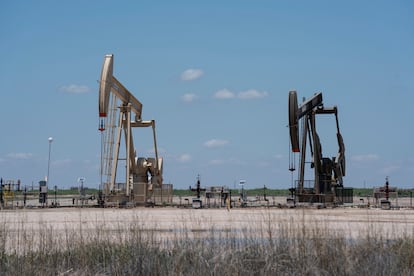
Fracking is a set of extraction techniques for hydrocarbons contained in rocks that cannot be exploited conventionally. Essentially, millions of liters of water mixed with sand and chemical additives — many highly toxic — are injected to fracture the rock and release the gas and oil. The opposition that Andrés Manuel López Obrador, Sheinbaum’s predecessor and mentor, maintained against this practice has forced the current government to perform a balancing act to open the door to fracking without it feeling like a betrayal. It is a paradigm shift that clashes with the global left, which opposes the technique as highly damaging to the environment, and with the government itself, which in December 2024 pledged at a conference that it would not use it.
Sign up for our weekly newsletter to get more English-language news coverage from EL PAÍS USA Edition









































