
The IPOs of SpaceX, OpenAI and Anthropic threaten to drive Wall Street to bubble-like levels
Their public listing will increase the stock market’s reliance on a single sector to levels not seen since the 19th century with the railway industry

Stock markets continue to perform strongly despite the mounting risks. Neither the war in the Middle East, nor the resurgence of inflationary pressures, nor fears of an economic slowdown have managed to slow down the equity market. However, beneath this apparent strength there lies an increasingly evident fragility: the growing concentration of the market. The bulk of the gains rests on an increasingly limited number of stocks, and the trend is particularly evident in the U.S. According to Goldman Sachs, 85% of the S&P 500’s gains so far in 2026 (10%) come from technology. Excluding the sector, the advance drops to 3%.
This narrowing of the market is beginning to worry analysts. Michael Hartnett, a strategist at Bank of America, warns that the upcoming IPOs of SpaceX, OpenAI and Anthropic could push market concentration to levels not seen since the late 19th century. At that time, the rail industry—driven by debt-financed expansion and a significant investment surplus—came to account for 63% of market capitalization in the United States. That episode ended in a crisis, with the bankruptcy of Jay Cooke and the closure of the New York Stock Exchange, reflecting the accumulated excesses. While the two situations are not exactly comparable, the parallels with the current situation are becoming increasingly evident.
Beyond the historical parallels, the market finds a closer point of reference in the 1990s. As was the case then, the spotlight is once again focused on a single sector: technology. Just as with the internet and the dot-com boom, expectations regarding the transformative potential of artificial intelligence are driving increasingly ambitious valuations, the true scope of which can only be gauged over time. Following a brief attempt to rotate toward more cyclical stocks at the start of the year, rising uncertainty and better-than-expected earnings have returned the spotlight to large growth companies.
Years ago, it was the FAANG companies—Facebook, Amazon, Apple, Netflix, and Google—that dominated the stock market and led the tech industry. With the rise of AI, the group expanded to become the Magnificent Seven. Names and technologies may change, but the market logic remains the same: a small group of tech giants dictates the direction of the indices. Nvidia, for example, has reached a market capitalization comparable to the size of economies like Germany’s.
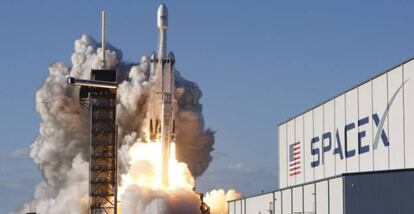
Against this backdrop, the market is bracing for a new wave of IPOs by major tech firms—deals that aim to break records and threaten to further intensify this trend. Upcoming IPOs by companies such as SpaceX, OpenAI, and Anthropic could further bolster the sector’s weight in the indices.
Another bubble?
Currently, tech companies account for nearly 40% of the total value of the U.S. market—a share that, according to Hartnett’s estimates, could rise to nearly 48% following the next wave of IPOs. History doesn’t repeat itself, but it rhymes strongly: if these forecasts come true, the sector would surpass the 41% reached during the dot-com bubble and the 44% recorded during Japan’s stock market euphoria in the late 1980s.
Although concentration levels are high, analysts insist that high valuations alone are not a trigger for a correction. Juan Gómez Bada, chief investment officer at Avantage Capital, states that, unlike what happened during the dot-com crisis, valuations have so far been supported by real earnings. The latest earnings season is a good example. According to FactSet data, the “Big Seven” reported a 62.3% earnings growth rate in the first quarter, well above the 17.4% for the rest of the S&P 500.
“The concentration of capital partly reflects that of earnings. Today’s dominant companies are of higher quality and have profitable business models,” notes Castelo. This is the main difference from the dot-com bubble, when stock prices were driven by expectations rather than results. “The graveyard of that bubble is full of companies that never made a dollar.”
Sign up for our weekly newsletter to get more English-language news coverage from EL PAÍS USA Edition









































