
Ecuador raises tariffs on Colombia to 100% and deepens the trade war
The decision by Daniel Noboa’s government comes after statements by Colombian president Gustavo Petro, who called former Ecuadorian VP Jorge Glas a ‘political prisoner’
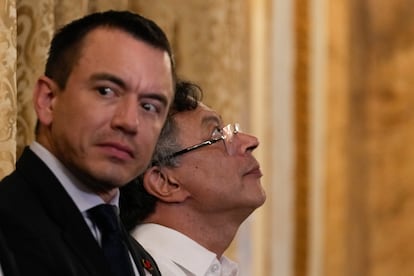
Ecuador has dealt another surprising blow to bilateral trade with Colombia. The government of Daniel Noboa announced that, starting May 1, the security tax on imports from the neighboring country will be raised from 50% to 100%. The decision is again based on national security criteria, “after observing the lack of implementation of concrete and effective measures regarding border security by Colombia,” according to a statement from the Ministry of Production. The executive branch claims the measure aims to strengthen shared responsibility in the fight against drug trafficking, a challenge they assert must be addressed jointly.
“Unfortunately, it is impossible to reach agreements with those who do not share the same commitment to fighting narco-terrorism,” President Noboa said on social media. “Since we took this measure, violent deaths on the northern border have fallen by 33%. In the future, we will be able to engage in dialogue with a government that is truly committed to combating crime and drug trafficking.” President Gustavo Petro also reacted on social media: “This is simply outrageous, but it marks the end of the Andean Pact for Colombia. We have no business there anymore. The foreign minister must take the first step toward full membership in Mercosur and turn our focus more strongly toward the Caribbean and Central America.” He then added that it is false to claim they do not combat drug trafficking: “The Ecuadorian government is distorting reality on orders from forces outside its sovereignty.”
The increase comes after a series of measures that had already strained trade relations. Just a month ago, the government of Ecuador again raised tariffs on Colombian products to 50%, in addition to imposing an extra charge for transporting crude oil through the SOTE pipeline.
The escalation coincides with a new diplomatic episode, coming just a day after the Ecuadorian government sent a protest note to Bogotá and recalled its ambassador for consultations, following Colombian President Gustavo Petro’s statements about former Ecuadorian vice president Jorge Glas, whom he again referred to as a “political prisoner.” In Quito, the remark was interpreted as an unacceptable interference in Ecuador’s domestic affairs. Noboa responded with a message on X: “From the outside, they want to sell the story of ‘political prisoners’ to cover up the obvious: there is a corrupt individual in jail who must answer to Ecuador,” characterizing Petro’s statements as an attack on Ecuador’s sovereignty.
Glas served as vice-president under the leftist leaders Rafael Correa and Lenín Moreno, and came to be in charge of oil resources at a time of dizzying development from oil revenues. He was one of the most visible faces of the movement that grew around Correa, a populist and charismatic leader who claimed he was leading his country into a form of 21st-century socialism. However, Glas fell into disgrace over three corruption investigations that the opposition considered persecution. On December 17, 2024 he sought shelter in the Mexican Embassy in Quito, but was forcibly removed in a raid that caused outrage across the Americas.
The recent diplomatic note demands that references to the Glas case be suspended and that the dialogue focus exclusively on security, which Ecuador considers the key to resolving trade tensions. The dispute dates back to January, when Noboa imposed a 30% “security tax” on Colombian goods due to Bogotá’s alleged inaction against organized crime on the border. Just a month later, the tariff was raised to 50%. The Andean Community of Nations attempted to mediate between the two countries, but the only meeting it managed to hold resulted in no agreement.
Ecuador’s Foreign Minister, Gabriela Sommerfeld, stated that a new schedule of technical working groups has been established to address pending issues such as energy, trade and security in the ongoing dialogue with Colombia regarding border security and tariffs. However, the minister confirmed that these meetings, scheduled to begin next week, were suspended on April 8 as a direct result of Petro’s statements concerning the case of Jorge Glas. This has escalated the trade war between Quito and Bogotá to a level that appears difficult to resolve through simple negotiations.
Sign up for our weekly newsletter to get more English-language news coverage from EL PAÍS USA Edition









































