
Gary Stevenson: ‘The left has a problem when it comes to how it perceives young men’
He quit a successful career as a financial trader after coming to terms with its role in making the economic system less equal — an experience he share in his memoir ‘The Trading Game’ — and has become one of the loudest voices in favor of raising taxes on the rich


Gary Stevenson was born 39 years ago in Ilford, one of the working-class towns in East London overshadowed by the city’s financial district skyscrapers, into which local youth typically venture only to deliver food or sell illegal wares. He started working as a trader for Citibank in 2008 at just 22 years old, thanks to his tremendous talent for mathematics and ambition of nearly the same scale. A few years later, he had become one of the company’s most valuable hires (according to Stevenson, he was its most profitable trader in 2011).
But fast forward five years, and he was depressed and close to a breakdown on the other side of the world. Stevenson had been transferred to Japan, and his only goal, as he’d later relate in his bestseller The Trading Game (Crown Currency), was to get fired. One night, they brought him to do karaoke. He got up to sing, reluctantly. He finished. He sat down. Then, a veteran Japanese co-worker came up and told him that he didn’t understand the true nature of karaoke. “He told me, ‘It doesn’t matter if you sing well or sing badly. What matters is that your guests have a good time,” remembers Stevenson on the terrace of Yurt Café, a feet feet from the home he bought in Limehouse — very close to where he was born, with a view of the Citigroup tower — with part of the money he amassed through betting on the global economy’s systemic collapse.
“One of the best parts of a society like Japan’s is that people spend a lot of time thinking about others. And if they are concerned about you, you can spend less time being concerned about yourself. Egotism does not lead to happiness. You should be less worried about whether you sing well or poorly. I’m not Buddha, I’m just as big an asshole as everyone else. But simply put, I’ve decided to dedicate my life to a mission,” he explains. That mission is raising awareness about the necessity of raising taxes on the rich. Stevenson wants to put an end to inequality, because he is convinced that, if that is fixed, the rest will follow.
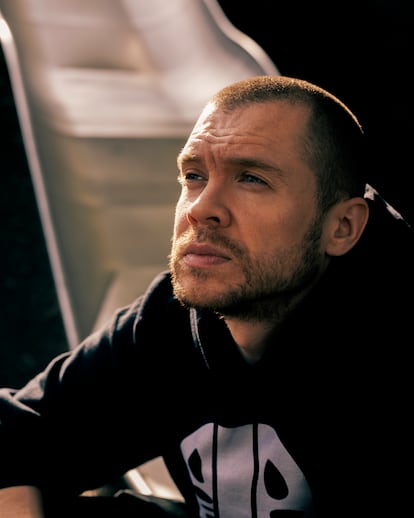
It all began with a few rudimentary videos on YouTube five years ago. Then, in February 2024, Penguin Random House published the memoir of a guy with a #3 buzz cut who tends to dress like he’s going to the gym (or about to ask you for a rolling paper in the park), and who has has a clear working-class accent. Stevenson began to attract attention from the public and from the British establishment. Financial Times published a long-form article contesting the idea that he was the best trader in the world. There was no need for anyone to take the rest of his statements seriously, the piece implied.
His book went to #1 in the United Kingdom (during 2025, it held the position for 11 weeks) and was published in 13 countries. Its film adaptation will soon be released, and that once-rudimentary YouTube channel now has 1.5 million subscribers. Recently, Stevenson took a break to go on vacation in Italy. But after two weeks, he came back to announce that he was canceling the rest of the trip because he had decided to produce a documentary about taxes for Channel 4. On October 1, he appeared on the podcast hosted by Zack Polanski, the flamboyant new Leader of England’s Green Party. There, Stevenson announced the end of an era, of a societal ideal that he says has collapsed. “I think it’s pretty obvious what the loudest idea is at the moment, not just in this country, but across the world, which is, you know, [Reform UK leader Nigel] Farage, reform, the far right, the alt right, what you want to call them, they’re entering that vacuum.”
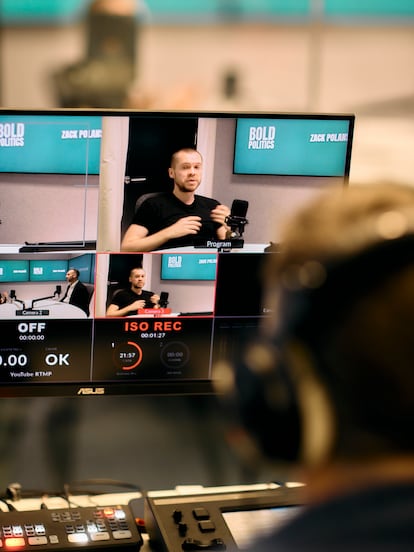
Stevenson appears to be a new voice on the left, one that is connected to the white, male working class, and who has decided to center his discourse on inequality and the economy. As to be expected, this has resulted in a certain amount of criticism. “I know about the economy. I know my subject and I don’t talk about things that aren’t my subject. Look, first they call you to talk about your thing; then, if it works, they call you to go on set at seven in the morning, sit on a sofa and comment on 10 headlines. I did that once, and I said I’d never do it again. I go on the news and I have to talk about trans rights, immigrants and the royal family; that minimizes the fact that I am an expert in the economy, in this concrete thing. And I don’t want my discourse to get diluted, because I’m practically the only one talking about the subject. But the fact that I focus on inequality doesn’t mean that I don’t think climate change is important. It’s just that I know less about it. They’ve tried to convince us in a devious way that it’s a debate between affordable housing and trans rights. That’s nonsense. The truth is that life is hard for men and for women and it’s important to understand why they’re all unhappy. There are a lot of unhappy people who want change. And the extreme right is not going to improve anyone’s lives. We are fucked because they are going to vote for the ones who are going to make their lives worse, and that has to change now. The left should stop talking about Trump voters and listen to Trump voters.”
His proposal has lead to a deluge of criticism from individuals who are aligned with his economic ideals, but who aren’t willing to approach a segment of the population that is supposedly sexist, racist and xenophobic in order to stop the rise to power of a sexist, racist and xenophobic political party. But in Stevenson’s worldview, it makes sense. In the end, everything comes down to whether our economic well-being gets better or worse, including our most perverse and uncompromising ideals.

What makes Stevenson uncomfortable is also what makes him special. He exudes an alpha masculinity from the first pages of his book, which comes across as a mix between Goodfellas and The Wolf of Wall Street, two films whose messages have been co-opted as a foundational texts for the crypto-bro set. He believes stridently that he is right, and has no explanation for the fact that he has yet to be tapped by any political party. There is an arrogance in him that runs tremendously counter to what is meant to be today’s progressivism. “Someone told me the other day at a talk in Newcastle that the left’s problem is that it doesn’t appeal to men. I think that in certain leftist spaces, young men feel like they’re not wanted. It’s happened to me. It’s fucked, but it’s the truth. There’s a kind of racism. I never sought out to have young men as my primary audience, although it’s true that many find space on my channel. And that comes from the fact that the left has a problem when it comes to how it perceives young men. They don’t make money, and the left doesn’t accept them. So they go to Reform, or Vox, or Chega, and they’re told, ‘We want you here.’”
The men he says go to his YouTube channel are those who have grown up adoring billionaires like Elon Musk, those for whom the only status symbol, nearly the only cultural good still relevant in the 21st century, is money. “When you’re 18, you can think that you’ll be a billionaire when you’re older. But if you still think that at 26, it means you have a problem. I’m not very popular among people under 26. But I do very well with those who have realized that the game is fixed, that they’re not going to win.”
Another factor in which Stevenson sees certain dissonance in the progressive ecosystem is its way of navigating our relationship to the past, its position on the debate of whether we are better or worse off than our parents. The Brit does feel nostalgic sometimes, but not for summers in his grandparents’ small town, or the supposed sincerity of life without weekends sponsored by Ryanair or subscriptions to Netflix and Uber Eats. What he longs for is a tax system that, he says, was more just. “I see my father’s generation and I think that the majority weren’t at all obsessed with money. For them, the important thing was work. You work hard and you take care of your family. Now, you work hard and you don’t earn money. They’re telling you that if you don’t manage to make a lot of money, you’re a failure, but the truth is that without family money, without connections, it’s incredibly hard to get rich. We have to communicate how the truth of the matter is that the majority of wealth today is based on what you inherit. If you understand that, you may stop judging everyone else and yourself based on what they earn. And from there, getting back to the subject of men, this thing about not earning generates more frustration for them, and it’s one of the big causes of the masculinity crises we’re experiencing. Men and women receive the message that if they’re not getting rich, they’re shit. The difference is that men take it worse,” he says.
In February of this year, he appeared on the program run by Piers Morgan, the outspoken commentator from the right who was publisher of News of the World and Daily Mirror. Stevenson was meant to debate with the conservative talking head Dave Rubin, who is known for having coined the term “regressive left.” Stevenson recalls how the program was running late, and he ended spending an hour in his dressing room watching the show and trying to understand the kind of traps that were being set for the left-wing activists who were paraded across the set, their actual views being ignored when they weren’t being outright ridiculed. Perhaps, Stevenson thought, they didn’t mind getting into conflict or being the butt of Morgan’s jokes, because they understood that this was not their audience, that their only job was to be performative. When they returned to their circle, they too would have a good laugh about what had happened on set.
But he wasn’t going to do that. “They always look for left-wing activists who fit their stereotypical idea of who that is, someone with blue hair, transgender… And then they try to get them mad and say something scandalous that will outrage their audience. Then they can say, ‘Look, this is what the left is like.’ And it’s so easy for them, because there are many activists who fall into that trap. So I thought, ‘I’m going to listen and I’m not going to play their game.’ They asked me if I liked Trump, I replied that I didn’t know him. Then, if I liked Musk. The same thing: ‘I haven’t had the pleasure.’ In the end, I told them that everyone at the table was a millionaire and that the world would be a better place if we paid more taxes. I don’t think they liked me putting myself in the same group as them, but they couldn’t contradict me,” says the author, a member of the Patriotic Millionaires group in the United Kingdom, whose members are wealthy people who want to pay more taxes.
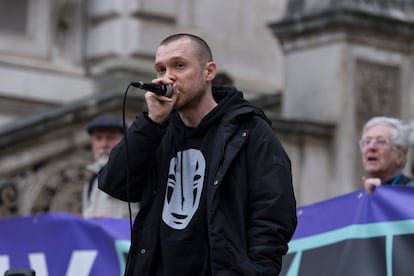
This exposure to mainstream media raised Stevenson’s profile. In contrast, his attempts to attach himself to a political party through which to put his agenda into action have been less successful, though he has made inroads with Polanski’s Green Party, whose popularity is skyrocketing. It pains him that prior to writing his book, he was snubbed by the Labour Party, while a large corporation like Penguin was willing to take a chance on him with a significant advance — for a book that was, in essence, the story of a guy who enters the global financial system and discovers that the best thing to do with it all is to destroy it.
Today, he says that he has yet to be contacted by anyone in Prime Minister Keir Starmer’s administration, and though he is convinced that an internal revolution will change the party’s leadership next year, his hope in the party is practically null. “Nothing is going to work if they keep playing at being sensitive and sensible. That’s no good anymore. Unfortunately for the moderate left of the world, it’s easier to buy into the right’s framing than that of the people to their left. Look, all this shit about grow, grow, grow — no one believes that anymore. Where will the money come from? There’s no more time. Everything went to help during COVID, when we knew that governments were going to have to spend a lot of money, trillions, but we weren’t concerned about whose hands that money was going to wind up in. We were already headed towards a tremendously unequal world, but that accelerated everything. That inequality brings with it a halt on social mobility, which means that this society is no longer capable of putting the best people in the best positions. Today, there is no connection between how intelligent you are and how far that can get you. We are run by idiots who have gotten to where they are by having rich parents. That’s how the Roman Empire collapsed,” says Stevenson, who has a personal vendetta against economists since going to Oxford University to get his master’s degree. He tried debating a few of them, and things turned out only so-so. “The economy has failed, and economists are trying not to talk about it. They don’t want anything new to happen, and I have new ideas… although, so does Milei.”
When presented with the observation that some people think it would almost be better to let the Mileis of the world win, to burn it all down, the author balks.
“And how is that idea going in Argentina? Like shit, I’ll tell you. I’m no expert on Milei, but the truth is that watching that kind of person fall is not enough. It’s not enough to see your enemy immolate themselves if you don’t have anything to say after their fall,” he says.
What is it that he most fears about a far-right government? “The far right only has one direction to move towards: further right. They always have a long list of people and entities to blame for everything: universities, immigrants, feminists, the media. You play at a big advantage when you can blame almost everything for what is wrong. Farage says that he is going to stop the entry of refugees, but that is obviously not going to improve the economy. So what will he do when it’s clear nothing is getting better? Well, he’ll say the real problem is illegal immigration. Then, he’ll begin to deport people. When the center fails, which it has done, it collapses because it has nowhere to go. In contrast, the right can always go a little further right. There’s always more room there.”
Is that what’s happening right now with the Trump administration? “Obviously he’s much more radical than he was in 2016,” he says. “My hope is that we can use Trump. It’s important to see how quality of life in the United States is not getting better and understand that if Trump hasn’t been able to make that happen, the far right won’t be able to in Europe, either. The problem is that here, we’re not talking about the fact that quality of life in the United States is collapsing. Trump is our opportunity to show that the extreme right doesn’t make people’s lives better. But we are not building that discourse, or any alternative.”
And the housing crisis? “It’s very strange, because there’s a housing crisis everywhere and everyone thinks that theirs is special and unique,” he says. “It’s not. What is happening is that there are massive purchases of global property because, what do rich people do? They buy, and they make prices go up. The problem is that you can’t compete with them to buy anything, including a house, clearly. The most wealthy aren’t going to live in a thousand houses, but they can buy a thousand houses.”
And does he regret not continuing his rap career? “No, I was really bad,” says Stevenson. “My sister is the good one. I’m much better at this.”
Sign up for our weekly newsletter to get more English-language news coverage from EL PAÍS USA Edition









































