
The myth of alpha male dominance: Study debunks the idea that males always rule primate societies
In 70% of the populations analyzed in a study, the power relations are unclear, and neither sex dominates the other
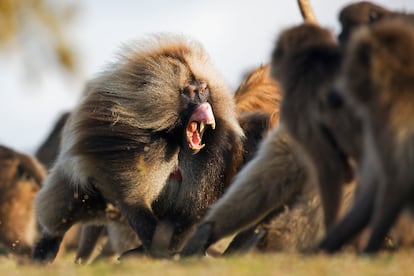

Here’s a seemingly counterintuitive fact: power dynamics between males and females in nature are not clear-cut at all. For a long time, it was believed that males generally dominated females socially among primates, because they are bigger, stronger, and more necessary for the group’s survival. But this view is increasingly being challenged by the scientific community — and with good reason. A new study has shown that in most populations and species, neither sex clearly dominates the other. So falls the long-standing myth of male dominance.
The results of the study were published Monday in the journal Proceedings of the National Academy of Sciences. Researchers from the Max Planck Institute for Evolutionary Anthropology (Germany) and the University of Montpellier (France) compiled data from 253 studies covering 121 primate species. They focused on agonistic interactions — fights, threats, submissions — between adult males and females, which make up half of all social conflicts in primate groups. Their findings challenge the long-held notion that males are naturally the dominant sex, suggesting instead that male dominance is more the exception than the rule.
“Power relationships between males and females are much more flexible than is often assumed,” explains Dieter Lukas, one of the study’s authors. The study found that only 17% of primate populations showed strict male dominance, 13% strict female dominance, and in 70% of cases, dominance was shared or ambiguous — meaning it was not clearly held by one sex.
“Other researchers had already begun to highlight this in nature, but our study showed great variation in these relationships, where power shifts can even be observed between different populations of the same species,” adds Lukas.
The idea that male dominance is nearly universal arose because researchers often projected their own biases and expectations onto animal behavior. Co-author Élise Huchard points out that this reflects human biases and the way they are projected onto animal relationships. “It’s difficult, even for scientists, to free themselves from their subjectivity, as we are also influenced by the society in which we live,” she says.
The first species studied by primatologists — baboons, macaques, chimpanzees — were all male-dominated. “For a time, researchers thought these species represented the ‘archetype,’ until some studies revealed exceptional social diversity,” says Huchard.
This research showed that females have alternative ways to gain power, which are sometimes subtler and more peaceful. While males rely on physical strength and coercion, female empowerment stems from different strategies that had long gone unnoticed by science.
The reasons for dominance
Female dominance is mainly observed in species where females are monogamous or similar in size to males, such as lemurs, galagos, and slow lorises. It also occurs where females control reproduction — deciding when and with whom to mate, as with bonobos — or where there is no infanticide, which helps reduce conflict.
Male dominance, on the other hand, occurs where males are larger, groups are terrestrial, and many females mate with multiple males, as seen in chacma baboons, chimpanzees, and gorillas.
“The main mechanisms by which females gain power appear to be related to their ability to choose which males to associate with and which to mate with,” says Lukas. However, in some cases, females assert dominance aggressively: for example, bonobo females band together to overpower individual males.
The findings have implications for humans, offering new insights into disentangling biological and cultural factors behind gender inequality in Homo sapiens. For now, the authors suggest that our primate ancestors did not have such a biased power structure as previously thought, and that dominance between males and females was flexible. “Humans are not part of a species group where power is fixed toward one sex,” Lukas notes. Huchard adds: “Our species lies on a spectrum.”
Humans display many traits seen in species where relationships and power play are highly nuanced. “I don’t think there’s a single gender inequality system in our species. There are huge cultural differences around power,” says Lukas. What does seem certain is that historical gender imbalances are not the product of an evolutionary legacy.
Sign up for our weekly newsletter to get more English-language news coverage from EL PAÍS USA Edition









































