
Mexican peso defies uncertainty with forecasts of a new period of stability in 2026
The market consensus is that the exchange rate will remain in the range of 18 to 20 pesos per dollar with a slight tendency towards depreciation, given a still weak economy and attention to monetary policy decisions both at home and in the United States
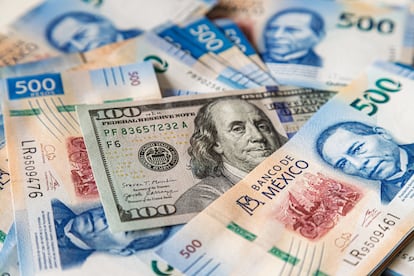

The Mexican peso ended the year stronger, breaking the psychological barrier of 18 units against a weaker U.S. dollar. The market now anticipates that one of the preferred emerging market currencies will maintain its relatively stable performance in the coming months, albeit with a slight tendency toward depreciation, trading in the 18-20 unit range, attentive to economic weakness, the Bank of Mexico’s anti-inflationary policy, and U.S. interest rate decisions.
According to the consensus of year-end surveys, the peso is expected to remain hovering near 19 pesos per dollar in 2026. The latest Reuters poll estimated that the currency will weaken 3.4% to 18.92 pesos per dollar over the next 12 months, after closing the year in the upper 17-peso range. Citi’s expectations survey also adjusted its forecast, placing the average annual exchange rate at around 19 pesos per dollar.
“One of the key factors behind the peso’s strength has been the perception of macroeconomic stability in Mexico, supported by inflation that has shown signs of moderation and by a still-restrictive monetary policy. This interest rate differential with respect to developed economies continues to be a significant attraction for capital flows, especially in a global environment where investors continue to prioritize risk-adjusted returns,” wrote Antonio Di Giacomo, senior market analyst at XS.com, a digital asset broker, in a market note.
While the Mexican economy is set to end the year with modest growth, it managed to avoid a recession triggered by the uncertainty stemming from the rhetoric of the country’s main trading partner, the United States, which announced tariffs on Mexican imports in early 2025. Multiple postponements of the measure, along with a proactive negotiation policy led by Mexico City in Washington, have eased investor concerns. However, they have not been entirely dispelled, and capital will remain attentive to the review of the USMCA, the regional free trade agreement, which will be key to investment decisions, particularly in manufacturing and industrial goods linked to bilateral trade. A contentious discussion could take its toll on the peso.
Meanwhile, the Bank of Mexico has begun to signal that it is considering economic growth in its monetary policy decisions, taking a more cautious approach to cutting its benchmark interest rate, currently at 7%. On the dollar front, markets are also closely monitoring the decisions of a Federal Reserve that is showing increasing internal divisions under pressure from President Donald Trump, who is calling for more aggressive interest rate cuts.
At its last meeting in December, the Fed cut the federal funds rate by 25 basis points, bringing it to a range of 3.50% to 3.75%, in a decision reached by the majority but with three dissenting votes. The adjustment responded to weaker labor market performance and inflation with lower upside risks. “We anticipate that the Fed will keep the rate unchanged at the January 28, 2026 meeting, awaiting greater clarity on inflation and employment,” said the economic analysis team at the brokerage firm Valmex.
“The majority of the Committee (Federal Open Market Committee) felt that, with this adjustment, monetary policy is better positioned to respond flexibly to the economic environment. However, differences remain: some participants see room for further cuts in 2026 if the inflation outlook continues to improve, while others believe the policy stance could remain within the current range,” the firm added.
On the penultimate trading day of 2025, the Mexican peso remained virtually unchanged at 17.99 units per dollar, amid the lower liquidity typical of this time of year. According to the GBM brokerage, the annual average exchange rate closed Tuesday at 19.22 units, a benchmark that offers clues as to the level at which the currency might trade next year.
Sign up for our weekly newsletter to get more English-language news coverage from EL PAÍS USA Edition









































