
‘A new frontier of potential abuse’: Is it legitimate to charge someone flying to a funeral more than a leisure traveler?
Delta Air Lines’ intention to use artificial intelligence to set personalized prices opens the debate on the limits of privacy and freedom of choice in commerce
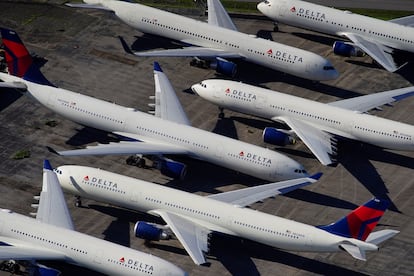

A plane ticket doesn’t always cost the same. The price can vary depending on the type of seat, the day of the week, the time of the flight, or the time of year, among other things. But what if those facing unforeseen events, such as attending a funeral, were also charged more? That’s what Delta Air Lines intended to do: establish personalized prices using artificial intelligence (AI) tools that process each customer’s unique data. The idea surfaced this summer and drew angry criticism from some members of Congress and senators, to the point that the company withdrew the initiative.
But the debate was sparked: is it legitimate to set specific prices for each customer based on the analysis of their personal data? For Lina Khan, commissioner of the U.S. Federal Trade Commission (FTC) until last January, it’s something we should refuse as a society. The jurist calls this practice surveillance pricing. “It’s not just that data is collected about you, but that it’s also used against you to charge you whatever you’re able to pay,” she recently said in a podcast. The expert wonders what would happen if a customer suffers the death of a relative and receives an email with available funeral services. The airline might know that customer wants to go to a funeral and decide to charge them more. “This is one of the new frontiers of potential abuse that we have to be on guard against,” she warned.
The FTC published a report in January — three days before Khan’s dismissal by the recently reelected Donald Trump — warning of the detrimental effects of AI-powered personalized pricing on both competition and users. “There are concerns that, at least for some potential buyers, the use of surveillance pricing may result in some consumers paying higher prices than others in cases where the algorithms predict the potential buyer has a strong desire for the given product or service,” the investigation concluded after examining documents provided by Mastercard, Accenture, and McKinsey, among others.
Corporations are using AI and your private data to hike up prices or cut your wages.
— Congressman Greg Casar (@RepCasar) July 29, 2025
If Congress doesn't ban this practice now, it'll spread like wildfire. My new bill would ban it. pic.twitter.com/PWwRsqZiBS
That’s precisely what they’re aiming for: reaching the so-called “pain threshold,” the maximum price a customer is willing to pay at a given time. The approach is to use as much personal information as possible — from location and demographic data to mouse movements on the websites visited — to exploit the customer’s weaknesses. AI is capable of processing the large databases purchased from data brokers, companies that collect and sell the digital footprint of internet users, in addition to all the contextual information already taken into account (time of year, competitor prices, etc.).
Delta President Glen Hauenstein said in an investor meeting that they would be able to calculate exactly how much each customer can afford to pay for their ticket. The goal was to have “a price available for that flight, at that time, for that specific person.” He also said that 3% of fares were already being calculated using AI, and that they aimed to reach 20% by the end of the year.
“The implications for individual consumer privacy are severe on their own. Surveillance pricing has been shown to utilize extensive personal information obtained through a variety of thirdparty channels, including data about a passenger’s purchase history, web browsing behavior, geolocation, social media activity, biometric data, and financial status,” three senators wrote in a letter sent to Delta’s CEO after the plan came to light.
Following complaints, the company issued a statement to the effect that it would not use personal information to set prices. Fetcherr, the company that developed Delta’s tool, counts among its clients other airlines such as Virgin Atlantic, Westjet, Viva Aerobus, and Brazilian airline Azul.
A well-known practice
Prices have been varying depending on the customer for some time now. Or at least that’s what many companies with the capacity try to do. It’s been documented, for example, that a plane ticket or other products can be more expensive if purchased from an iPhone than from an Android (Apple phones are more expensive than others, so this metadata — the device used — serves as an indicator of income). Or that if someone checks the price of the same flight several times and ultimately buys it, the final price will likely be higher than the first one shown.
Imagine needing to fly home to take care of a sick parent and AI has your personal data, knows you’re desperate, and raises your ticket price.
— Ruben Gallego (@RubenGallego) July 22, 2025
That’s the future Delta could be heading toward. Pricing based on your personal pain point.
I’m demanding answers and fighting back.
Charging each customer the maximum they’re willing to pay for a product at any given time is an idea that makes perfect sense from a strictly business perspective. “On a theoretical level, this has to do with the so-called consumer surplus: if you’re willing to pay €200 to go to a concert by your favorite band, but it costs €50, then you’re in luck. Companies have always tried to capture part of that surplus through various techniques. The classic case is airline tickets,” explains Manuel Alejandro Hidalgo, a professor at Pablo de Olavide University and an economist at EsadeEcPol. “In a scenario where all companies set personalized prices, we could reach a point where the extraction of that surplus would be almost perfect. But that would have side effects: consumption would be reduced, because if the user spends a good portion of their income on what they like most, they won’t have any income left over for other things,” he points out.
Is it legal in the EU?
AI has long been used to set product prices. Amazon, for example, can adjust the price of its items dozens of times a day based on algorithms that analyze real-time information about competitors and user behavior (for example, whether a product is selling quickly or slowly), as well as events, weather, or other factors that may affect sales.
But perfecting market analysis techniques is one thing, and incorporating users’ personal information into the equation is another. That’s where the EU draws the line. “Article 22 of the General Data Protection Regulation prohibits the adoption of fully automated decisions based on your personal data that affect your rights or have other significant effects on you,” explains Jorge García Herrero, a lawyer specializing in data protection. “The company needs the data subject’s consent to do this,” he emphasizes.
In the U.S., however, the use of personal information for personalized pricing would not be illegal. That’s why figures like the former FTC chairwoman, the three aforementioned Democratic senators, and Congressman Greg Casar are calling for a ban. “I think all states should pass bans on surveillance-based pricing, especially if Congress fails to act,” said Sam Levine, former director of the U.S. Bureau of Consumer Protection, referring to the Delta case. “We have an opportunity to protect both people’s privacy and affordability before it’s too late.”
Sign up for our weekly newsletter to get more English-language news coverage from EL PAÍS USA Edition









































