
‘Music, Fashion, Film’ and the death of ‘Brat’: Charli XCX’s new creative era
The British artist launches her much-awaited collaborative project with producers A.G. Cook and Finn Keane on July 24
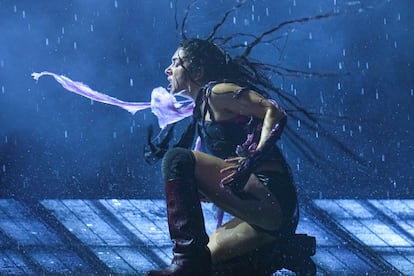

When speaking of Charli XCX, nearly everyone thinks of a woman behind sunglasses, her disheveled hair falling across her face, smoking Parliaments as though her life depended on it. This is, at least, the character (“persona”) represented on a conceptual level by Brat, an album immersed in the idea of the cool kid, femme fatale who displays her candor and confrontational nature while embracing rave culture, purporting to do whatever she wants as if nothing mattered and never would.
Such was the essence of the cultural phenomenon behind the pixelated album title in Arial Narrow Bold on a recognizable lime green background. But there was much more behind the logo: conversational verses that offered a perfect portrayal of pain, Charli’s introspective and cathartic process when it came to making the album, all told from the perspective of a woman in the industry, a chronically online pop star.
Brat’s message connected because it reflected key characteristics of Gen Z: radical honesty with no filters, endowed with a raw way of exposing pain and insecurity, an identity fragmented by societal pressure and social media, an ambivalent relationship with traditional femininity (always hovering between rebelliousness and vulnerability), a rejection of polish in the pursuit of authenticity and an existential exhaustion that translates into explosive expressiveness.
@charlixcx Von dutch - Feb 29
♬ Von dutch - Charli xcx
Still, for the launch of her new album Music, Fashion, Film, which has one of the most iconic covers of the year (reuniting John Cale, Marc Jacobs and Martin Scorsese in a single image) and which will be released on July 24, Charli wanted to do something totally different.
“All of my albums work in opposites. They repel against each other, and that’s the connective tissue,” she said in a Rolling Stone interview published on June 18. “I knew when I was making [Brat] that I was never going to make that record again. It’s not creatively rewarding for me to make the same thing twice.”
Throughout the process of writing MFF, an album the artist put together with one of her oldest collaborators, British producer A.G. Cook, and composer Finn Keane, Charli has spoken on multiple occasions about her feelings about launching a new project after a hit as massive, with such an explosive reach, as Brat, which earned eight 2024 Grammy nominations and won three, including Album of the Year.
“I don’t really feel the pressure, because I feel that you can never really do the same thing twice, and my next record will probably be a flop, which I’m down for, to be honest,” the artist told Culted in 2025.
She was of the same mind in May 2026, when she declared, “It’s funny the way that success can cage you, but I’ve experienced such a wide range of success and failure [..] For the people who knew me before Brat, they know the ebbs and flows of my process, and I understand the ebbs and flows of pop music and pop culture. So I feel relatively free in creating whatever I’ll do next.”
All this is precisely the subject matter of Music, Fashion, Film. According to Charli herself in a recent conversation with content creator Nicky Reardon, her public — and particularly, the fans who came to her through Brat — has been able to see and get to know a very specific part of her life and identity. The new album is about sharing her experiences tied to success, as well as the introspection they occasioned.
“When I’m thinking about Music, Fashion, Film, in ways, it is the polar opposite to Brat. Because Brat was so — it was very blunt, it was very off-the-cuff. Having these conversational songs and sort of talking about living on the internet, and the way that affects me as a person and things like that, whereas Music, Fashion, Film is much more me talking in-depth about my process and the way that I think about the way my life kind of changed during Brat,” she told Reardon.
Meaning of new album
That explains why in MFF’s lead singles, one of the central elements has been Charli’s public perception. In the song Rock Music, she fantasizes about the idealization of success, but this time from the perspective of said rock star. She satirizes herself (a recurrent theme in the album up to this point), saying that “the dance floor is dead” — a verse that led to beef with Madonna, but that Charli herself has explained has to do with her own relationship with Brat — speaking to self-destruction as the only way of feeling something, and whose music video ends with the audience shattering her own image.
This skeptical, destructive tone continued in her next release, SS26, from whose lyrics the album’s title hails. “Spring, Summer ’26 / When the world is gonna end, no hope / for any of it / Yeah, we’re walkin’ / on a runway that / goes straight to hell / Nothing’s gonna save us, not music / fashion or film,” sings the artist in the first verse.
Contrary to appearances (such words could initially seem like a critique of social decline, cynicism and generational desperation), the track is not about the end of the world as such, but rather morality, cancellation, puritanism and collective validation. Charli also makes a reference to her indie ascendence and the banality of music marketing: “Think my politics / could work as a / press strategy / And my heritage / could give me quite / thе USP [unique selling proposition],” she sings.
The latest plot twist comes via Wink Wink, which at first glance seems like an ironic and rebellious sketch of puritanism and a satire of the rise of traditional values (in its music video, Charli comically portrays the tradwife aesthetic, standing in stark contrast to the femme fatale she was perceived as during the Brat era).
“It’s kind of like, about playing into these things that people sort of think that you are and then being like, ‘But I’m not that anymore.’ And it’s like, ‘Well OK, are you?’ It’s like I was saying earlier, there are boxes that people want to put you in, and this is me sort of like, dancing around in that box in a way,” she says in the Reardon interview. “And like, satirizing the box,” the host adds.
As to the musical genre of the album, the artist has stated that “it’s not a rock album, it’s a Charli XCX album,” sharing that it will feature fusions, variations and a unique perspective that will be complex to classify, but that will remain in the arena of pop, the genre the British performer has long inhabited.
If there is something clear about the transition from Brat to Music, Fashion, Film (Charli also released an album between the two, the soundtrack of Emerald Fennell’s Wuthering Heights), it is that it follows her tendency to switch things up between projects. Only, this change is taking place on a completely different level, given that Brat has been by far her biggest hit. Perhaps for this reason, MFF hints at maturity and has greater lyrical complexity, though the project is inevitably colored by the disillusionment brought by large-scale success: validation, fetishization of one’s own image in the industry, self-doubt and that which comes from external sources, and the thin line that separates attention from artistic irrelevance.
In some ways, the album’s discourse represents a social and political experiment (though it seems that in interviews, Charli rejects its social dimension, focusing instead on her own lived experience — though the two can prove difficult to separate entirely). It is the silence after success, the expectations of a next act, a portrait of the sentence of being seen, and the questions that surround whether or not things can continue as they are.
Sign up for our weekly newsletter to get more English-language news coverage from EL PAÍS USA Edition









































