
The brief rise and retreat of Generation Z in Mexico
Born on social media, amplified by indignation, diluted by a lack of clear demands, the movement went from dominating the political agenda to lackluster marches in a matter of weeks
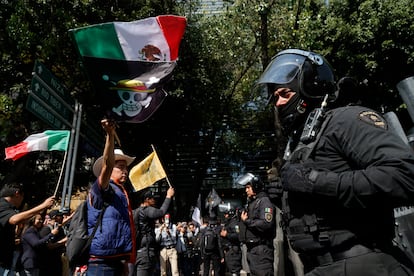

Gen Z is right-leaning, addicted to their phone, diverse and critical, and grew up amid precarity, uncertainty and distrust in politics. Such is the portrait painted by older generations of young people between the ages of 13 and 28. In some countries, these youth have toppled governments, made things quite difficult for other administrations, and in November, a movement calling for protests under the banner of Generation Z had the Mexican government with its back against the ropes. For a couple of weeks, the phenomenon born from social media, with no famous faces, leaders nor unifying rallying cry, managed to install itself in public discourse, and forced Claudia Sheinbaum’s government to react.
It began online, with AI-generated images that utilized the Japanese animated series One Piece. Quickly, it went from being a dispersed phenomenon to claiming popular attention, driven by an indignation awoken by the murder of the mayor of Urupan, Carlos Manzo. From Mexico’s National Palace, the response was clear. The president dedicated space in several morning press conferences to disqualifying and minimizing the protest, citing an investigation by Infodemia that uncovered an international network of misinformation and bots behind the march, which cost around $5 million and was backed by business magnate Ricardo Salinas Pliego.
For Andrea Samaniego, an expert on political discourse from the National Autonomous University of Mexico (UNAM), the government was perceiving a potential threat. In her opinion, the fact that Sheinbaum focused on the march during her morning press conferences shows that the movement was not as irrelevant as she claimed. “If it were as tiny as she says, it’s hard to understand why she would dedicate two entire weeks at the press conferences to who was behind it, which actors, who was paying for it. So, I don’t think it was that insignificant,” she says.
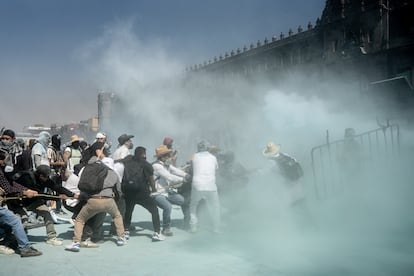
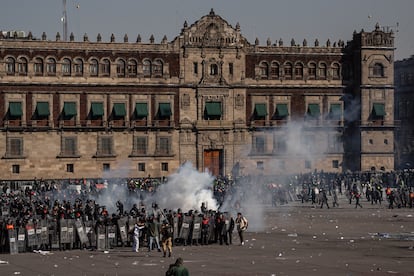
Finally, on November 15, the highly anticipated event took place. The Gen Z protest drew some 17,000 people in the Zócalo, Mexico City’s center square, where protestors clashed with the police. The official tally was 120 injured, 100 of them law enforcement, and 20 arrests. A follow-up came five days later, but wasn’t as impactful, though organizers promised it would overshadow the city’s Revolution Day parade. Ultimately, only a few hundred people showed up, escorted by a large police presence. The third and most recent protest was December 14. It failed, with barely 300 people showing up.
Samaniego attributes this decline in the movement to the lack of clarity in its demands. “In the calls to action, they only talk about a generation that has woken up, a generation that is fed up, but very ambiguously. They don’t clearly communicate who is feeling aggrieved. The retreat is a direct result of not being clear about why they are marching.”
The use of symbols recognized by the age group didn’t help clarify their message either. “The images from One Piece, which had already been employed in Nepal, allude to young people being fed up,” says Samaniego, who asks: fed up with what? “Young people have something to demand. They are a sector that has been deeply marginalized by the system: they have no access to well-paid jobs, they are in the most precarious positions, most of them in the informal sector, they have no access to housing, not to buy nor, in many cases, to rent.” To that vulnerability is added exposure to organized crime. “Recruitment, drug sales, kidnapping in order to blackmail or even for human trafficking are some of the threats they face,” Samaniego says. Even so, the protest lacked specific demands.
The government’s response may have inflated the moment. “Saying that they are part of the opposition could have detonated it growing larger, like what happened in 2012 with the #YoSoy132 movement,” Samaniego continues. At the time, she remembers, the rallying cry was “We aren’t sold out, we aren’t uncritical.” From this, she concludes: “Devoting two weeks to criminalizing a protest as if the constitutional right to demonstrate didn’t exist is serious. Even if those who were protesting had a certain political leaning, it was well within their rights.”
On the other hand, the movement’s lack of visible leaders worked both for and against it. “By not having leadership, they are much more difficult to co-opt, though not impossible. There were many other opposition groups: peasants, farmers, those who had been affected by electoral reform, disputes with business associations like Grupo Salinas, who saw an opportunity to insert their own agendas. Different demands entered into the protest, and that diluted it,” she says. All told, “it seemed like it was not an organic movement. A natural movement persists as long as there is a clear demand. Here, there wasn’t one. It wasn’t completely artificial — if it had been, the government wouldn’t have dedicated so much time to it — but it was amplified by other interests.”
After the protest, Sheinbaum convened her party and followers for a mobilization to show their strength, with the pretext of celebrating the seven years of their so-called Fourth Transformation (the national political reform agenda launched under president López Obrador, which Sheinbaum supports). “They countered with the march on December 7. It was supposed to be a celebration of seven years of victory, seven years of transformation, but it was also a response,” says Samaniego.
Sheinbaum insisted on demonstrating support for Mexican youth during the event: “Let no one be mistaken, the majority of young people are with the transformation of public life in Mexico,” she said. It was the second time in two months that she had sought to fill the Zócalo to silence critics.
At the close of 2025, the president still has high approval ratings, though there have been signs of her support weakening after the assassination of Manzo, youth protests, and demonstrations by transit workers and farmers. Her popularity is at 74%, still higher than that of her predecessors, but the lowest of her administration, according to the latest survey by Enkoll for EL PAÍS and W Radio.
In the video invitation for her Zócalo event, Sheinbaum speaks of “the transformation’s defensive act” against “a monthlong attack campaign.” At the rally she insisted: “In these days, it has been demonstrated that, for all the dirty campaigns they pay on social media, for all the bots they buy, for all the alliances with special-interest groups, for all the communication consultants they hire to invent slander and lies, for all their attempts to make the world believe that Mexico is not a free and democratic country, for all of that, they will not defeat the Mexican people nor their president!”
To Samaniego, the reaction reveals nervousness. “A government with a 70% approval rating shouldn’t react like that. What are they afraid of? Perhaps different internal data, perhaps a right-leaning worldwide trend. It was a very reactive response, one of damage control.” Samaniego offers her reading of the future of the Gen Z movement: “Right now it is paused, but it could reactivate. The government still has issues to address with young people. As long as that structural vulnerability is not addressed, the breeding ground will continue to exist,” she concludes.
Sign up for our weekly newsletter to get more English-language news coverage from EL PAÍS USA Edition









































