
Emilia Clarke, beyond Daenerys: ‘I look back at ‘Game of Thrones’ like you would look back at high school’
The actor stars alongside Haley Lu Richardson in the series ‘Ponies,’ in which she plays a secretary turned spy in 1970s Moscow


Emilia Clarke (London, 39) has accepted it: she will always be Daenerys from Game of Thrones. “I am realizing that for better or for worse, no matter how many other jobs I do and how long I have the good fortune of being an actor, that will be the headline on my gravestone,” she tells EL PAÍS via video call. The interview, conducted in mid-January, is focused on her new series, Ponies (SkyShowtime), but she accepts the questions about her most famous role with a smile, and a touch of resignation. Does she think she’ll ever be able to shake off the weight of having been the Mother of Dragons? “Oh, she’s not a burden, but I don’t think I ever will. And I don’t think that’s the worst thing in the world. I had a beautiful experience, an insane opportunity. I feel incredibly grateful for that. I look back at Game of Thrones and it’s like how you would look back at high school. You kind of have mixed feelings about your time at school. You know, sometimes you’re like that was fun and sometimes you’re like, that sucked,” the actress explains. “And if I discount Daenerys, then I discount me and my twenties. And I don’t want to do that because she was great. I had a great time.”
In Ponies, Clarke and Haley Lu Richardson play two women working at the U.S. embassy in Moscow in 1977. The mysterious deaths of their husbands in a plane crash lead them to become CIA agents to investigate what happened. They leverage their status as “PONIES,” an acronym for “people of no interest.” The two are very different, but their shared experiences will bring them together. Furthermore, Clarke’s character, Bea, is fluent in Russian, something the actor herself, she notes, does not speak. “I had to learn it. Real languages are much harder than made-up ones [referring to Dothraki, a language from Game of Thrones]. And the pressure, because there are different accents in Russia and different dialects. I learned the lines. I couldn’t have done any more. I learned them really well. But on the last day, my very last day, sitting in the car with Artium [Gilz, another cast member], who is Russian, he asked me a question in Russian, and I answered that. I literally was able to answer!” she recounts.
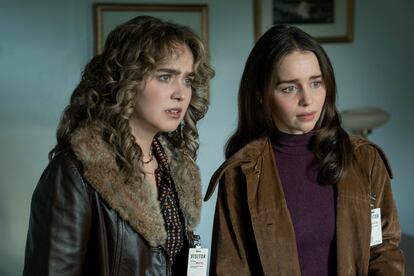
Ponies differs from other spy stories in the comedic touches brought by the personalities of the two protagonists, and their inexperience. With a lighthearted tone, fast pace, and a plot that becomes increasingly complex as it unfolds, the story focuses on the adventures of these two women. “It’s got all the spy show stuff that’s exciting and reels you in and gets you hooked, but then, at the end of every episode, it’s about these two women, their friendship and their growth and their purpose in life,” says Richardson (Phoenix, 30), who is accompanying Clarke in the interview.
Both emphasize the importance of the female perspective in this story. “We’re talking about a time where women didn’t have a perspective. We’re seeing it from a historically silenced group,” says Clarke. “It’s getting to see them thrive in positions of power, the things that women can innately bring to the table that are very useful in those kinds of positions, like, oh, she’s actually good at this because she’s a woman. She can get in his head this way because she’s a woman, she can multitask. She can contain crowds,” adds Richardson, who starred as Portia in the second season of The White Lotus.
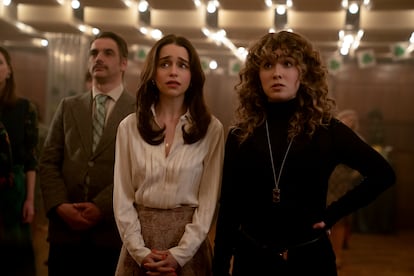
Releasing a series set during the Cold War at a time when the international stage is so turbulent seems particularly apposite. Do its stars think that Ponies is especially relevant today? “Yes and no,” says Clarke. “I think history will always repeat itself. We will always be in moments of tension. And I think that having shows like this highlighting a time that has come before… This isn’t a made up thing. If you were to watch Succession, you’re like, oh my God, they predicted a bunch of stuff. Like they saw the future.’ Whereas with us, we’re talking about a bygone era that existed and is already done. It’s there. But it’s always relevant. It’s always scary,” the actor reflects. “But I think what the series does best is what I look for when I sit down to watch television, which is escapism,” she adds.
The two protagonists of Ponies are American women living in Moscow in the 1970s who feel like outsiders in a world very different from their own, a world that is often hostile. It’s a feeling that’s not unfamiliar to Clarke and Richardson. “You start out in the industry and you get massive imposter syndrome. You put me in an awards ceremony and that can feel real hostile. It’s scary,” Clarke laughs heartily. Her co-star remembers that feeling from her early days in acting. “I mean, moving to L.A. to be an actor at 16. Hello, world. Hello, life. Hello, sharks. Hello, egos. Hello, people that want something from me. It’s a weird balance of not becoming bitter and untrustworthy and closed off, but also protecting yourself,” Richardson recalls. “So yeah, I think we’re talking about the same thing: the industry,” Clarke summarizes. “The world,” Richardson adds.
Sign up for our weekly newsletter to get more English-language news coverage from EL PAÍS USA Edition









































