
Zorro is back — but this time, he’s a French communist who fights the rich
‘You couldn’t shoot this version in the United States,’ says the creator of the new streaming series, Benjamin Charbit
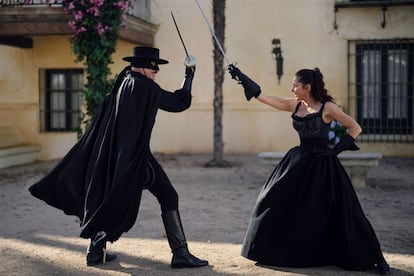

What leads a character as classic and archaic as Zorro to reappear on television on 2026? And of all the potential subject matter, why would he return by way of a French series? “The primary motivation was that producer Marc Dujardin said his brother Jean Dujardin [who won an Oscar for his role in The Artist] wanted to play him. I wasn’t entirely sure about it, but it was a possibility,” series creator Benjamin Charbit tells this publication. “Plus, he had the idea that the vigilante could be used to talk about politics, powerful men and populism. Curiously, when we began to write it six years ago, Donald Trump was the president of the United States. Now, with Trump back again, the violence of the political class continues to be a relevant topic. [The series] was meant to be a comic way of addressing it.”
The new version of the famous masked avenger, which premieres this week on the AMC+ streaming platform, is actually a comedy in true French style. “But it is not a parody,” says Charbit during a January 2025 presentation of the series hosted by Unifrance, a Parisian brand overseeing its local promotion that invited EL PAÍS to the event.
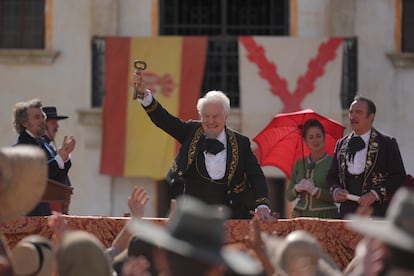
Don Diego de la Vega is, in this latest version of the classic tale, an aged hero in his fifties who is mayor of Los Angeles. His mission is to fight for the city’s residents, but via politics. Serving as foil to the optimism of this Zorro are the classic rich villains of capitalism, who want to steal the water of the city’s Indigenous inhabitants through corrupt ploys. “Everything is so polarized, and with money concentrated in the hands of the few, it’s normal that the villains would be rich people. That makes this a very European Zorro. I think that you couldn’t shoot this in the United States, because it is very political,” says Charbit.
This predicament leads the protagonist to once again don his cape and saddle up his horse to fight magnates in the countryside of the Spanish regions of Castilla-La Mancha and Almería, which stand in for the California deserts and were shot by a primarily Spanish crew, who recycled set aesthetics from Exodus, Ridley Scott and Game of Thrones. “It’s a pre-Western era, so we wanted to give it a more Spanish touch through the buildings, the music… and the contrast with European elegance,” Charbit says.
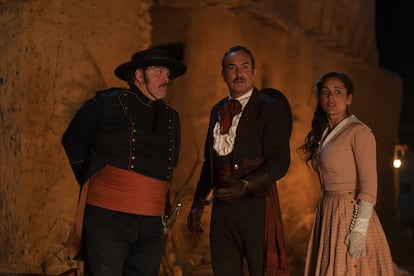
“I was scared. Because it’s very strange to have a Dujardin playing a Spanish noble who lives in California and speaks French, so we had to try to make everything else as realistic as possible, with a lot of historic research about the place and time. The whole message about immigration, Native Americans, their customs, the caste system… that’s real,” says Charbit, who highlighted the series’ focus on themes like hatred of immigrants and Indigenous people. Spanish is also spoken on the show, but as a technique for indicating different social classes. Such messages make the production extremely current, despite it resembling a serial from another era.
A proto superhero’s long revenge
Zorro is a character with more than a century of history behind him, having made his debut in 1919 with the pulp novel The Curse of Capistrano as a proto superhero. He rose to fame thanks to the film The Mask of Zorro one year later, a movie featuring silent film superstar Douglas Fairbanks. Since then, Zorro has sought revenge in more than 40 adaptations. Even Batman was based on his dark, mysterious panache. Tyrone Power embodied Zorro’s 1940s version, he had the face of Guy Williams in a 1950s series, Antonio Banderas brought him to the Hollywood spotlight with two movies in 1998 and 2005 that inspired yet another series, and he’s been the subject of animated programs and Japanese versions. Amazon Prime Video clad Spanish actor Miguel Bernardeau in his cape in 2024, a rendering that recalled 1970s Andalusian bandit Curro Jiménez. Charbit recalls how “that one focused more on action, violence and youth.” The character had never been played by a French actor. “My biggest inspiration was actually the Robin Hood movies, specifically the mature hero in Richard Lester’s Robin and Marian,” explains Charbit. “Both ask the question, ‘Is he the hero he was when he was young?’ We wanted to deconstruct that.”
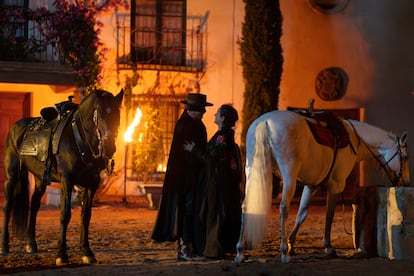
To complicate matters further, the new Zorro is kind of a communist who wants to share everything among the people. “Zorro is a Marxist, despite himself. Don Diego is a Spanish noble, but he doesn’t see all the privilege he has. As Diego, he wants to improve the situation, but not change it. As Zorro he breaks the boundaries without knowing it and confronts the status quo,” says Charbit. The series creator still looked to respect the character’s classic traits like his sense of justice, positivism, his loneliness and his goal to not kill. “That aspect also makes it very European, because over here, we don’t use the American kind of violence. The use of guns and murder is strange to us. It serves as a contrast with Batman and other contemporary figures, whose violence and action is exaggerated and computer-generated,” says Charbit. This version of Zorro is far more given to circus tricks, leaps and gallops.
Of course, as a classic serial program, it also makes time for a conflicted love story. Audrey Dana plays opposite Jean Dujardin, and the series also seeks to highlight women’s struggle. “She is a woman who also represents rebellion,” says Dana. “She has been with her husband Diego for 17 years, they have no children, they don’t make love. Suddenly, she meets Zorro, who reawakens her life,” says the actress in Spanish. In the end, these are timeless concepts. I think it’s very important to maintain hope in the world, and not to be afraid or give up our power. We have to fight, with humor and hope. Whether it’s for the environment, against violence... art can open that up.” She also highlights the importance of the show depicting a mature couple. “Everyone looks young on screen, women don’t want to have wrinkles. The world is clearly afraid of dying. That’s why this Zorro wants to show how time passes for the characters and their choices. It’s natural.”
Does this make a hero as archaic as Zorro the solution to today’s problems? Charbit points out, “Perhaps superheros like to fix things, but I don’t believe violence is the long-term solution. What we do need from him is his way of rising up, of saying things clearly and having empathy. The world needs more of that.”
Sign up for our weekly newsletter to get more English-language news coverage from EL PAÍS USA Edition









































