
Alejandro Jodorowsky, the immortal artist: ‘I’ve been thinking about death since the day I was born’
Approaching his 97th birthday, the Chilean artist has published a book with Taschen in which he reviews his career, almost as boundless as it is surreal: ‘My most important work is tying my shoelaces with my teeth’
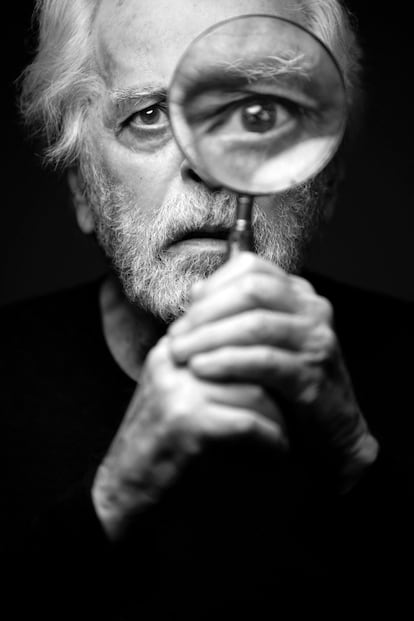

On February 17, Alejandro Jodorowsky — born in Tocopilla, Chile in 1929 — will turn 97. His birthday was still a few weeks away at the time of this interview, but the artist said he already knew the three wishes he’ll make when he blows out the candles: time, time, and more time. “I want to live 15 more years to continue doing what I’m doing: living pleasantly,” he explained in a video conference from his home in Paris. He has so many projects in the works that it’s hard for him to list them all. “Ask my wife,” he said, pointing to his wife, the artist Pascale Montandon, who was by his side throughout the interview.
“Alejandro is working on several books and comics, exhibitions, films…,” noted Montandon, who is 43 years younger than the artist, and has been his wife and collaborator for more than two decades. Jodorowsky’s most recent project is Alejandro Jodorowsky. Art Sin Fin (Taschen), two volumes in which he reviews his career, almost as boundless as it is surreal.
Curated by editor and academic Donatien Grau, director of contemporary programs at the Louvre, this monograph is a work of art in itself and a manifesto that captures Jodorowsky’s kaleidoscopic, mysterious, and dreamlike creative spirit across all his universes, from film and theater to poetry and comics, by way of philosophy and tarot. It also includes a chapter on psychomagic, a non-scientific technique he created and practices that combines shamanism, tarot, psychoanalysis and dramaturgy, and which, he claims, serves to resolve psychological conflicts and “heal” the spirit.
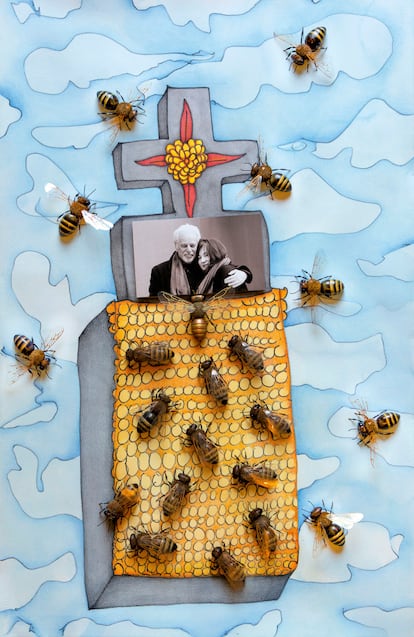
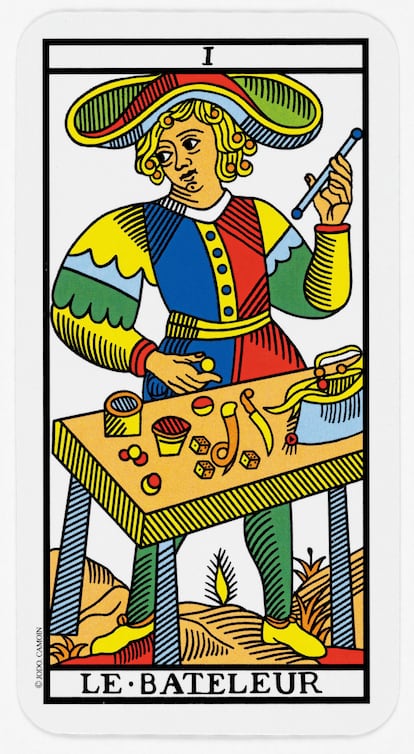
“I find psychoanalysis amusing. I’ve read Freud, Fromm, Jung—I’ve studied them all,” said Jodorowsky, recalling that as a young man he studied philosophy and psychology for two years at the University of Chile. “But psychoanalysis believes it works with the truth, and that’s a mistake. We are millions of miles away from the truth. There are millions of truths. We seek to get closer to it, and that is already a great step,” he adds in his characteristic cryptic style.
Despite his advanced age, he continues to practice psychomagic. He also continues to read tarot cards for free. “I don’t charge. Now they charge you for everything, even for food. Look at the restaurants, they charge. Food should be free. Art should be free.”
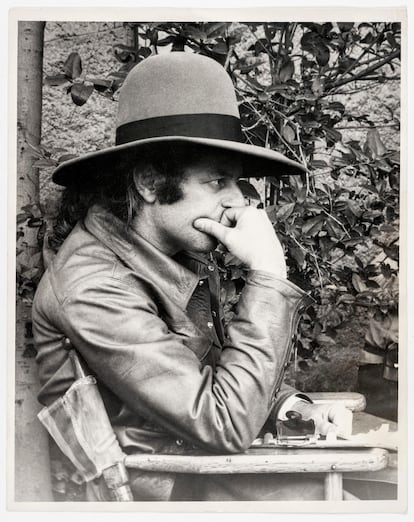
Like a riddle, his work is intricate, sometimes incomprehensible. The first volume of Art Sin Fin is a visual feast of fold-out pages, film stills, scenes from his performances, collages, drawings, and rare photographs from his personal archive. The book spans his career from the beginnings, when, at age 23, he arrived in Paris to study pantomime and, incidentally, “save surrealism” alongside Fernando Arrabal and Roland Topor. It also includes references to artistic milestones such as El Topo, his 1970 acid western; the hallucinatory and dreamlike The Holy Mountain from 1973; and his legendary, unfinished adaptation of Dune.
The second volume shifts from image to voice, collecting Jodorowsky’s own reflections and confessions about his work and life. In his singular style—philosophical, scandalous, unrestrained—he maps out his obsessions, triumphs, and failures.
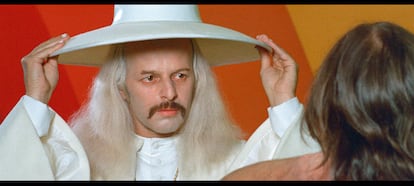
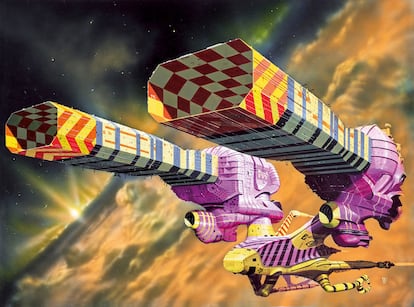
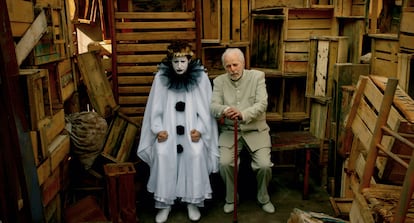
His ideas are often as hypnotic as they are indecipherable, always oscillating between the purest sanity and the most grotesque absurdity, between the logic of a child and the madness of an old man. When did he discover he wanted to be an artist? “When my mother gave birth to me,” he replied. What was his first artistic creation? “Reading the ABCs.” His most important work? “Tying my shoelaces with my teeth. I take the lace in my mouth and make a really pretty knot, like a rose. That’s the best thing I’ve ever done.” What things make him happy? “You, my wife, and me. Those are the three things that make me happiest right now.”
When asked how he stays in such good shape as he approaches his 97th birthday, he replied, “No effort at all.” Then the artist, who has had three wives and five children, added, “To reach 97, you have to have a lot of women.”
—Well, in that case I won’t live long because I’m gay.
—Are you gay? That’s fantastic. I’m not homosexual, I’m “trentisexual.”
Then his wife Pascale Montandon chimed in with a laugh: “Alejandro doesn’t have 30 women, he only has one.” It’s not easy to tell when Jodorowsky is serious and when he’s joking. He said he’d like to live to 100, like his father, but that he isn’t afraid of death. “I’ve thought about it since the day I was born. It doesn’t scare me. If we don’t think about death, we aren’t living,” he reflected. He doesn’t believe in God—“If he exists, he believes in me”—and defines himself as a “mystical atheist.”
Everything about his work and his life is a contradiction, and yet everything he says rings true. He is an invention in himself, a grand magic trick that began in his childhood in the town of Tocopilla. There, in the Chilean region of Antofagasta, where mutilated coal miners drank to forget their lost limbs and dead fish “swam” along the coast, little Alejandro began to dream and to dream himself.
“Tocopilla was a village built facing the sea and the Andes. Now it seems magical to me. Every Tocopilla native is a magical being. I was a brilliant child. At four years old I started reading and I threw myself into creating. Everything I was able to do as an adult I was able to do as a child,” he said.
The son of Ukrainian Jewish immigrants, he had a relatively comfortable childhood. His father, a merchant by trade, sympathized with communism. “He wasn’t a communist, he practiced communism. It’s something else entirely,” he quipped, preferring not to comment on his own ideology: “My ideology is cinema.” He also didn’t want to talk about the resurgence of right-wing politics in his two homelands, Chile and France. “For me, politics isn’t reality. Neither is religion.” Nor did he want to comment on the wars in Ukraine and Gaza. “I don’t live in that reality. I’m Jewish because I was born Jewish, but I’m not Jewish. That’s how it is.”
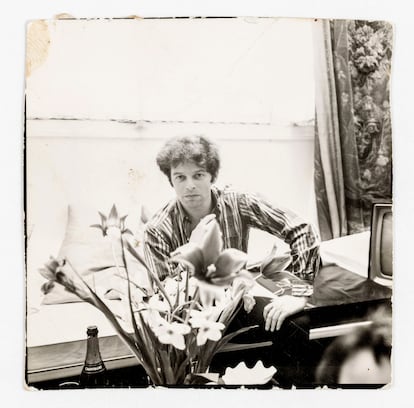
Jodorowsky has been playing a game of misdirection since childhood. At age 10, he moved with his family to Santiago, Chile. In 1945, he published his first poems and collaborated with Nicanor Parra and Enrique Lihn. Asked about Pablo Neruda, he hesitated. “A poet in politics is a very difficult thing. He’s no longer a poet, he’s an animal,” he remarked.
He then became interested in puppetry, pantomime and theater. At 17, he debuted as an actor, and a year later, he founded his own company. In 1953, he left Chile. In Paris, he made his film debut with the mime short film La Cravate, which was praised by Jean Cocteau. He met André Breton and Salvador Dalí and mingled with the Surrealists. He formed the Panic Movement with Arrabal and Topor. The group, specializing in ephemeral and transgressive performances, lasted for a few years. “I’m still in touch with Arrabal, although we haven’t seen each other for 20 years. He sometimes sends me a message. He’s very nice, but I don’t understand what he does,” he confided.
There are people who don’t understand what Jodorowsky does either. The big question is whether he himself knows. He’s not going to answer that, either.
Sign up for our weekly newsletter to get more English-language news coverage from EL PAÍS USA Edition









































