
Rowan Atkinson tops Netflix at 70: ‘He’s as funny as ever’
The Christmas comedy Man vs. Baby has outperformed Stranger Things in its first week, proving the enduring appeal of the physical humor that made the English actor a star
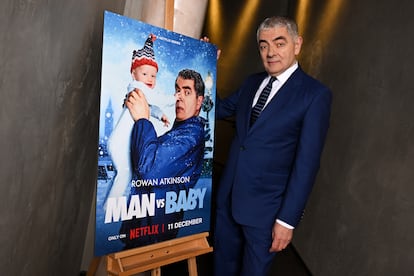

If in Life of Brian (1979) Monty Python imagined the existence of a neighbor in Jesus’ Nativity scene who was born on the same day, a new British comedy, the series Man vs. Baby, asks another weighty question: what fate would have befallen the Son of God if, instead of choosing the Virgin Mary as his mother, he had entrusted the sacred task to Mr. Bean. More or less.
In the four-episode Netflix comedy, a newborn magically appears in a school’s live Nativity scene to represent baby Jesus. When everyone else leaves for the holidays, the janitor, played by Rowan Atkinson, 70, realizes the baby is still there: no one claims him, and no one knows where he came from. The lonely protagonist has no choice but to spend Christmas with the baby, whom he begins to call Jesus, setting the stage for the cascade of mishaps characteristic of the actor’s comedies.

A follow-up to Man vs. Bee (2022), where the protagonist wreaks havoc trying to kill a bee that had snuck into a mansion under his watch, Man vs. Baby became the most-watched show on Netflix worldwide during its premiere week, despite coinciding with the release of a new batch of Stranger Things episodes, the platform’s flagship series.
It’s a triumph for Atkinson, who in his later years continues to rack up successes in his long career and demonstrates that, no matter how much time passes, the humor of slips, falls, and pratfalls never stops being funny. The miniseries also includes nods to his most famous role: Mr. Bean. The bedroom of Trevor Bingley, the main character, is very similar to the one in the movie Mr. Bean (1990), and a police officer, due to phone interference, mishears his surname and calls him “Mr. Bin.”
The actor has long hinted at retiring from these kinds of productions, believing that past a certain point his physical abilities had “started to decline.” But neither has he followed through on these plans, nor has the public made it easy for him to retire. In Man vs. Baby, the septuagenarian comic delivers a more restrained performance in terms of pratfalls or spasmodic movements, though his unmistakable miming and expressions of horror at disaster — the very traits that made him a star — remain intact.
“It’s a type of humor that doesn’t need translation, visual comedy that doesn’t require words. It’s understood everywhere,” says writer Jorge San Román to EL PAÍS. He has just published Con permiso de la reina. El humor inglés de los bufones a la sitcom (With the Queen’s Permission: English Humor from Court Jesters to Sitcoms), a look at the history of British comedy that, fittingly, features Mr. Bean on its cover. “British sitcoms were known for their sharp dialogue and witty comebacks, but Mr. Bean was a smash hit for the opposite reason. He didn’t speak; all he did was make guttural grunts and be the meanest guy in the world.”
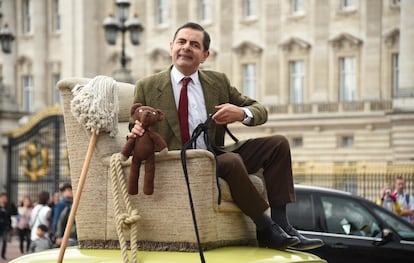
An electrical engineer by training, Rowan Atkinson ended up in comedy, encouraged by his experiences with the university theater group and the rise of Monty Python. During this period, he formed a close friendship with another key figure in contemporary British cinema, screenwriter Richard Curtis, with whom, before Mr. Bean, he would create another landmark of television humor: the sensational Blackadder (1983), set in different periods of British history, with Atkinson playing an unlucky duke and his descendants in subsequent seasons.
A perfectionist, the actor confessed that it took him decades to watch a single episode for enjoyment. Another national treasure, screenwriter Ben Elton, wrote in his memoirs that the series forced him to neglect almost everything in his life due to the “tortured micro-tinkering” the lead constantly demanded. In a recent interview with The Times, Atkinson made it clear he hasn’t changed: “I could write a list as long as your arm of all the things I don’t like about [about Man vs. Baby]. Oh that seems too long. Why is that line still there? […] I’m perennially dissatisfied.”
With Mr. Bean, he took a silent turn, drawing on silent film comedies and European influences such as Jacques Tati — whose Mr. Hulot’s Holiday (1953) he would pay homage to in the character’s second feature film, Mr. Bean’s Holiday (2007).
“Atkinson has European influences, but also a distinctly English character,” explains critic Bruce Dessau to EL PAÍS. Dessau published an unauthorized biography of the actor in 1998. “He follows in the tradition of Monty Python and The Goodies, being both physical and funny, but also very clever. His satirical work at the BBC with the team behind Not the Nine O’Clock News [1979, a sketch show structured as a news program] was, to a large extent, a bridge between the Python era and the irreverent, punk-influenced alternative comedy of the late 1970s and early 1980s.”
No filters
Jorge San Román identifies Rik Mayall as the third pillar of British humor at the time, alongside Atkinson and Elton, representing “that wilder, more anarchic comedy” of the emerging new wave. Mayall starred in and created the cult series The Young Ones with Atkinson, and also appeared in Blackadder. While Mayall would become, for many, the television equivalent of what Johnny Rotten meant for music, Rowan Atkinson focused his efforts on refining another archetype.
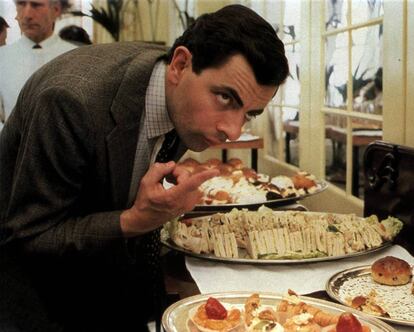
In contrast to the aggressiveness and destructive impulses of the powerless, Mr. Bean was a simple-minded character, yet, in his own way, successful. He was a character for whom the simplest actions became as challenging as climbing Everest, yet he faced adversity head-on, with extreme, childlike ingenuity, indifferent to collateral damage. Long before the phenomenon of impostor syndrome became widespread, Mr. Bean was its opposite — an inspiring example of moving forward and making your way without the slightest idea of what you’re doing, no filters, no language.
“Mr. Bean is a very English guy, with an English face, and he drives a Mini. What’s wrong with him? Absolutely everything. His attitude, his gestures, even his jacket are shabby,” explains Román, who believes that English humor is characterized more by “dryness and ruthlessness” than sentimentality.
According to the author, this is what makes Atkinson different from Richard Curtis, who would later achieve worldwide fame with romantic films like Four Weddings and a Funeral (1994) and Love Actually (2003). Atkinson appeared in both, albeit in supporting roles. “Those kinds of comedies give me the same strange feeling you get when you meet someone and shake their limp hand — you might find them charming, but you can feel there’s something limp about it.”
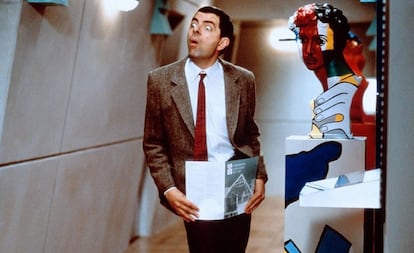
Meanwhile, Rowan Atkinson’s film career became an extension of his television journey. In Bean, the ultimate disaster comedy (1997), the character is sent to the United States as a supposed art expert. His iconic botched restoration of Whistler’s Mother (1871) became one of the most famous gags of the genre in the 1990s.
With the Johnny English trilogy (2003–2018), he brought the bumbling antihero archetype into the world of spy films, while in Keeping Mum (2005), a dark reinterpretation of Mary Poppins (1964) with murders, he revisited the insecure vicar role he had played in Four Weddings and a Funeral. He also made a few, but memorable, forays into U.S. cinema: besides a brief cameo in Hot Shots! Part Deux (1993), he voiced the bird Zazu in The Lion King (1994), played a deranged Italian narcoleptic in Rat Race (2001), and portrayed the villain in the live-action adaptation of Scooby-Doo (2002).
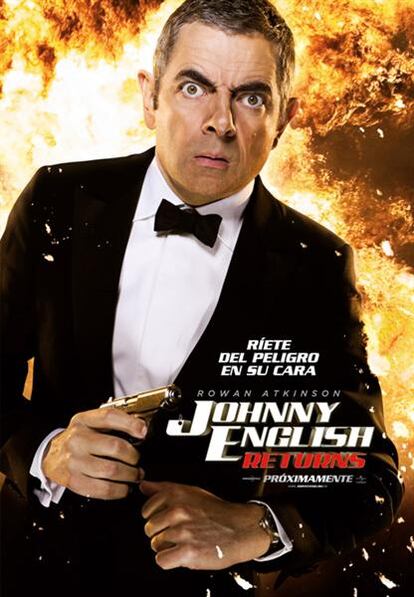
However, he has a smaller following across the Atlantic. His films as a leading actor have been more widely seen in Europe than in the U.S., sometimes earning only a tiny fraction of their box office revenue there. Regarding Johnny English Strikes Again (2018), a Variety critic suggested that Atkinson’s humor had become outdated, noting that it seemed more suited to a museum than a movie theater.
“Perhaps that American critic missed the joke!” says biographer Bruce Dessau. “His strength is that he hasn’t changed much since the success of Mr. Bean. Although he said that physical comedy wouldn’t be easy as he got older, he continues to do it and is as funny as ever.”
Jorge San Román agrees: “His films may have the problem of seeming like a succession of strung-together jokes, but they are not anachronistic. I still enjoy Laurel and Hardy’s comedies a lot, just as Atkinson’s will surely be enjoyed in the future.”
A British institution, Atkinson has also, somewhat unwillingly, frequently made headlines in the gossip press. In 2015, he divorced his wife of a quarter century, makeup artist Sunetra Sastry, after it became known he was in a relationship with comedian Louise Ford, a theater colleague 26 years his junior. Comedian James Acaster, Ford’s former partner, joked in his stand-up that Atkinson was “the only man in the world who’s been dumped for Mr. Bean.” Atkinson has a daughter with Ford, born in 2017, and two children from his first marriage, one of whom adopted his mother’s surname after the split. A car enthusiast, he also crashed his McLaren F1 twice — without serious injury — and opted to repair and sell it after the second accident.

The actor avoids commenting on his personal life in interviews and has rarely made political statements. In 2018, he defended Boris Johnson in a controversial letter, responding to criticism the then-prime minister received for comparing women in burkas to “letter boxes.” “As a lifelong beneficiary of the freedom to make jokes about religion, I do think that Boris Johnson’s joke about wearers of the burqa resembling letter boxes is a pretty good one,” he wrote.
This does not mean his sensibilities are necessarily conservative; in fact, both Man vs. Bee and Man vs. Baby include explicit critiques of the abuses of the rich. Years earlier, Atkinson appeared in the House of Lords to argue against a law that would have penalized “inciting religious hatred,” as he argued it was a form of censorship.
In 2013, the BBC received over 3,000 complaints after he dressed as the Archbishop of Canterbury to mock his homophobia — a stunt that also angered Atkinson’s own brother, a member of the far-right party UKIP. In the finale of the first Johnny English, he similarly roughed up the Archbishop by mistake, thinking him a fraud; in the sequel, Johnny English Returns (2011), this gag went further, with him accidentally beating up the Queen of England herself. If you’re concerned about baby Jesus in the new Netflix series, fear not: the baby is, for the most part, digital.
Sign up for our weekly newsletter to get more English-language news coverage from EL PAÍS USA Edition









































