
‘How does it feel to be a failure?’: Elizabeth Berkley’s journey from ‘Showgirls’ ridicule to vindication
Thirty years after the release of one of Hollywood’s most notorious flops, the actress has overcome the savage criticism she faced and is now seeing the film appreciated anew by critics and audiences alike
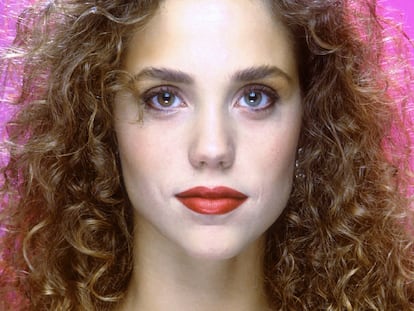

There’s no need to talk about Showgirls again. Almost everyone knows its story: it went from being a massive commercial and critical flop in 1995, to being beloved by viewers with an ironic sense of humor and dominating the video rental market. Today it is a cult classic — enjoyed by many as satire and admired by others without irony, as a film unlike any other that accurately reflects the time and place in which it was made.
There’s no need to retell that story, but the story of its star, Elizabeth Berkley, is worth recounting. She was the one who fared the worst after the movie bombed at the box office, and it took years for her career to bounce back.
Nomi/Elizabeth
Berkley, born into a conservative, middle-class family in Michigan, had always wanted to be part of show business. She studied acting and dance and, as a child, became a young ballet dancer, performing for five years in Detroit’s Christmas productions of The Nutcracker. As a teenager, she wrote letters to various producers in Los Angeles and traveled back and forth from her home in Michigan in search of roles and opportunities. One of them paid off: the role of Jesse Spano on Saved by the Bell (1989-1993) made her a teen idol.
When she learned in 1993 that a film called Showgirls was in the works, with the director-screenwriter duo (Paul Verhoeven and Joe Eszterhas) who had triumphed with Basic Instinct two years earlier, the determination of its protagonist (Nomi) to succeed in Las Vegas reminded her of her own. When she arrived for the audition, she told the producers and Verhoeven: “You don’t have to look any further. I’m Nomi.”
According to Verhoeven, who spoke to several media outlets at the time, he had Drew Barrymore in mind for the role, but the actress had no dance experience, which made it impossible. It’s interesting to think of an actress so opposite to Berkley’s physical exuberance and aesthetic, but in the end, Berkley got the part. With Barrymore, Showgirls would have been a completely different movie.
Screenwriter Joe Eszterhas never felt much fondness for Elizabeth Berkley. He took writing the script very seriously, visiting hundreds of Las Vegas strippers for field research, and in a full-page ad he paid for himself in the trade magazine Variety, he described the film as a “spiritual regeneration” for its star. The character, incidentally, was named Nomi as a nod to the childhood nickname of the love of his life, his wife Naomi. In his memoir Hollywood Animal, he recounts that after visiting the set for the first time and seeing Berkley in a thong while filming one of the strip club sequences, he told his wife, almost apologetically: “He cast a blow-up fuck doll as Nomi.”
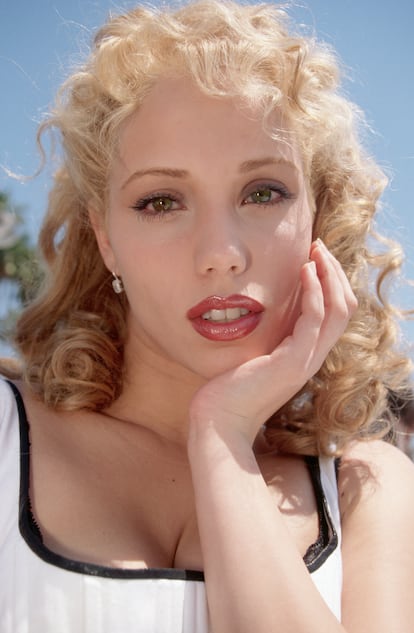
Paradoxically, Berkley only had fond memories of the shoot. She told Howard Stern: “The actual process of making the film was amazing.”
But Showgirls flopped at the box office and received scathing reviews, some of them particularly vicious. Verhoeven and Eszterhas took much of the criticism, but the harshest attacks were aimed at its star, Elizabeth Berkley. She was described as having “the open-mouth, vacant -eyed look of an inflatable party doll” (in The New York Times) and compared to “a meat puppet on a stick.”
To make matters worse, Eszterhas claimed in two different books that Berkley and Verhoeven had a secret romance during filming. In his book The Devil’s Guide to Hollywood, he writes: “After the film bombed, I said to Paul: ‘When a man gets a hard-on, his brains slide into his ass.’”

Berkley, who was only 21 at the time, was accused of giving a hysterical, over-the-top, and contrived performance. The criticism wasn’t entirely wrong, but that excess is an integral part of the film — it fits her character and has helped it endure. Some scenes have become pure memes: Nomi smashing a ketchup bottle over fries, Nomi brandishing a knife at a driver, Nomi dancing wildly in a nightclub, Nomi showing off her nails to anyone, Nomi having an orgasm in a pool while convulsing as if in ecstasy.
Her performance, despite everything, has been defended by directors like Quentin Tarantino. Some critics understood it at the time: the legendary Roger Ebert wrote in the Chicago Sun-Times that “the lead performance by newcomer Elizabeth Berkley has a fierce energy that’s always interesting,” while Entertainment Weekly said her “party-doll blowsiness works for the picture.”
They were her only defenders. Berkley had officially become a joke, and her career was over just as it was beginning. She won two Razzies — the opposite of the Oscars — in 1996. She was dropped by her agency, CAA, and in her book Ask Elizabeth, she revealed that one interviewer began by asking her: “How does it feel to be a failure?”
“A lot of things went on that wouldn’t be allowed now — someone could not be pummeled to that degree,” the actress said in a recent interview with The Hollywood Reporter. “I couldn’t understand how people could be so cruel, but I’m tough. I had to separate out what they said from what I believed to be true.”
She went from being a rising star, traveling the world, and posing at the Cannes Film Festival as a promising newcomer to being rejected by directors, talent scouts, and agencies. It didn’t matter how much she tried to distance herself from her role in Showgirls (the fact that she dyed her blonde hair black right during the debacle cannot be a coincidence).
Her next role after the flop was small, in the comedy The First Wives Club (1997), which she got by sending a video to the film’s production company, since she says she was not even allowed to attend the audition. The actress later told Chelsea Handler that Goldie Hawn, one of the film’s three leads, distressed by the treatment Berkley was receiving, stepped in to give her a hand.
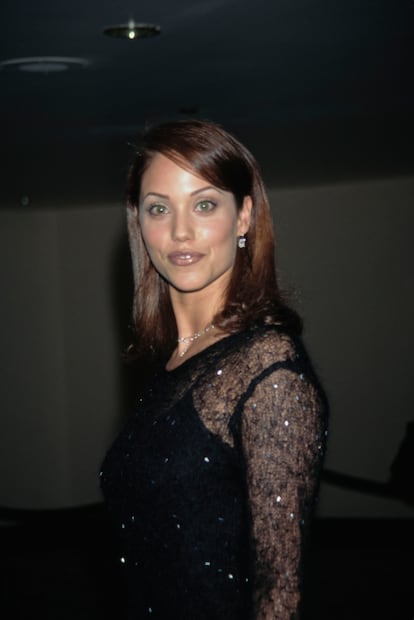
The same actress who seemed destined to be the next Sharon Stone was only landing small roles in film and television, and her career had been reduced to a cruel joke. One of the harshest aspects of this story is that no one on the crew — and certainly not Verhoeven or Eszterhas, the two men in charge of Showgirls — stood up for her. “I believed in my work and in myself deeply. I’d hoped someone would stand up for me.” It didn’t happen.
In 1996, a year after the film’s release, the actress appeared on The Howard Stern Show, where Stern took her side. “I find it remarkable that he [Verhoeven] didn’t get blamed for the movie, you did,” he said. “Considering that I didn’t direct it or write it or produce it…” she replied. She added, “Unfortunately, it’s not like I have 10 other movies that you can compare and say ‘she’s that and that and that.’ So suddenly people thought, ‘oh she’s that character.’”
Verhoeven took too long to defend her, although even during the promotion he had dropped subtle hints that Berkley was, perhaps, simply following his directions. At a press conference in 1995, he said that the character of Nomi was modeled after his mother, who would suddenly explode and create a scene for no reason at all.
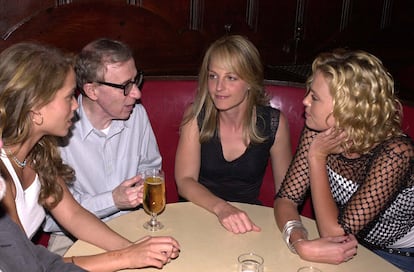
Berkley spent several years trying to distance herself from the film. She balanced work in television with small roles in movies. In Any Given Sunday (1999), directed by Oliver Stone, she played a sex worker. In 2001, Woody Allen gave her a better opportunity: a supporting role as his secretary in The Curse of the Jade Scorpion, which allowed her to show her comic talent.
While promoting the film, she began to talk about Showgirls again, albeit tentatively. On comedian Craig Kilborn’s late-night show, when he showed a video of her as a child dancing in a school performance, she quipped: “How did you get my audition tape for Showgirls?” However, when she returned to the same show the following year to announce that she had landed a role in a stage production of the musical Chicago (which was ultimately canceled), it was Kilborn who dared to ask more in-depth questions about Showgirls. “Let’s make a deal,” she replied. “When I am nominated for a Golden Globe or an Academy Award, you can ask me anything you want about Showgirls.”
No nomination was necessary. The 21st century began to bring a kinder perspective on the film. In 2003, Entertainment Weekly included it in its list of the 50 best cult movies, and in 2004, Slant gave it a four-out-of-four-star review, calling it “undoubtedly the think-piece object d’art of its time.”
In 2015, Paul Verhoeven finally spoke up for her, 20 years late, in an interview with the New York Daily News. “Showgirls certainly ruined the career of Elizabeth Berkley in a major way,” he admitted. “It made my life more difficult, but not to the degree it did Elizabeth’s. Hollywood turned their backs on her. Elizabeth could only have recovered from the movie by being offered a very different role, but that just didn’t happen for her, otherwise she would have taken the job.”
He continued: “I asked Elizabeth to do all that — to be abrupt and to act in that way, but people have been attacking her about for that ever since. If somebody has to be blamed, it should be me, because I thought that it was interesting to portray somebody like that."
That same year, 2015, Berkley found the courage for the first time to return to the scene of the crime. At a screening of Showgirls at the (ironically named) Hollywood Forever Cemetery, the actress publicly reconciled with the character for the first time in a brief speech that, recorded by attendees, went mildly viral on social media and now has hundreds of thousands of views.
“When a dream is happening, it’s unlike anything you can ever imagine,” she said. “Which is why when the movie came out, it was more painful than anything you can imagine. I’m not going to spend a lot of time on that moment, because why do that? We don’t live in the past,” the actress continued. “Tonight I want to thank you guys for giving me this gift of truly getting a full-circle moment of experiencing the joy with you.”
For the 30th anniversary of the film, Berkley attended another screening of Showgirls, this time at the Academy Museum in Hollywood. Three decades later, Showgirls was finally receiving the legitimate recognition of the same industry that had first produced it and then laughed at it. Once again, her speech was heartfelt, focusing especially on the audience that had come to celebrate the film with her. “Who knew from there that while I put my head down and got back to work, back in acting class [...] and just tried to bang on doors to get in to audition again, you all were falling in love with this movie in your own way?”
At one point in her speech, Elizabeth Berkley broke down, and the entire auditorium rose to its feet to applaud and shouted: “We love you!” Surely there are performers who have an Oscar or more at home, but few — if any — have experienced a moment of such intensity and connection with an audience that truly loves them. This time, without irony.
Sign up for our weekly newsletter to get more English-language news coverage from EL PAÍS USA Edition









































